Elephant's Perch "Mountaineers Route" (5.9)
Friends: SteveLocation: Elephant's Perch
Elevation gain: 1000m = 1000m
Note: After publishing this, Steve checked his rope and noticed that it was considerably less than 60 meters! He'd forgotten that he'd chopped it down from a 70 to a 60 when he asked me to do that task. So I dutifully chopped off 10 meters. Therefore, the rope was more like 50 meters. As you read my comments about how there was always only barely enough rope for each pitch, keep that in mind! I think the rope was about 52 meters.
Steve and I got the second boat going down Redfish Lake on the morning of the 14th. We had a rope and rack to climb the "Mountaineer's Route" on Elephant's Perch, above the Saddleback Lakes in the Sawtooth Mountains. We were pretty excited about it. After two Sawtooth trips, we were learning the lay of the land. The climbing in the City of Rocks, especially at the "Crack House" (actually at Castle Rocks) had reawakened my skill at climbing on gear and cracks, after many years of climbing mostly on bolts in the Alps. Still, it felt like a large objective for us old duffers!
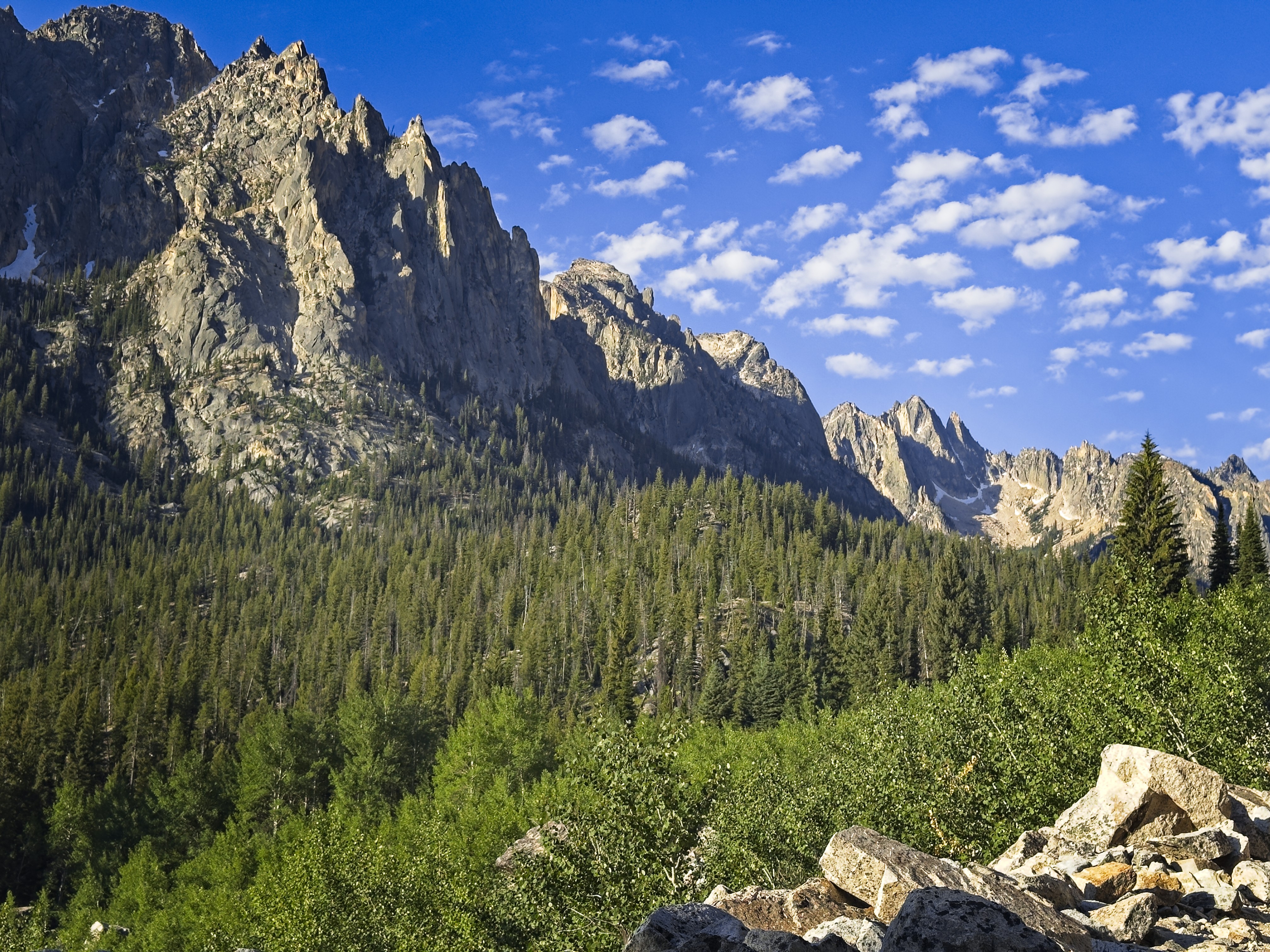
Looking up Redfish Creek, decorated by impressive spires
The route is only about 8 pitches, which doesn't seem that big a deal. However, most pitches take a full 60 meter rope. Combine that with gear belays and pretty sustained climbing in the 5.7 - 5.8 range, and cautious old folks like me are going to place a lot of gear! We were really aided by the MountainProject topo and especially Radek's page on Summitpost. Had I read it more carefully I would have saved myself a potentially dangerous error on the second pitch.
Also, the routefinding is not straightforward. At a distance, the route appears simple. But up close, you often have a few likely-looking choices among cracks beetling up and left, or maybe up and right, with a tempting low angle area of flakes to pinch and yard up on. But you need to choose the right one. For such a "bald, big" face, pitches have a way of going around corners at mid-height, which confuse route descriptions and limit the value of photos. In this internet age, it's possible to read a half-dozen reports of climbs and variations, both clarifying and muddying the mental picture.
We'd been waylaid by afternoon heat in the Sawtooths before, so we were happy to start early. The big granitic walls of Mount Heyburn on one side and the Grand Mogul on the other entertained us on the hike up. Fred Beckey was in here often, however, it doesn't seem like those mountains have yielded classic routes. There are a couple that deserve exploration though, and the mind can't help but imagine possibilities.
The approach was pleasant, despite the heavy packs. We set up camp on the east side of the outlet from the middle to the lower Saddleback Lakes, pleased to have a ring of trees for shade in the lazy afternoon. We dutifully made the approach hike to the base of the route though, discovering the exact start place, and noting the way through boulderfields below the peak. After that, it was reading, napping, and admiring the view while day hikers came and jumped in or fished in the central, largest lake. It rained a bit in the late afternoon, which was surprising. We chatted with two climbers with a bright orange tent. One of them had climbed the Matterhorn with his wife, and we exchanged impressions of that climb. Two other climbers were still on the wall, but came down after we ate dinner.
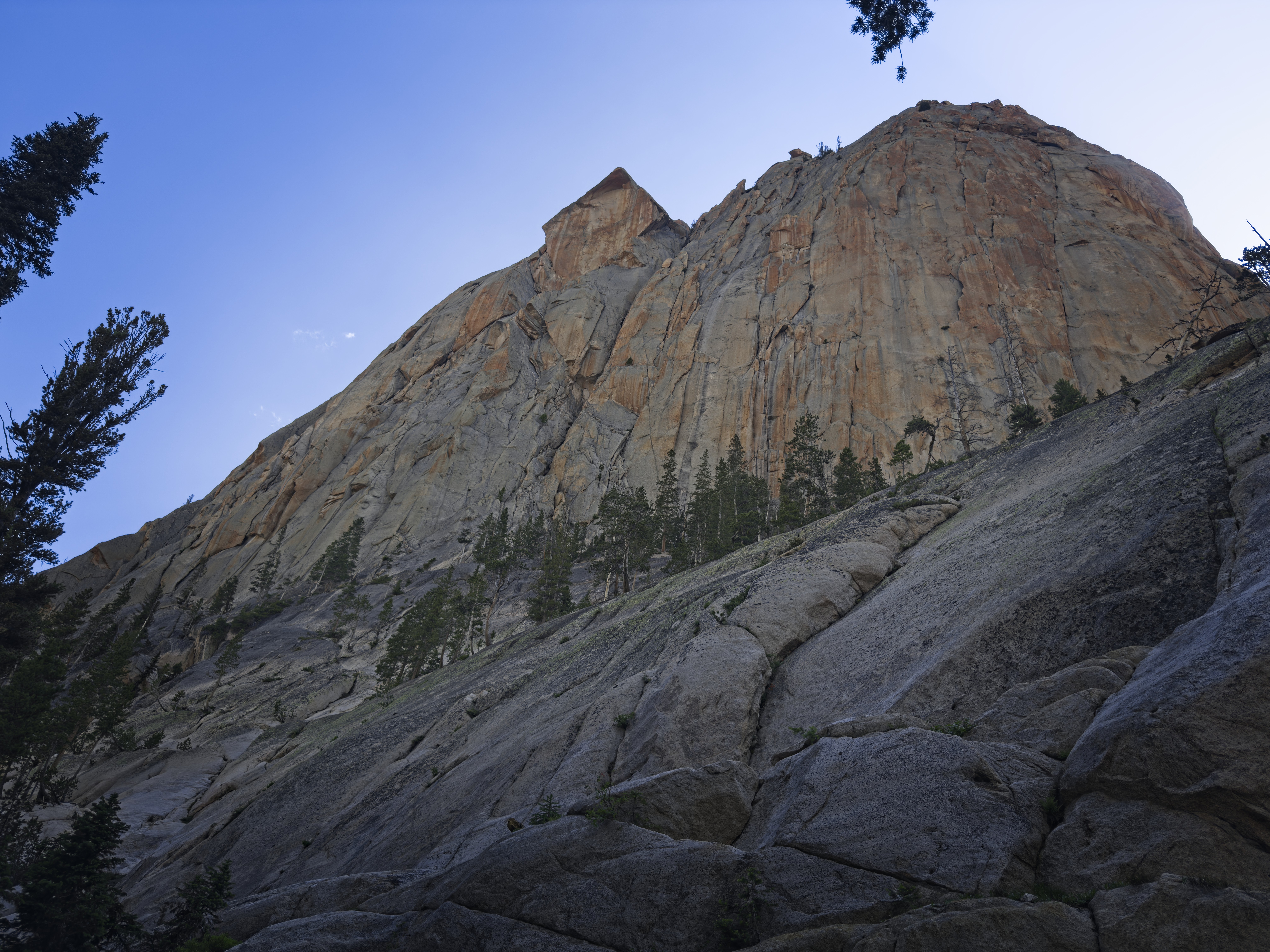
Our route from below, overseen by the "cobra" or "diamond" which rules
over it, on the left of the main wall
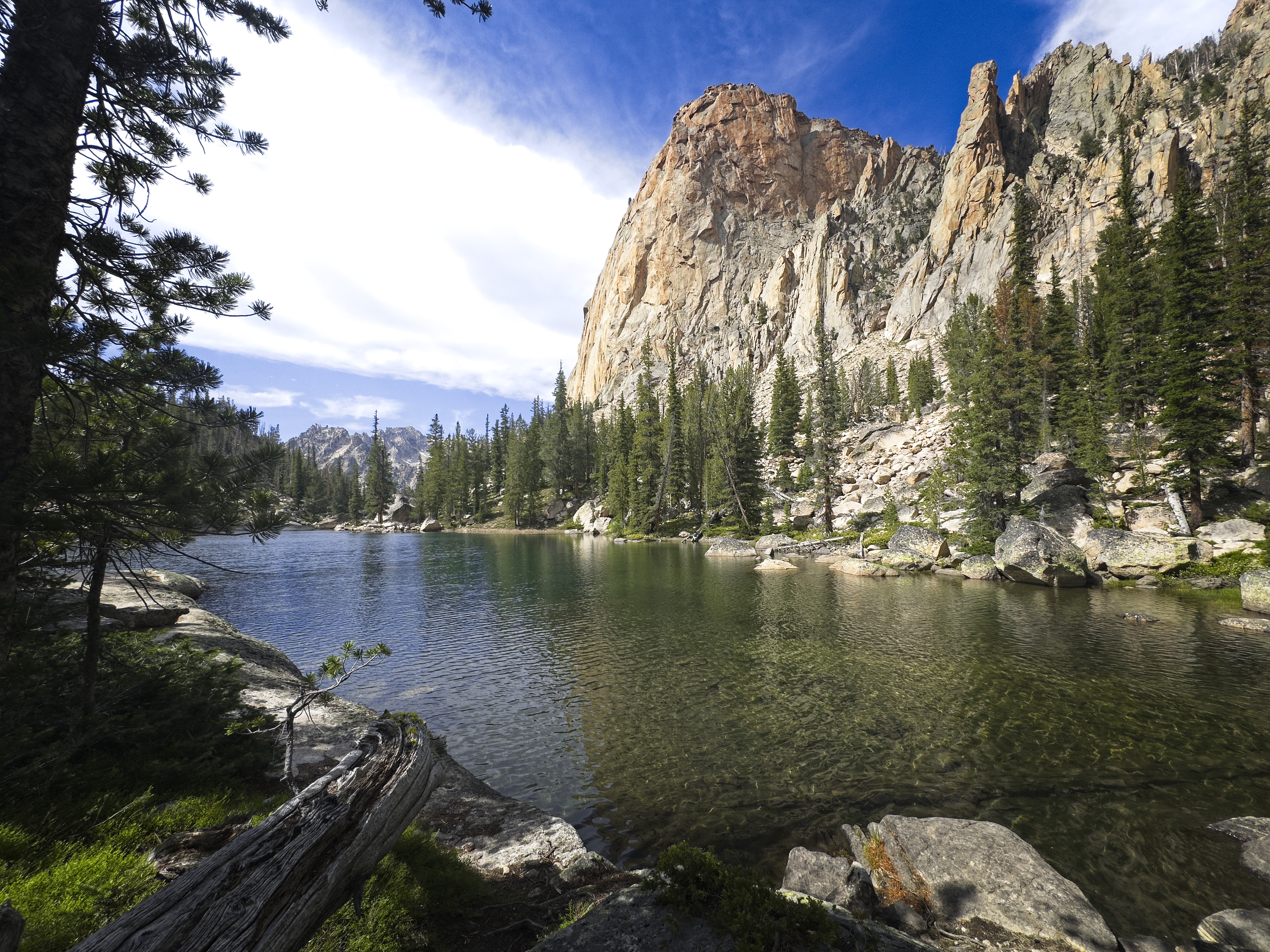
The red/orange cliffs of the Elephant's Perch above the lower
Saddleback Lake from our camp
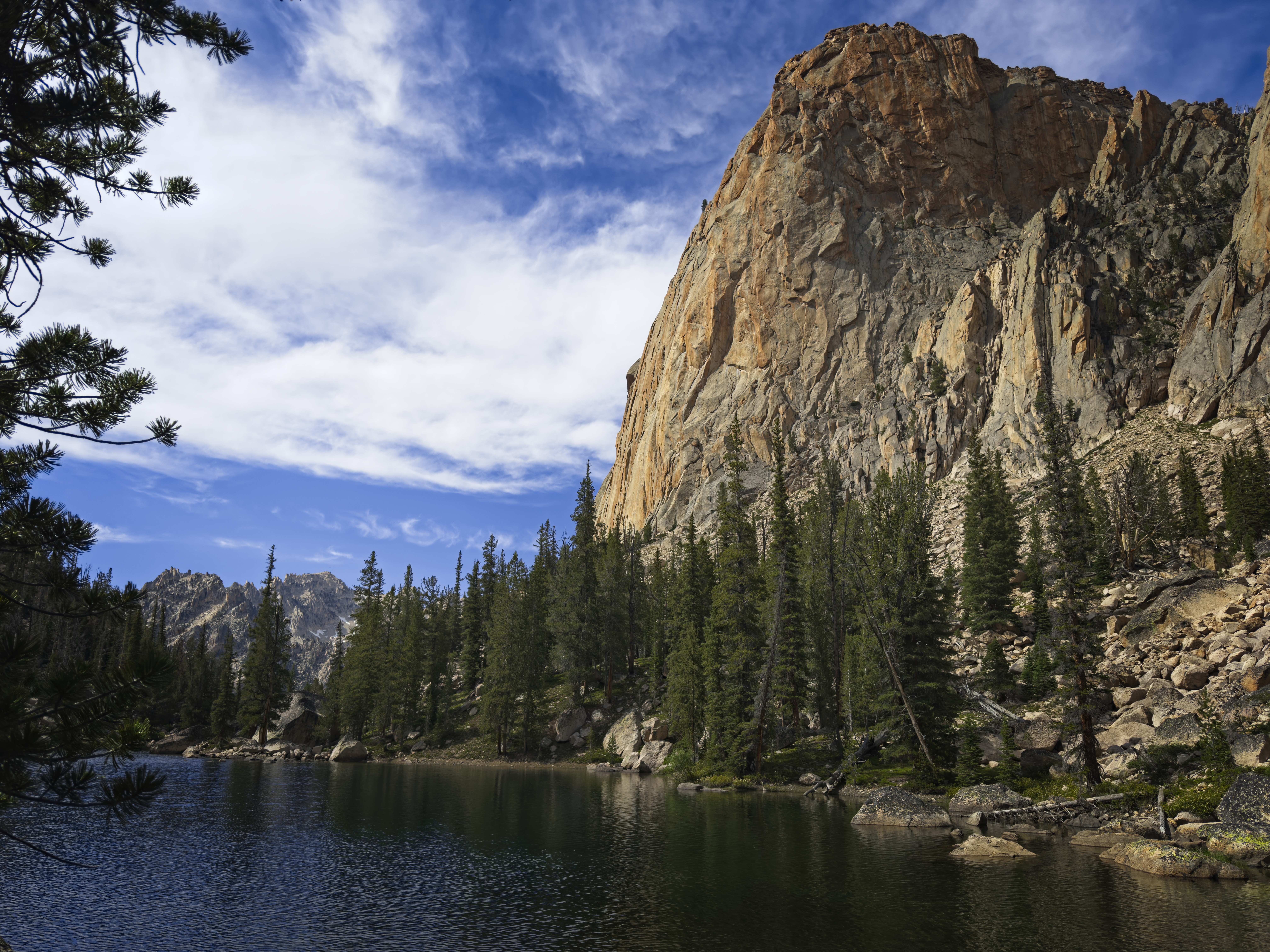
A similar shot, with the "cobra" making his presence known...
Climb day
We were walking up to the wall at 6:30, and Steve started up the first pitch a few minutes after 7:00. He was tempted left above the initial gully, but then reached the "mantle move" (5.8) below the tree that marks the end of the first pitch. I had to get right up to the base of the wall to give him enough rope to reach it. Following the pitch, I was impressed by the odd stemming and chimneying required below the mantle move, which felt reasonably difficult. There was a fixed cam in this section. Lots of stemming and smearing, with the occasional hand or foot jam.
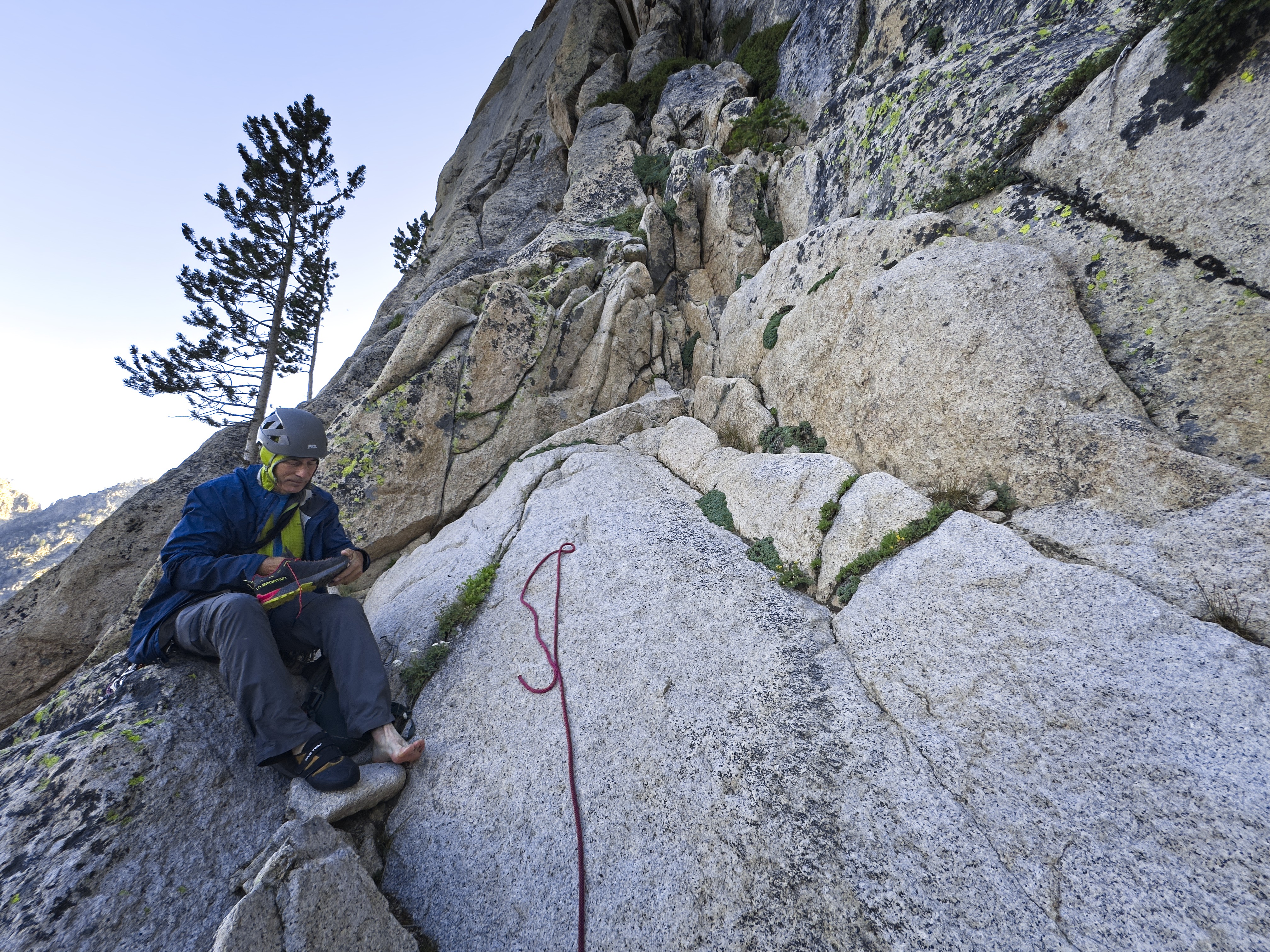
Steve changing into more appropriate shoes for a date with the Cobra
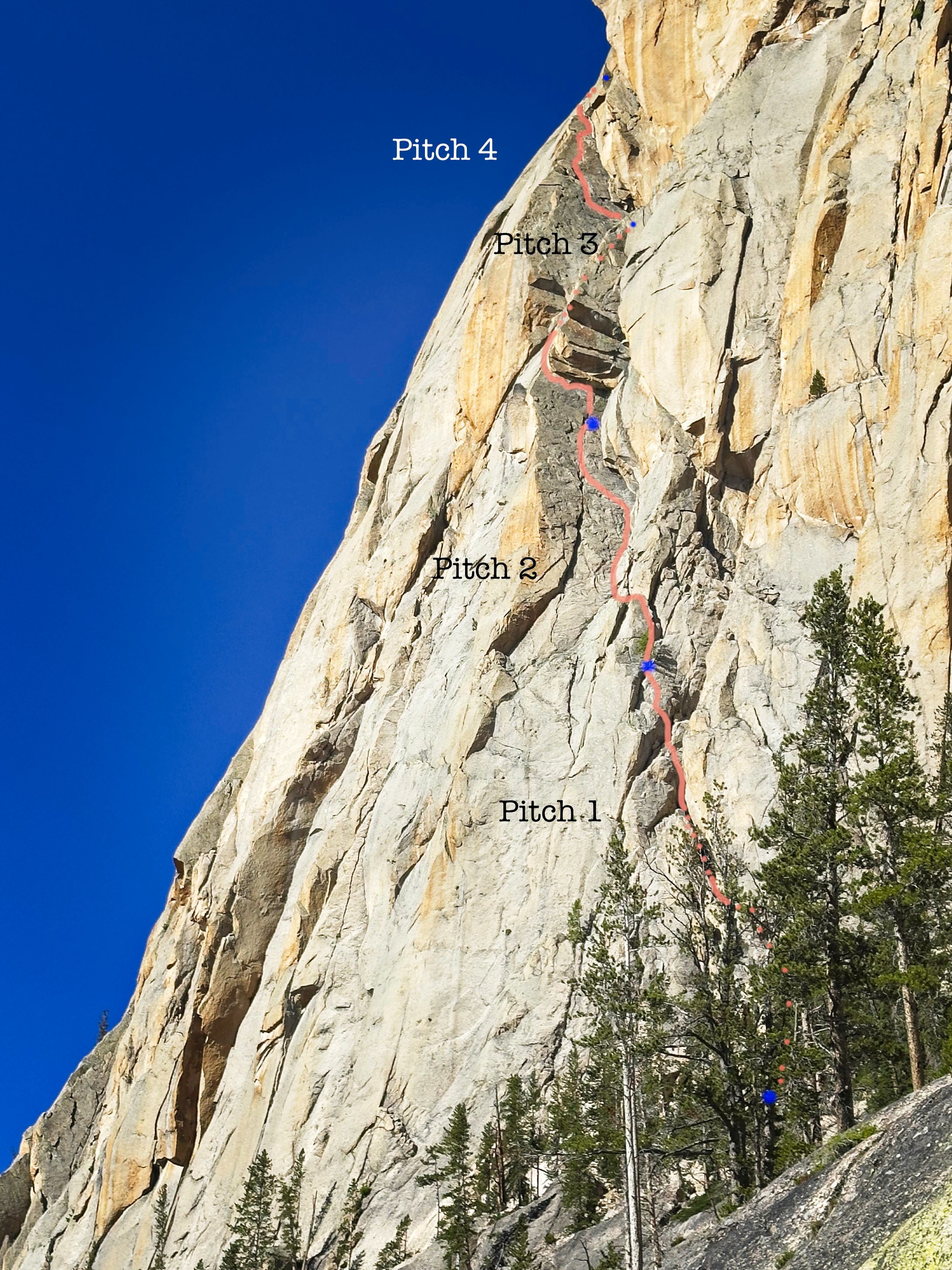
My little drawing of the first 4 pitches
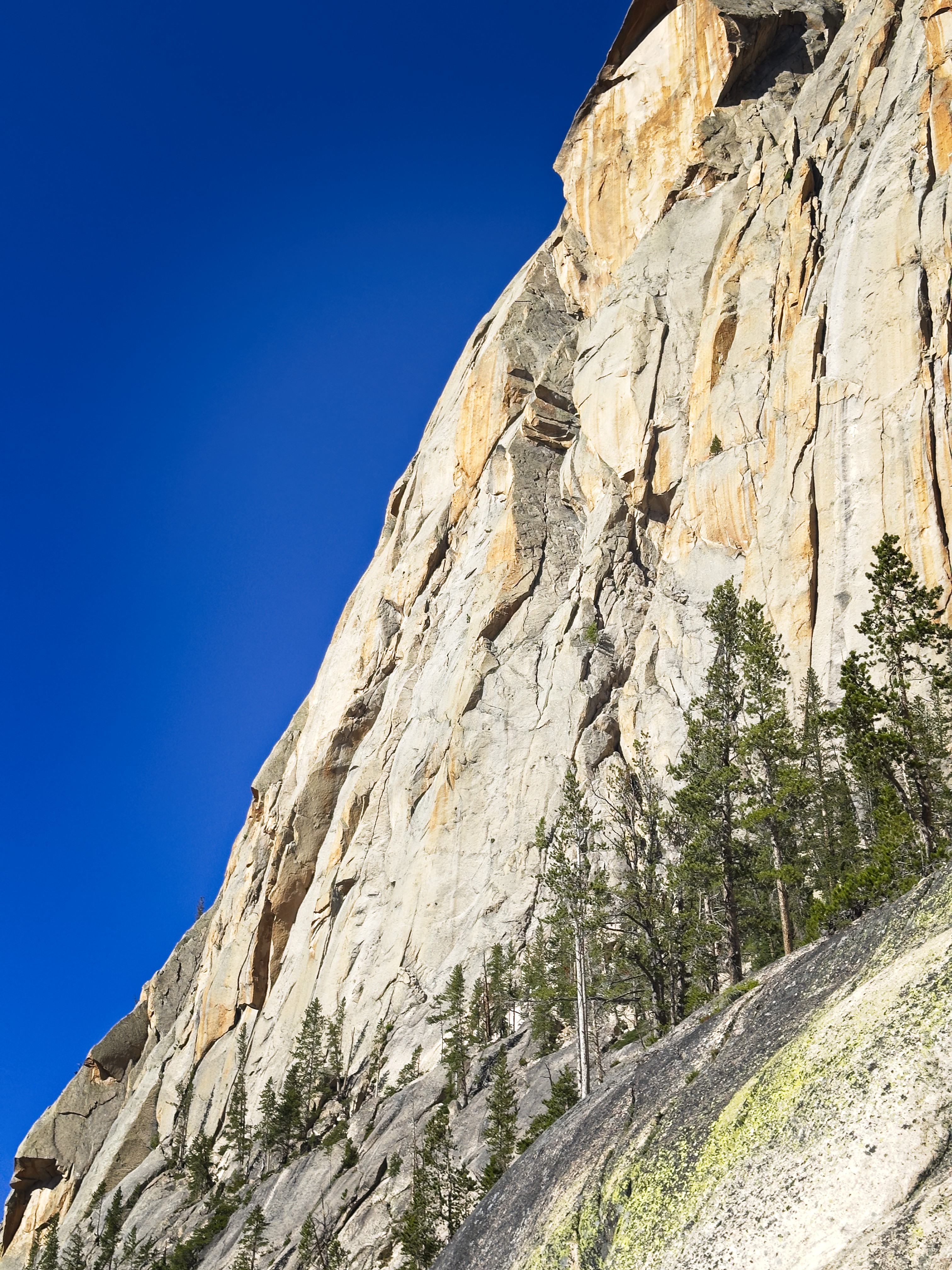
Again, without annotations
For pitch 2, I set off up a dihedral to a pillar, then looked for old bolts on a ledge just above, however they were gone. I climbed a dihredral above, then, mistakenly thinking I'd gone high enough, and should traverse out to the left, I did so, on small ledges and pockets for fingers. I reached a wide crack on the left, and got myself wedged in it, holding myself in with a hand jam and wedged shoulders. Belatedly, I recognized I was off-route, and would have to extract myself and return to the dihedral -- not a very pleasant thought! But I did so. This error came from an over-reading of the beta -- I knew I needed to gain a crack on the left. Just as Adam blamed Eve for the apple, I blame the chalked-up finger pockets that led me out there!
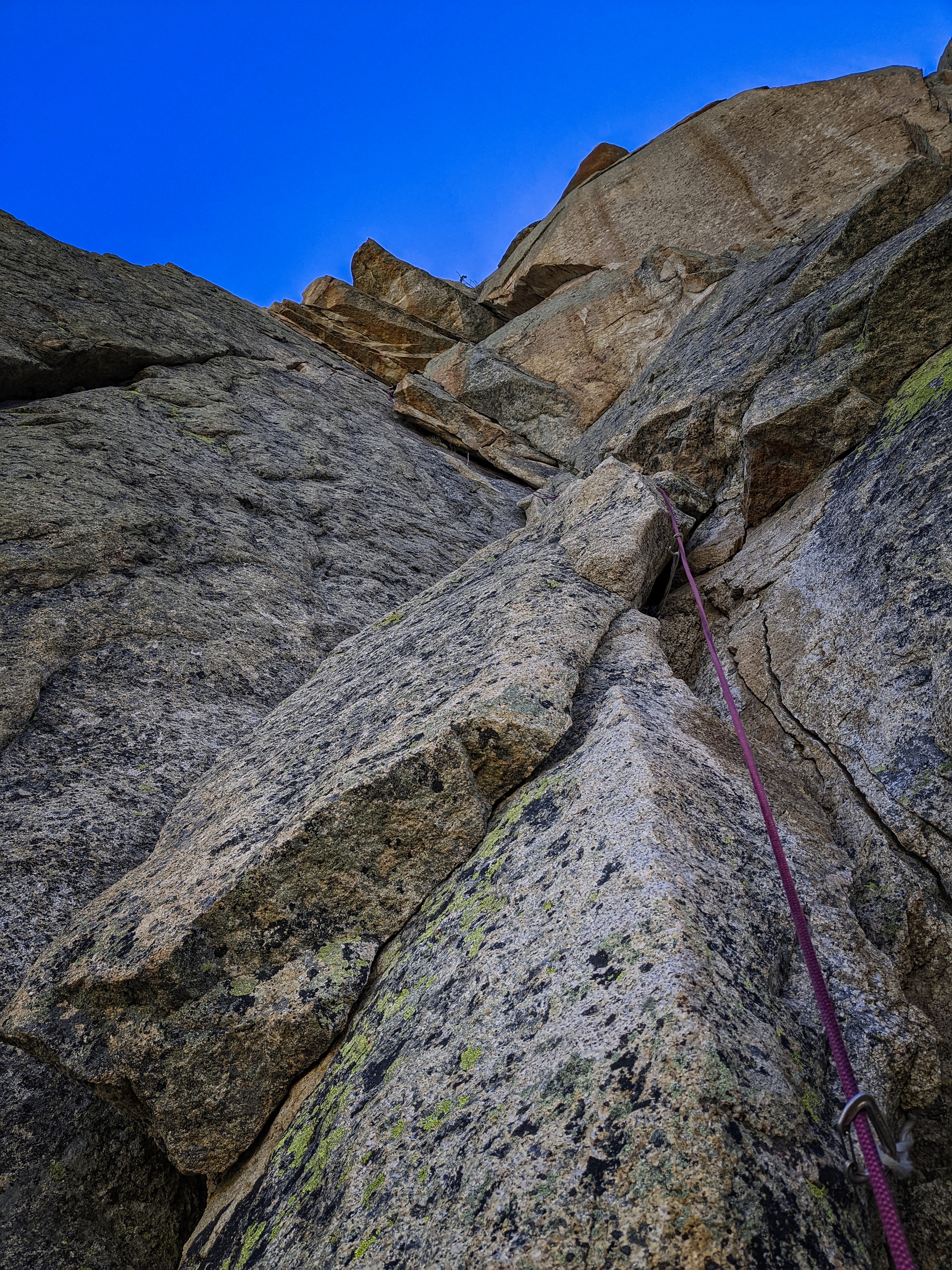
Looking up pitch 2 from the ledge 20 feet above the tree belay.
You can just barely see me at the belay.
Back on track, I climbed another 15 feet up the dihredral, then found the obvious, and very easy ledge leading to the crack at a more appropriate place. Glad not to have epiced, I placed a glorious offset nut at the base of the crack (actually two, clipped to the same 'biner: only because I couldn't remove the first one I placed, but wasn't happy with the exact placement -- Steve would solve that problem for me!). This crack was wonderful to climb. All the old skills returned! There is nothing like a hand jam, and they are everywhere here. Soon I reached the ledge with bolts, clipped them and placed a cam in the crack on the right as a backup. I was near the end of the rope, and right below the dramatic roofs.
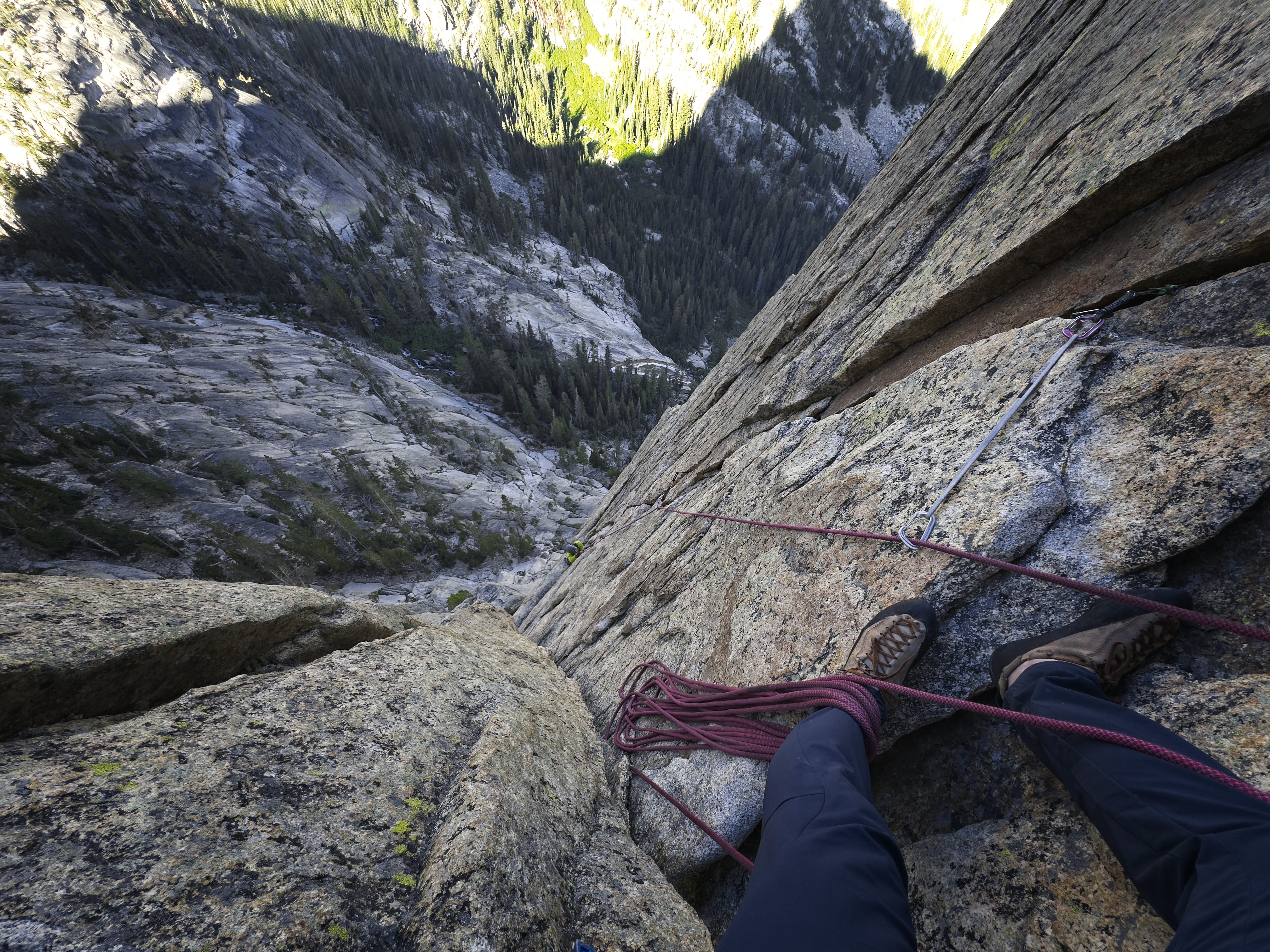
Looking down the 2nd pitch to Steve, climbing.
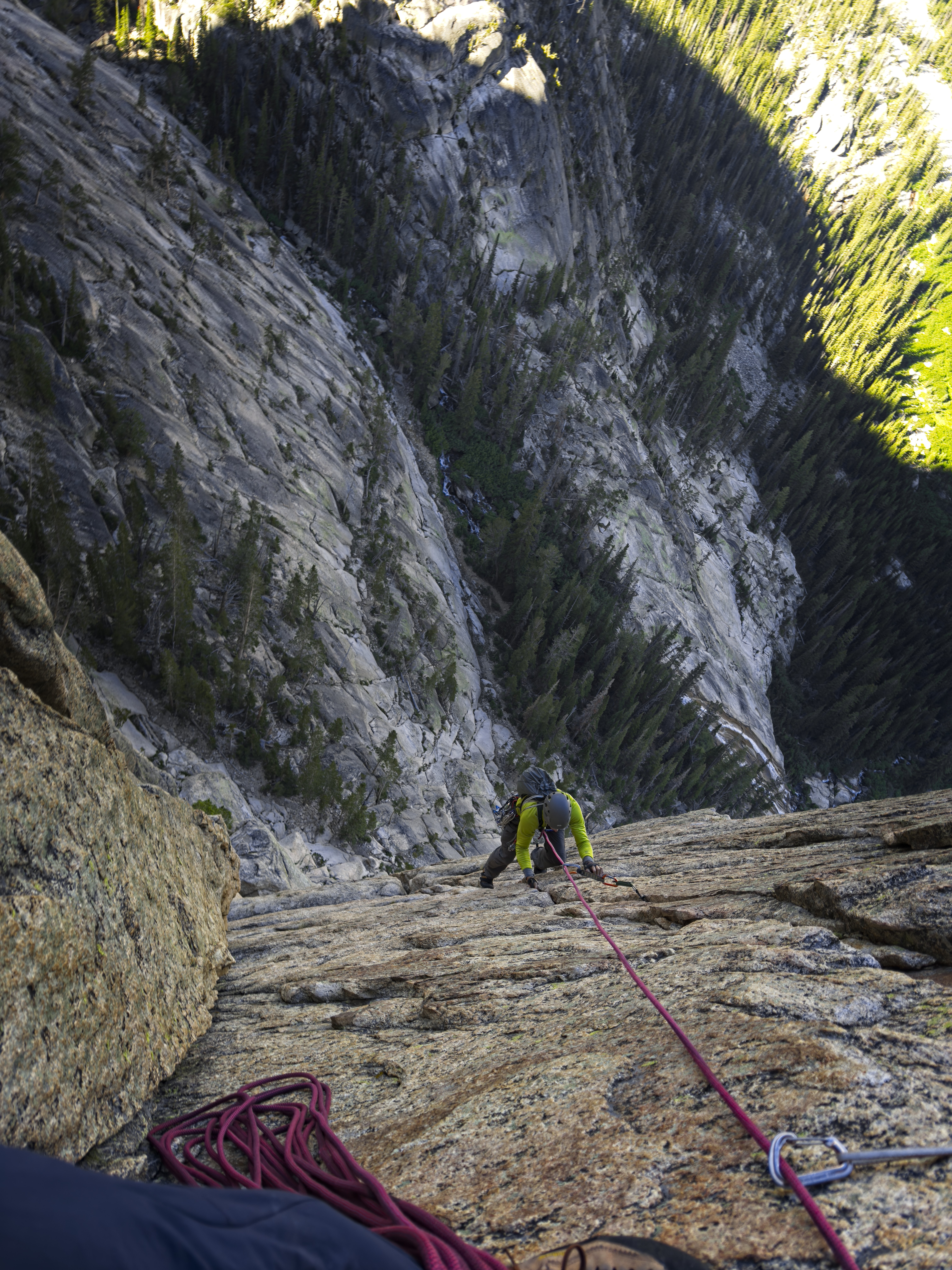
A similar shot
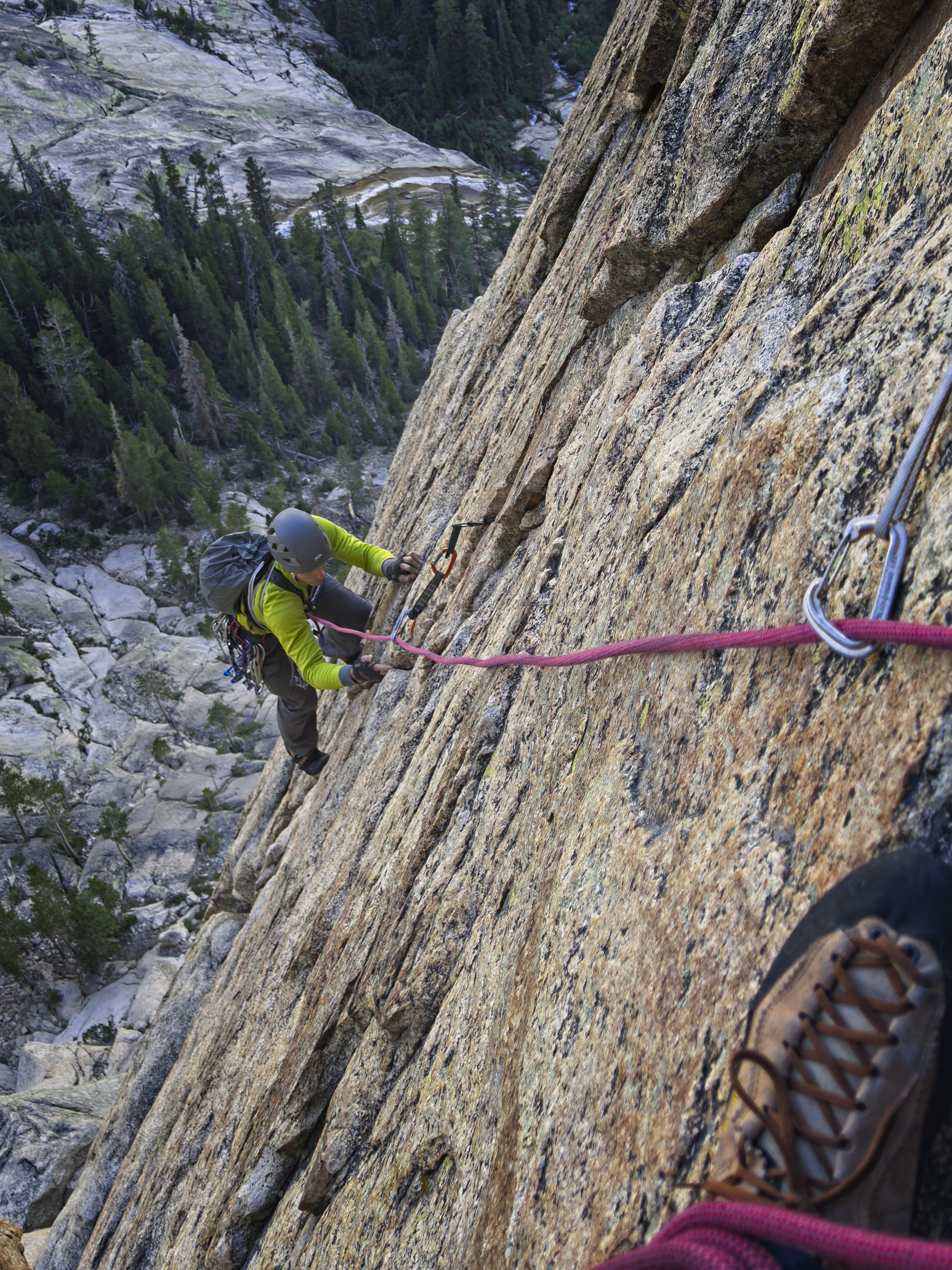
One more, close-up on Steve
Steve came up, and I sent him off for pitch 3, a justifiably famous traverse under the roof, back-cleaning gear as you go to avoid drag. He had a great time on this, snapping a picture of me at the belay just before disappearing around the corner for some nice climbing in cracks. These led to a v-slot gully that took him to the base of the diamond/cobra feature. It was fun to step around the corner for a new view on the route here.
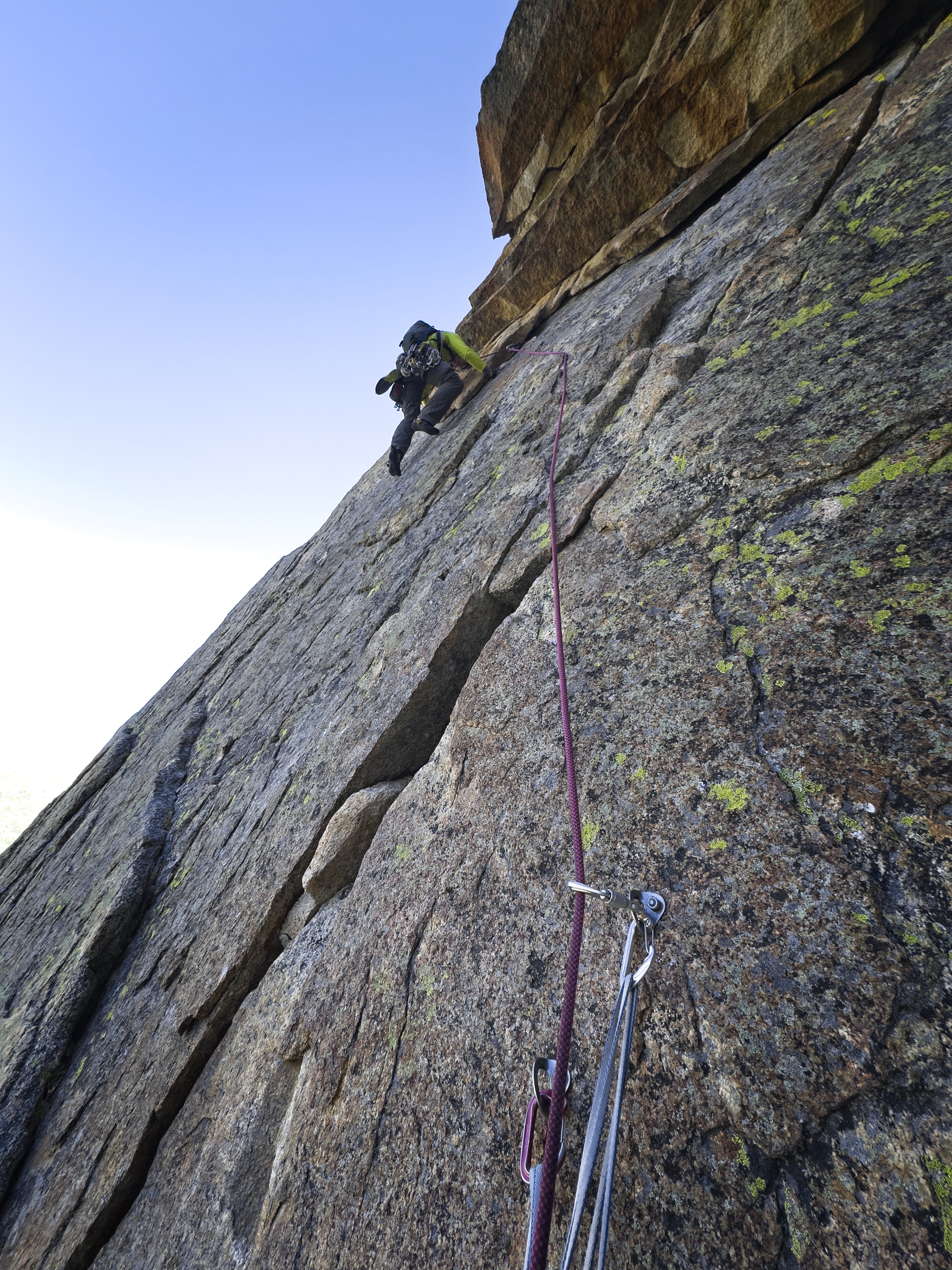
Steve, hero of the roofs!
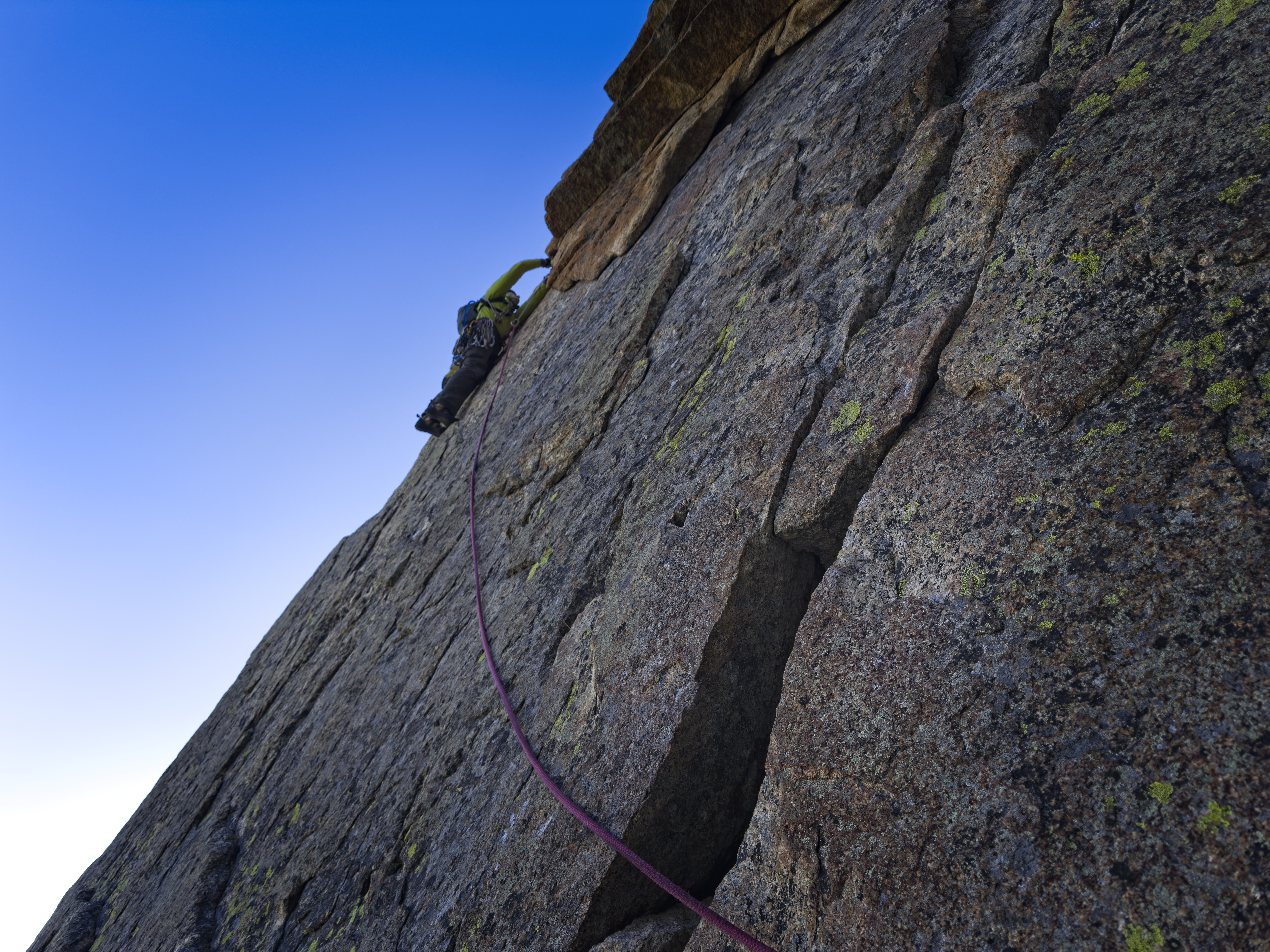
Escaping my peevish oversight, he rounds the corner for new delights.
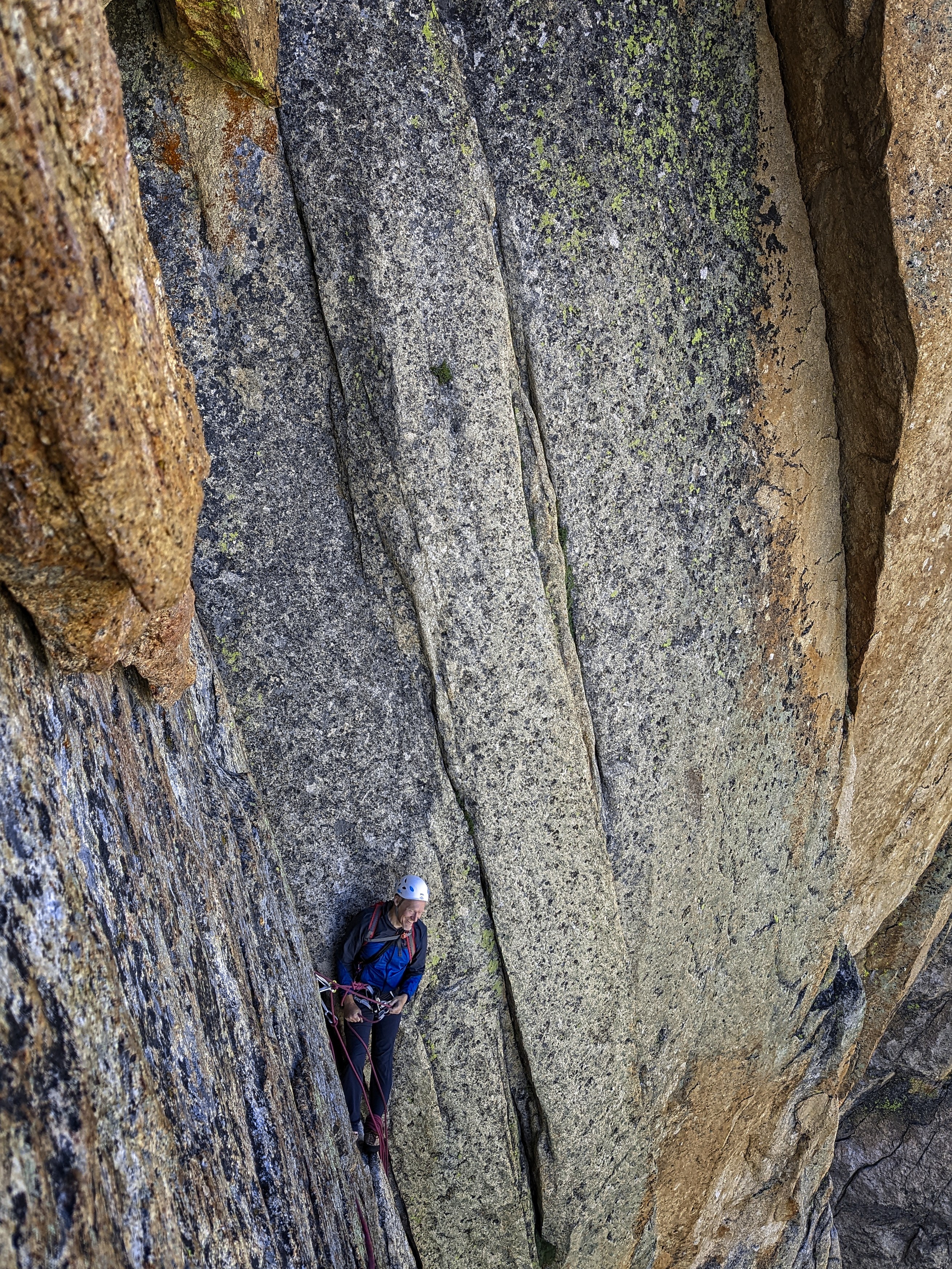
Michael enjoying himself at the belay for pitch 3.
After drinking some water and eating a snack at the comfortable little belay slot, Steve sent me off on pitch 4, which climbs the easy gray face up and left. There is no protection for a while, but the low angle and encouraging flakes to grab neutralize the danger. Halfway up the slab, I got a good cam in. From up here, the way is clear. I climbed a little higher to touch the rounded arete, then followed a ledge back right to a dihedral. Good climbing and protection in that. The slight overhang at the skyline on the dihedral worried me a bit, so I placed extra protection as I approached. However, the arete on the left helpfully culminates at this position too, so there is no need to cower and strain under the overhang to surmount it. I simply stood on the top of the arete which formed a ledge as I stepped easily around and out of Steve's sight. Here I was in a new world of dark buttresses riven by cracks and gullies. I continued up, passing an ominous-looking detached block. Ominous because I couldn't figure out how it was staying on the mountain, and kept imagining pulling it off on me. Just above this, the rope was coming tight, and happily I was in a little antechamber of the main gully. I built a gear belay from a fantastic nut and two small cams using Steve's wonderous "web-o-lette," a new piece of technology for me (I know, welcome to 2005 ;)). This was a great place to be. We were still in the shade, so it was nice and cool. My topo (from Mountain Project) had said there was some 5.9 on this pitch, which I expected at the slight overhang on the crest, but it was nowhere to be found. More like 5.7.
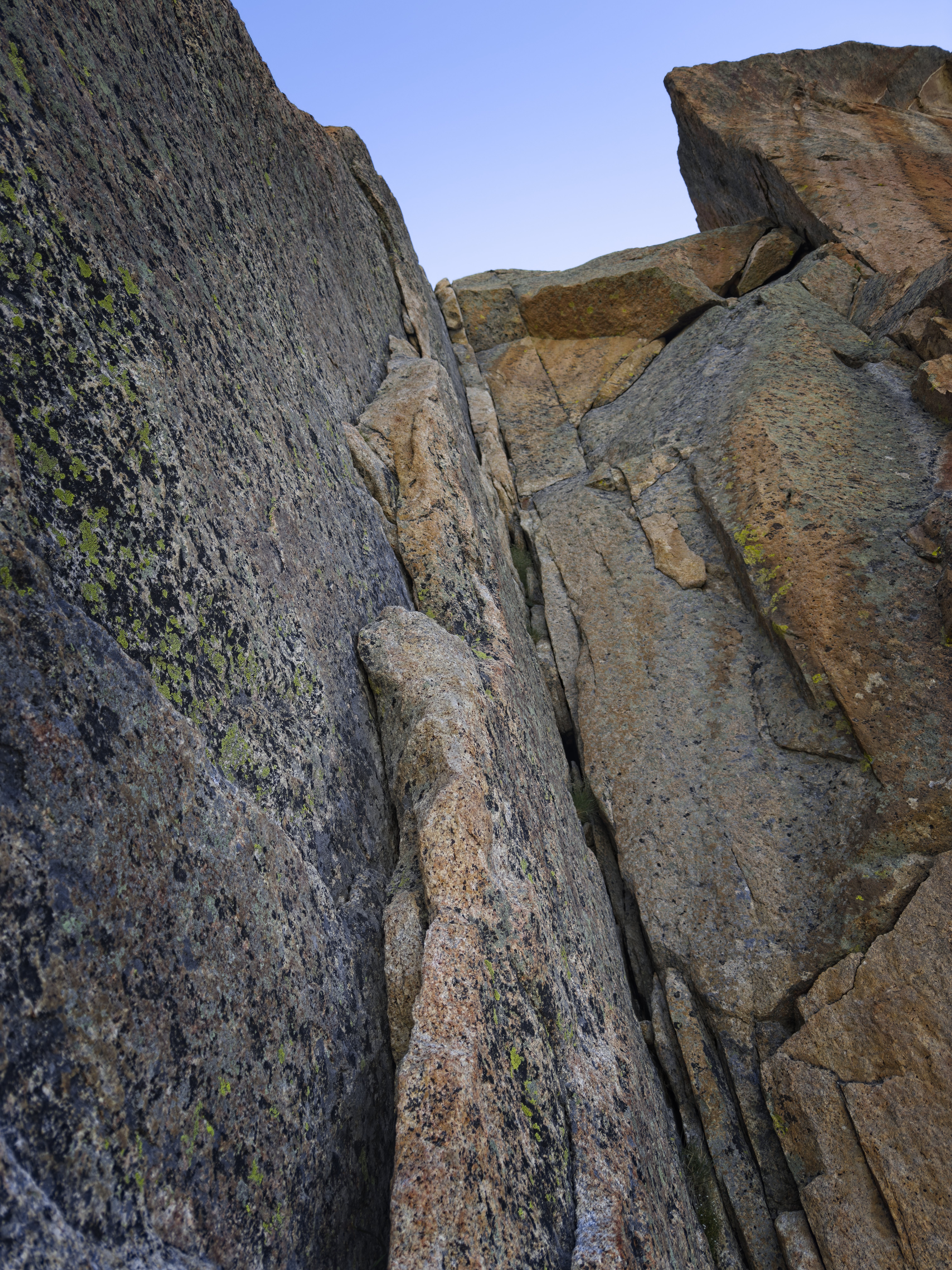
Looking up pitch 4, which is less intimidating than it looks thanks to
a traverse out left to touch the arete before dealing with the slight
overhang of the dihedral at the skyline (5.7/5.8).
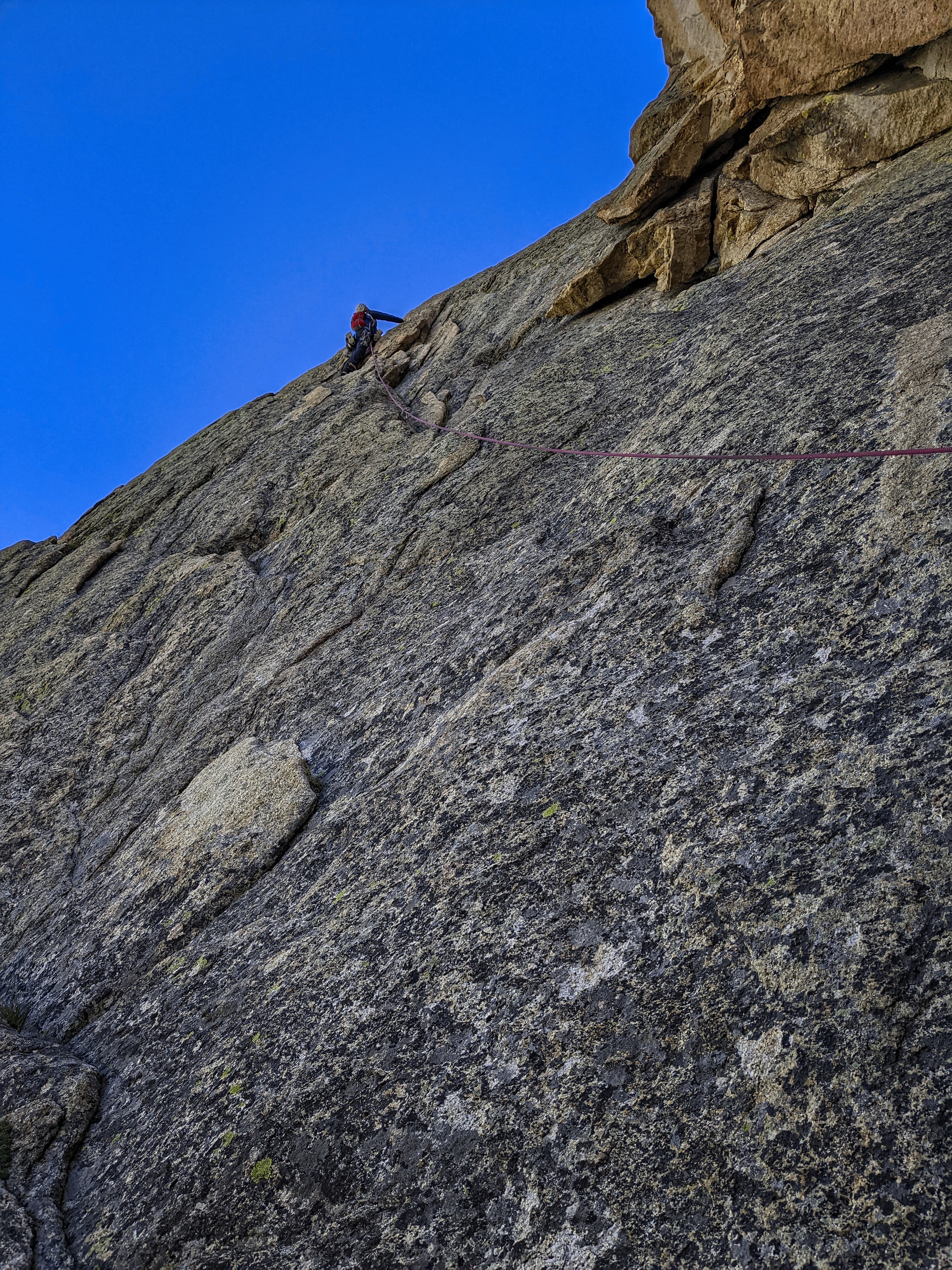
Michael on pitch 4. The route followed easy ground down and left in the
photo, then up and right to the first gear placement.
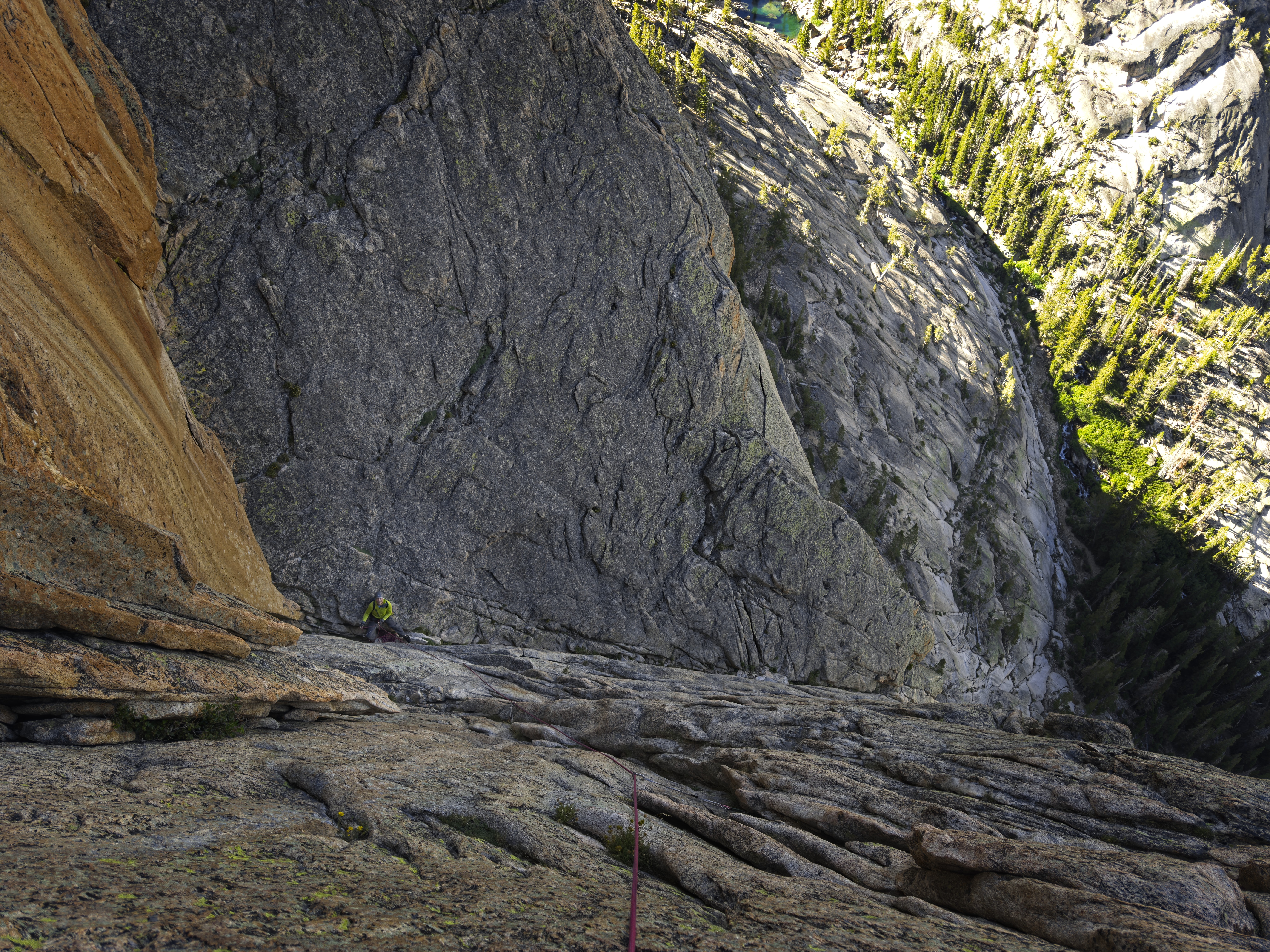
A look back to Steve at the belay for pitch 4 -- you can see the
friendly terrain that marks the first 30 meters of this pitch
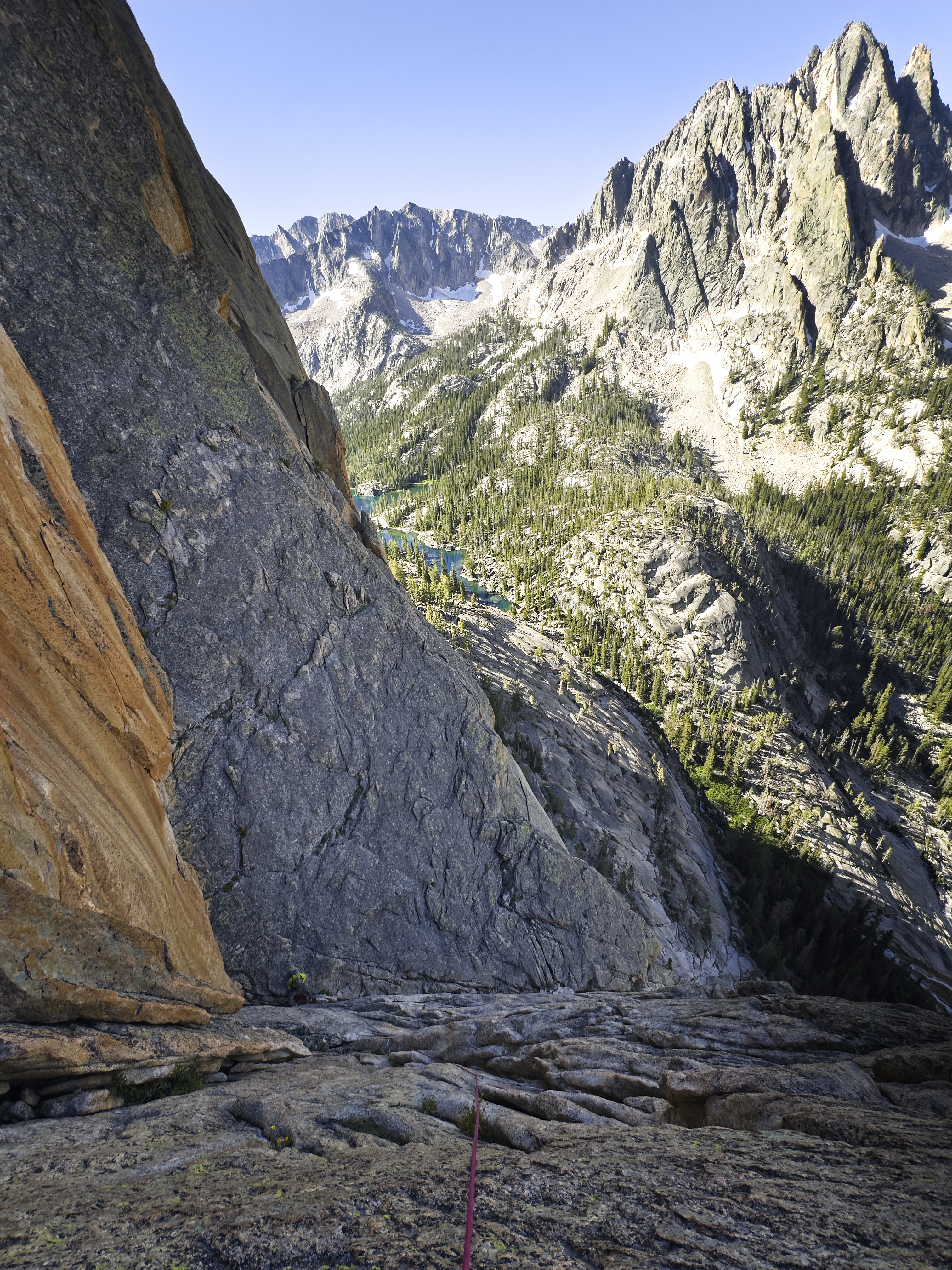
A similar shot, with the Goat Perch in the background...
Steve arrived and set out for pitch 5, which continues straight up at 5.7 or so. It's also the shortest pitch, at 35 meters or so. He was looking for the base of a finger crack, however, the face held an array of possibilities and he didn't want to go far above the expected rope-length. So he built a belay and brought me up. Working together, we eventually identified the only possible place, then moved the belay up 15 feet to it. Since pitch 6 was expected to require the whole rope, and have some difficult moves, I wanted to be absolutely sure I had enough rope...we were almost always using the whole thing!
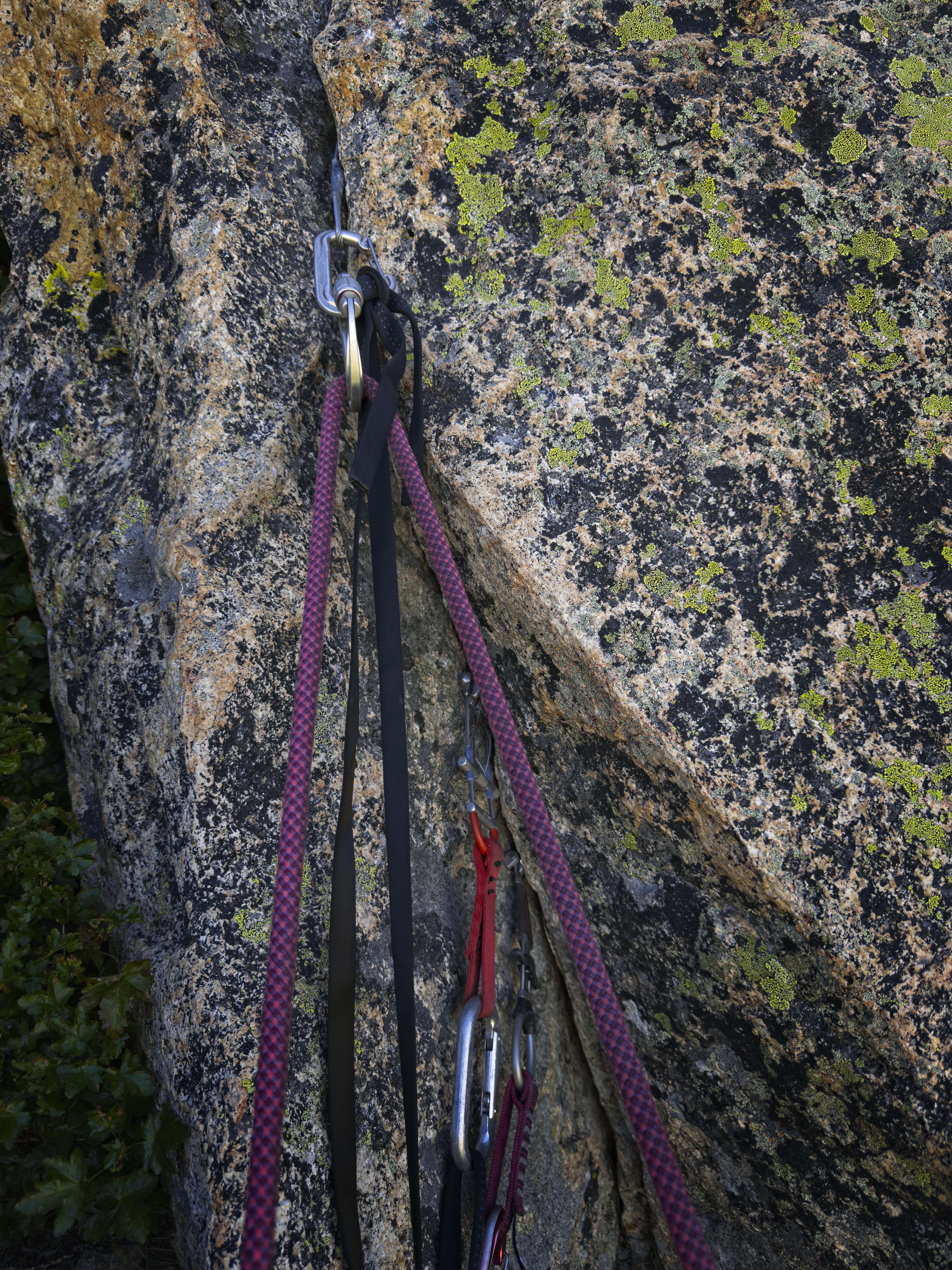
Perhaps a picture for a future edition of John Long's "Climbing Anchors."
Note that the lowest placement has one side of the cam only partially
engaged. Out of sight is that the upper nut would hold a Winnebago.
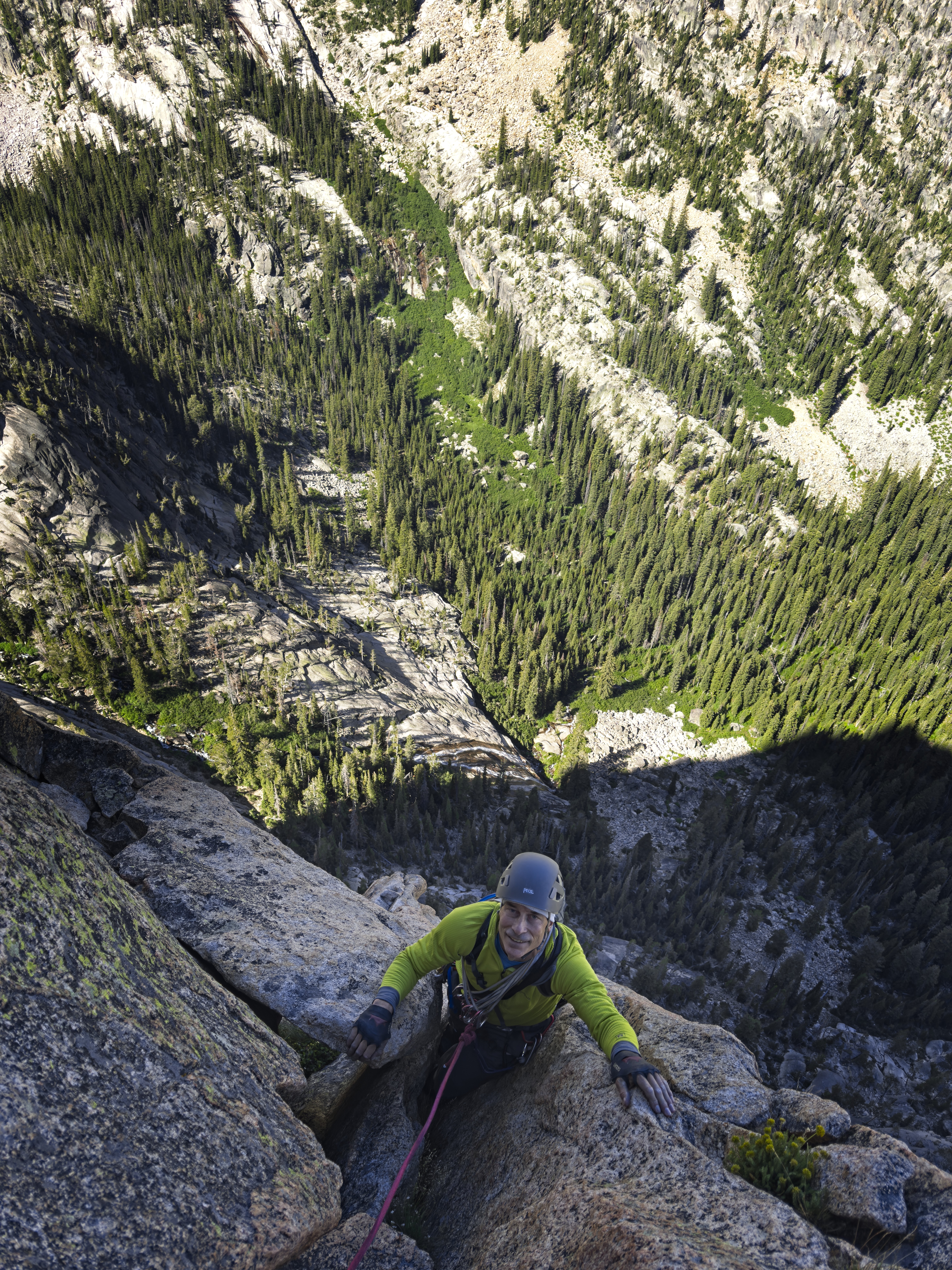
Steve arrives at the end of pitch 4, essentially pleased.
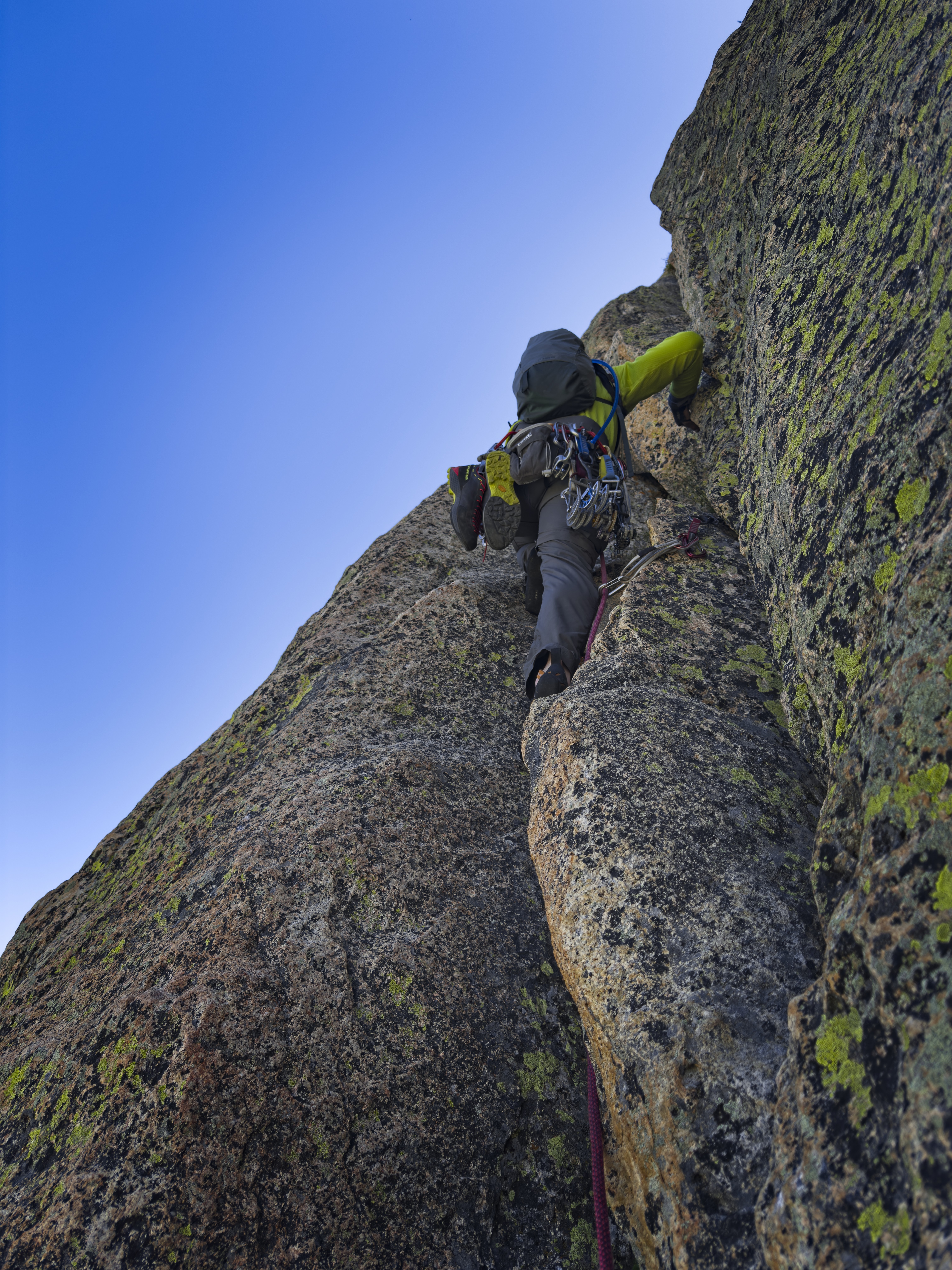
Steve heading up on the 5th pitch
I was able to avoid full-on finger and foot jamming by using a lower angle crack (also finger-sized) on the left for a good ways, but I finally had to join the vertical crack near it's top to move right into the dihedral that I'd follow to the end of the pitch. This was a delicate move. I think I did a single (and painful!) foot jam in the finger crack as I went across. But pain is a signal that you are locked in, so that's good!
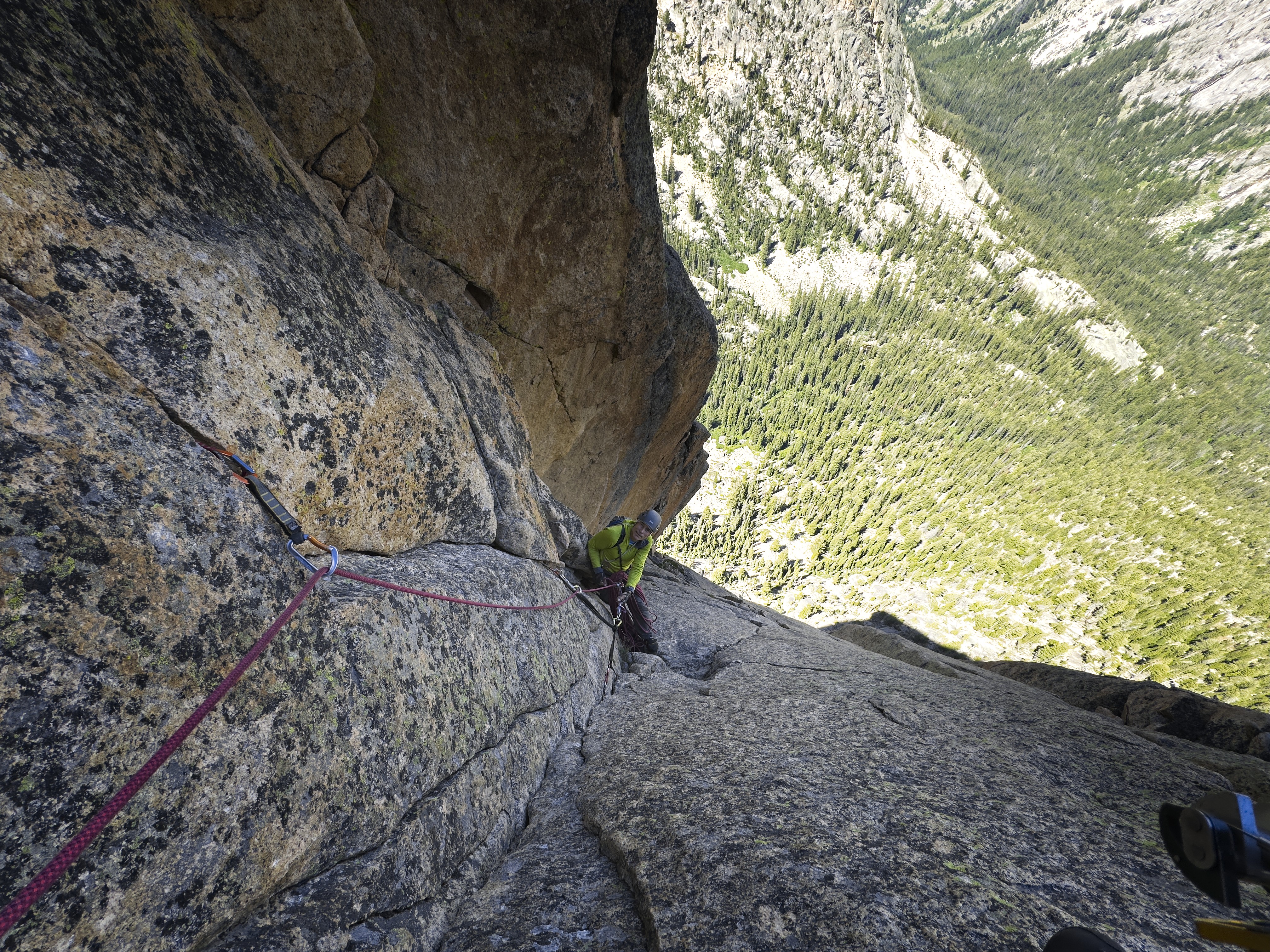
Steve at the pitch 6 belay
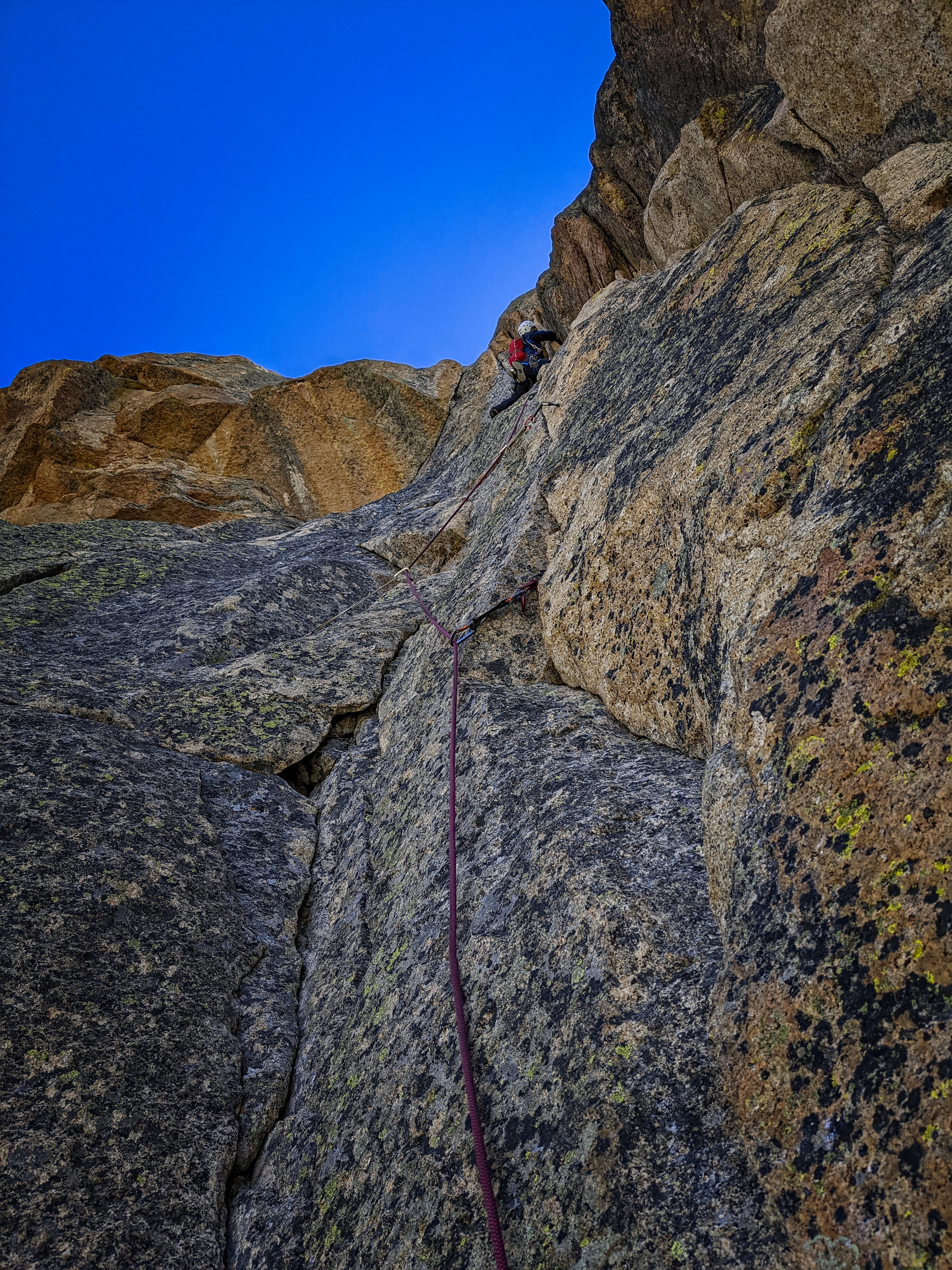
Michael climbing above the finger crack (photo from Steve)
The terrain eased in the lower part of the dihedral. In fact, I saw a video where a party belayed here. I think that's a great idea. That would also mean you don't have to situate your prior belay right at the finger crack.
I came to the "overhanging" wide cracks that mark the upper section of the pitch. I placed a #3 Camelot at the base of them, launched up into interesting moves, and enjoyed my conversation with the feature for the next 20 vertical feet. Not easy, but very engaging! There were a few face holds in the middle of this that proved useful, but mostly it's about cracks with a bit of stemming and grabbing the edges of flakes. Higher, I followed a lower-angle crack on the left for a good ways. It had less protection, but also less verticality, and the occasional welcome flake for the right hand. I ran out of rope just at a comfortable ledge atop the dihedral and built a belay with a cam and offset nut. I was out of gear...in fact I'd placed a good nut below but girth-hitched the sling to the wire to save a carabiner. Good fun.
Steve arrived, happy to be moving as he was getting cold below. He was impressed with the length and quality of the pitch, and I had to agree! Now things should be easing off rapidly. Steve followed his nose up pitch 7, rapidly climbing 30 meters to a ledge above and right. He'd identified an obvious way down into a boulderfield marked by trees, that we could then follow up to the boulderfield at a pass, thence on to the descent (or summit, if we chose). I was hoping we could keep climbing to the summit, though the buttress above us looked impossible. Here I led up for a pitch 8, placing no gear, for about 30 meters to a ledge just below a crest where we could see more. I belayed Steve up, then sent him off for a pitch 9 to go over the little crest and have a look around. He did so, then found a belay a bit down and left. We unroped here. Bickering "like an old married couple" for a few mintues, we debated the best choice: climb on, traversing below the impossible buttress (and risk getting "treed" above and below cliffs), or descend 100-200 feet to then walk up to the pass. Comically stubborn, with the rope badly tied to my back and falling off, I made for a small tree above a wide crack. "See, it's easy!" I cried, even as I slowed down and eventually nearly came to grief struggling with a wide crack, foot jams, and nothing for hands.
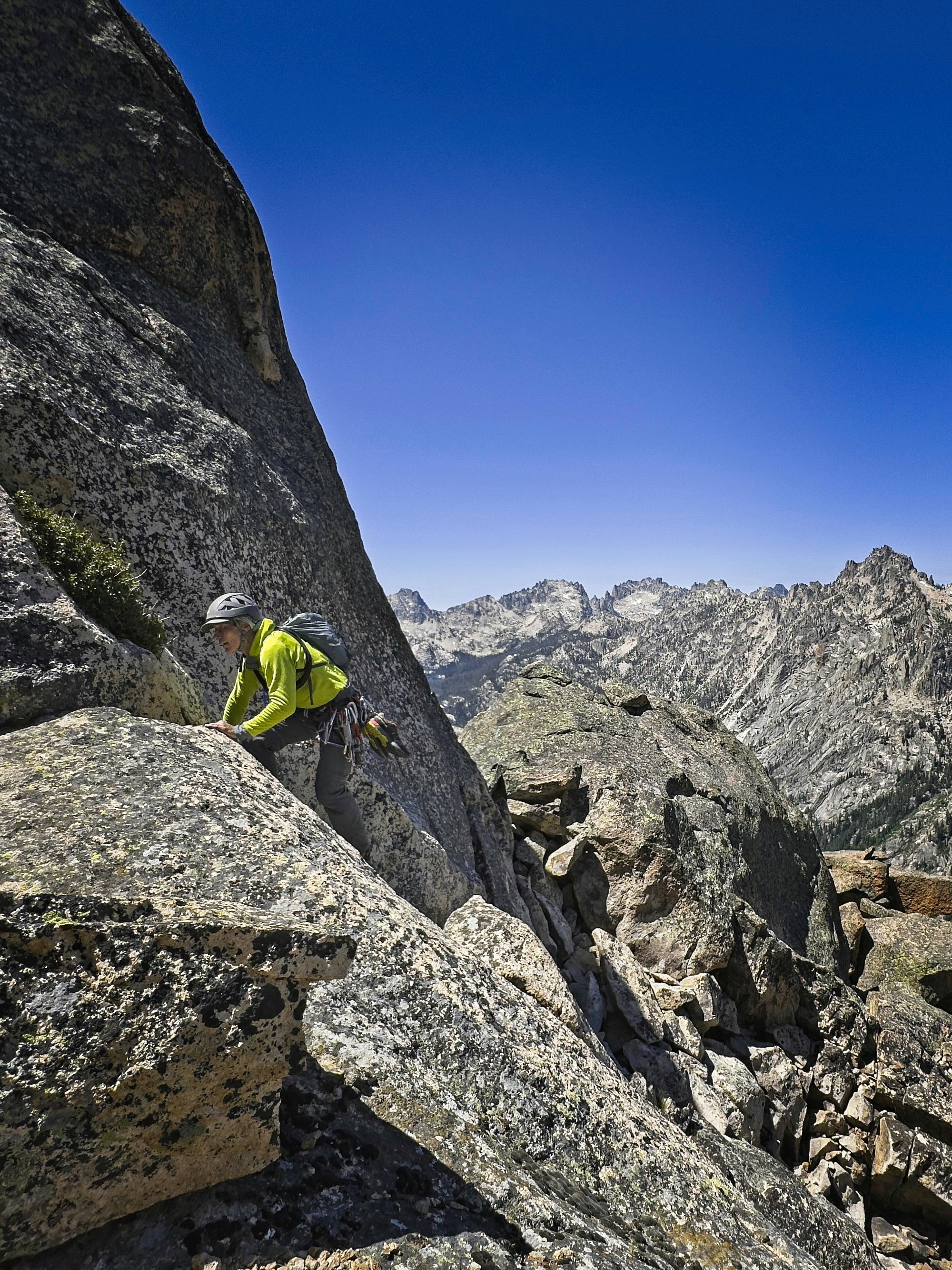
Scrambling to the summit. We had to traverse around a blank, slabby
buttress on the left side, then continue traversing and climbing
around ribs in 3rd, 4th and occasionally moves of low 5th class.
Steve wisely stepped around right and came up an elegant way (seen in the picture just above). Then he led off as I panted behind, rounding multiple ribs until the way above opened up into inviting slabby dihedrals. "We can just climb up this," he said, and took off. The climbing was fun, though rather at the limit of soloing for me. We may have been able to follow it all the way, but the angle kept steepening slightly, so Steve moved further left over a buttress crest to discover a great slab ocean. Here we could traverse naturally, and climb up when the angle allowed. We navigated a couple of small snowfields along the way. Finally, we'd crossed the slab in an ascending traverse to a point on the summit ridge crest a bit below the true summit.
Nice! Here we finally changed into blessed tennis shoes. Leaving the gear, we walked over to the true summit and admired the view. We espied Alpine Lake, which we planned to camp at for a climb of Warbonnet Peak soon. We looked down at the colorful tent of our companions by the lake camp. They were doubtless on another hard line of the Perch right now.
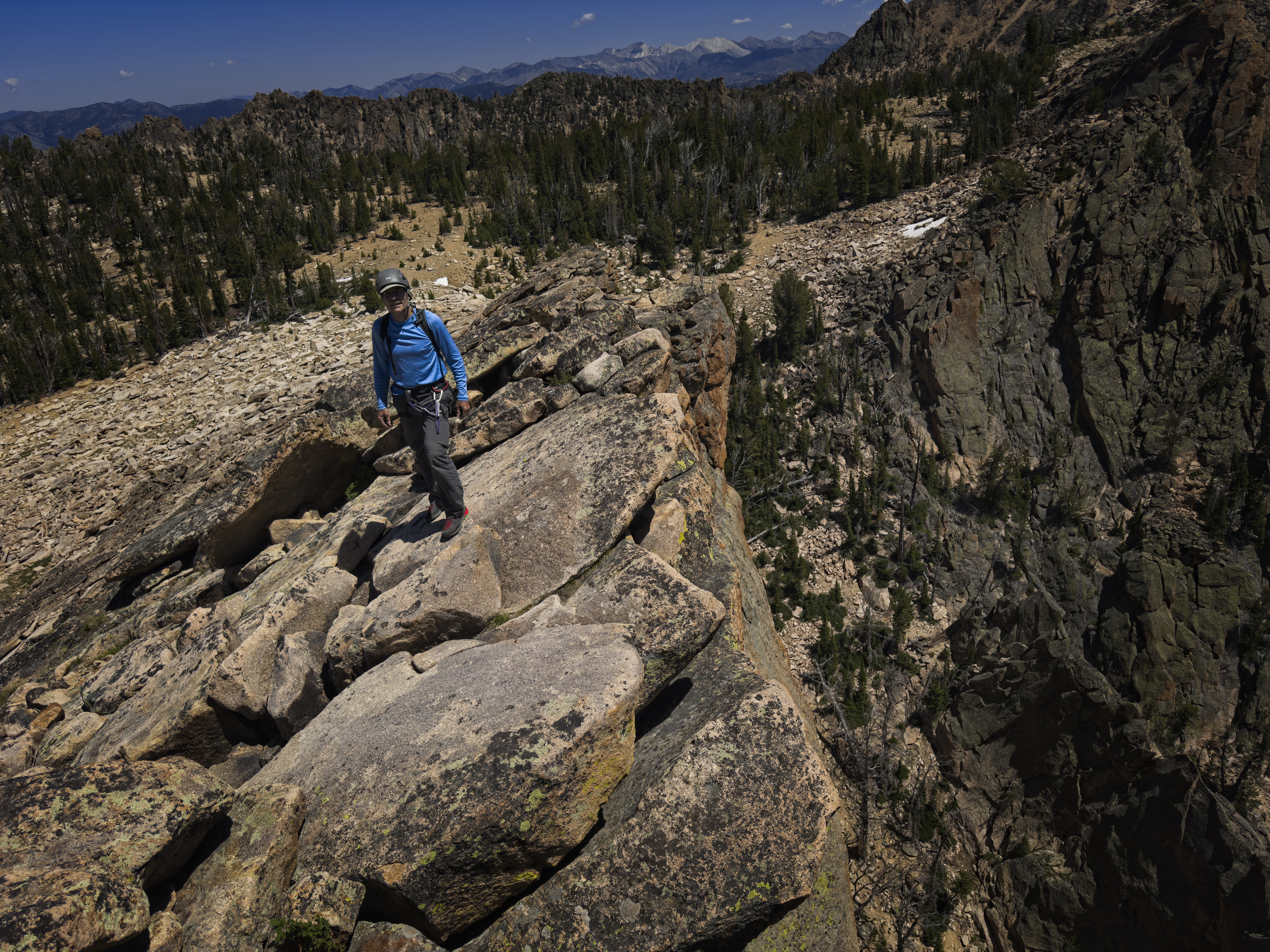
Steve on the summit ridge
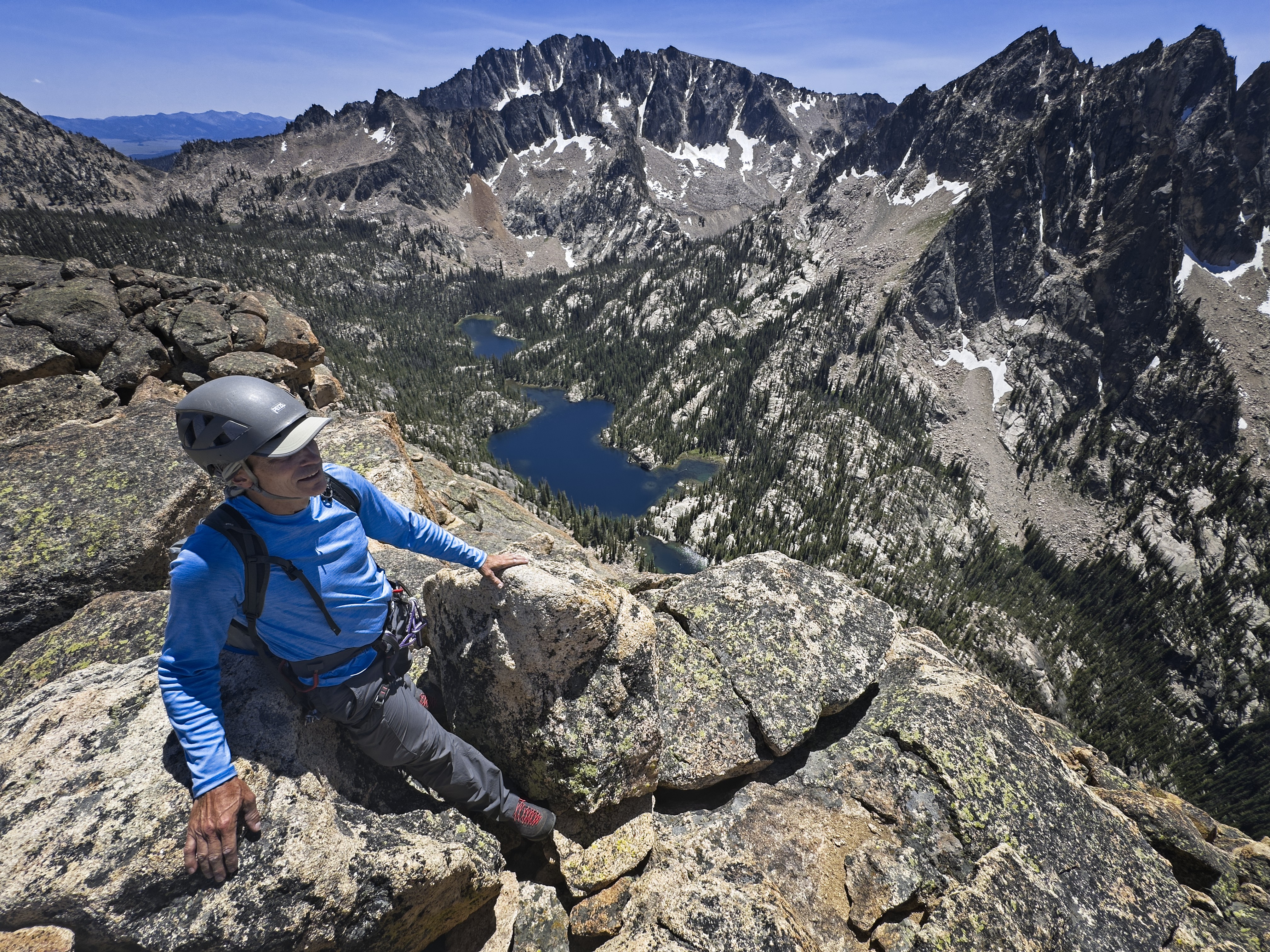
On top! With the Saddleback Lakes below
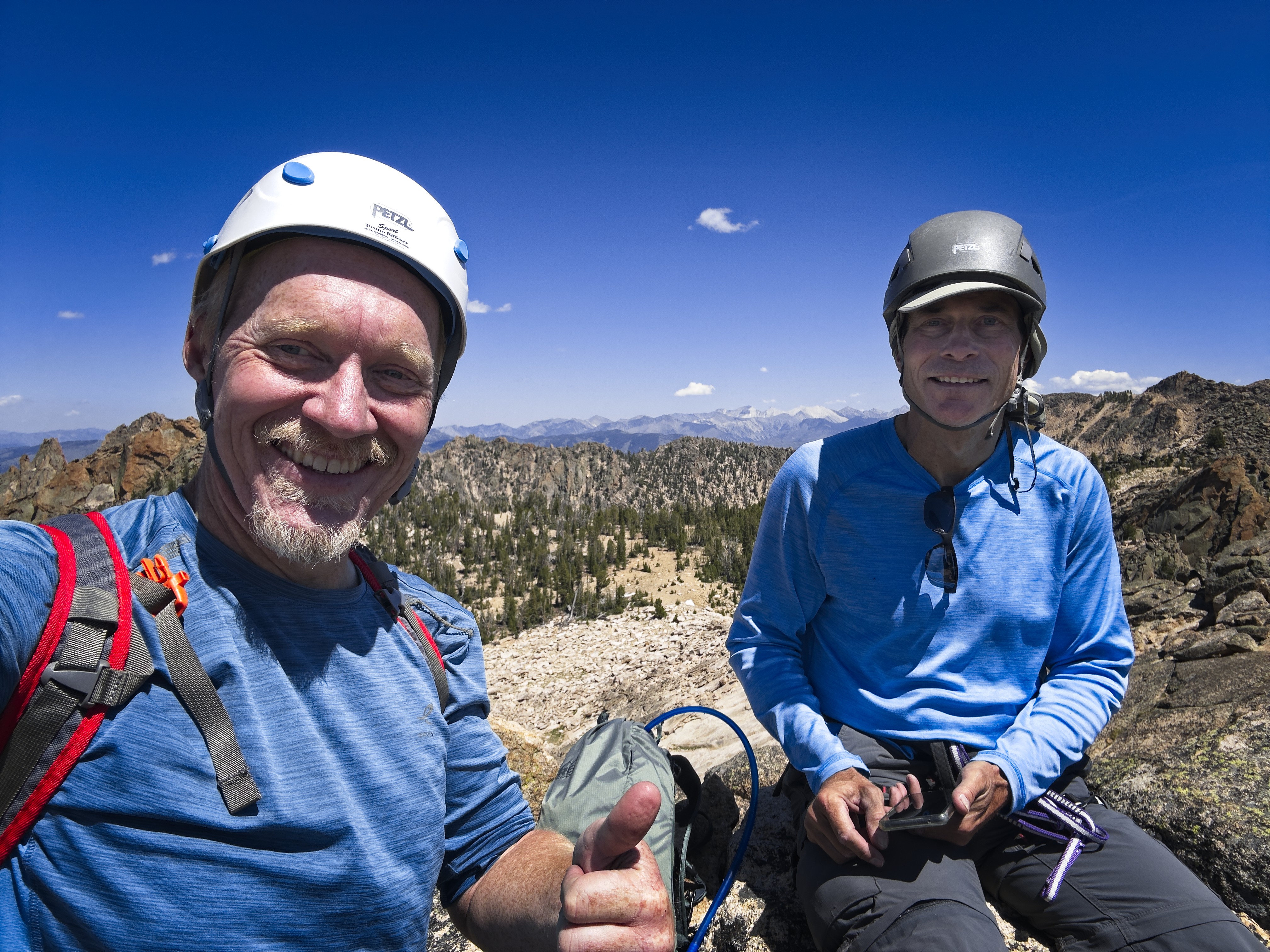
Partners in grime
A good climb! Now we just had to get down...
We descended the obvious gully just on the side of the Perch easily enough. Along the way, we saw two climbers on "the Sunrise Book" (5.10, A1), which looked amazing. After a sometimes-tedious descent, we found the rappel anchors above a steep cliff, and Steve set off on rappel. He couldn't quite touch the ground, but he could downclimb the last bit by ingeniously tunnelling behind a chockstone. As I descended, he'd scouted a way for me to downclimb on the outside of the chockstone, which was also easy enough though without contortions.
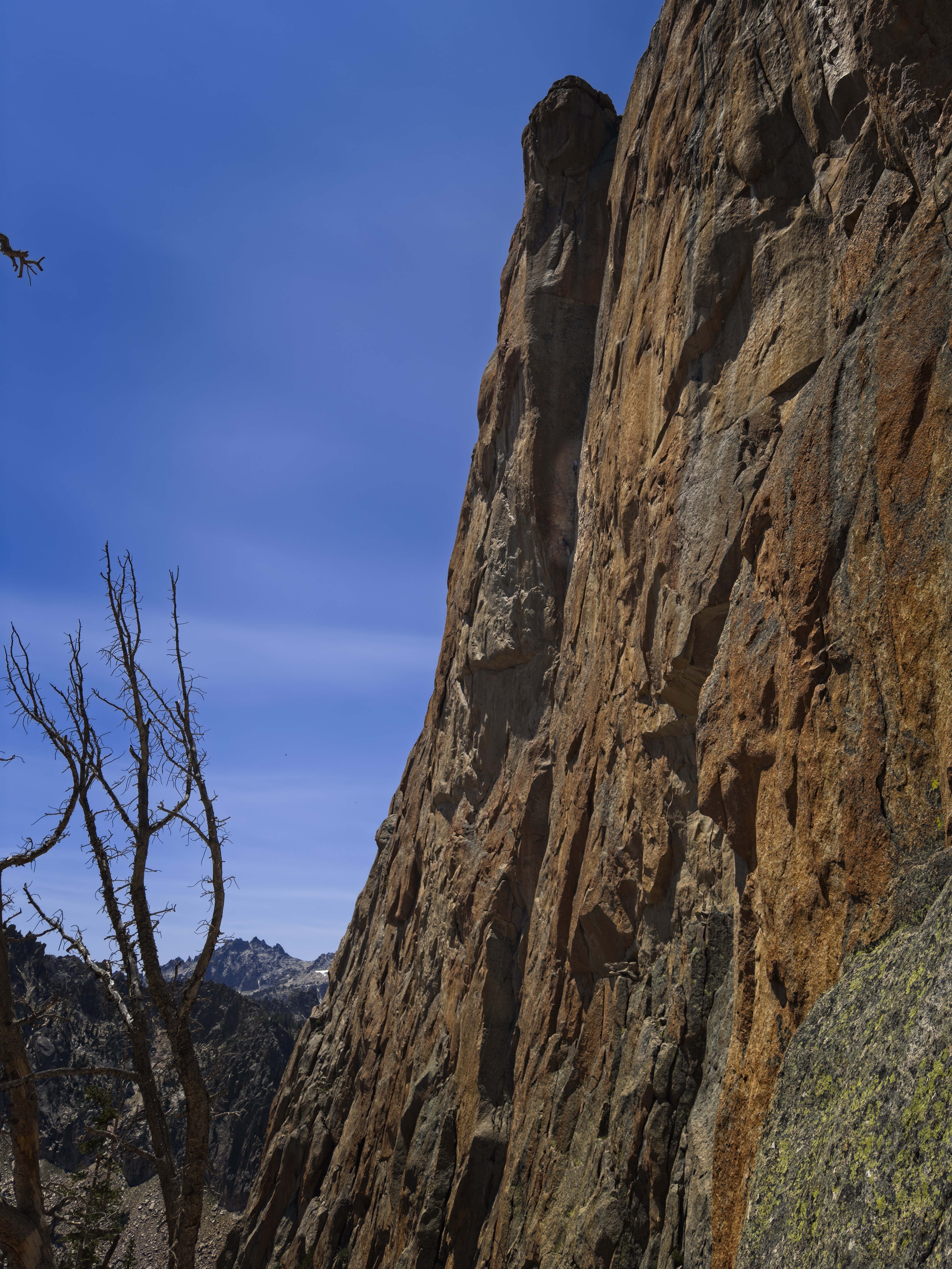
Two climbers (highlighted) on the Sunrise Book
I'd seen beta about doing this rappel with a 60-meter rope telling you to angle to skiers right, where you should land on easier, broken terrain, instead of abseiling straight down. This may work, but I can report straight down is okay too, as long as you have knots in your rope and are okay with downclimbing about 3 meters of 5.0 (and escaping the abseil, etc.).
We followed trail down to our tents where we rested an hour or so. The guys we'd met the day before came down, having done a climb on a neighboring buttress. We packed and descended to the river, enjoying the descent trail even more now after the sketchy, slow gully descent from the summit! Trails are nice.
We simply waded across the river, and marched on in the increasingly pleasant evening to the boat dock. We set up camp, ate dinner, and slept, with visions of buttresses and cracks and foot jams...
Out with the first boat of the morning at 7:15, along with the two pairs from the lake. A good time! Thanks to Steve and of course, thanks to the Cobra for not stinging us!
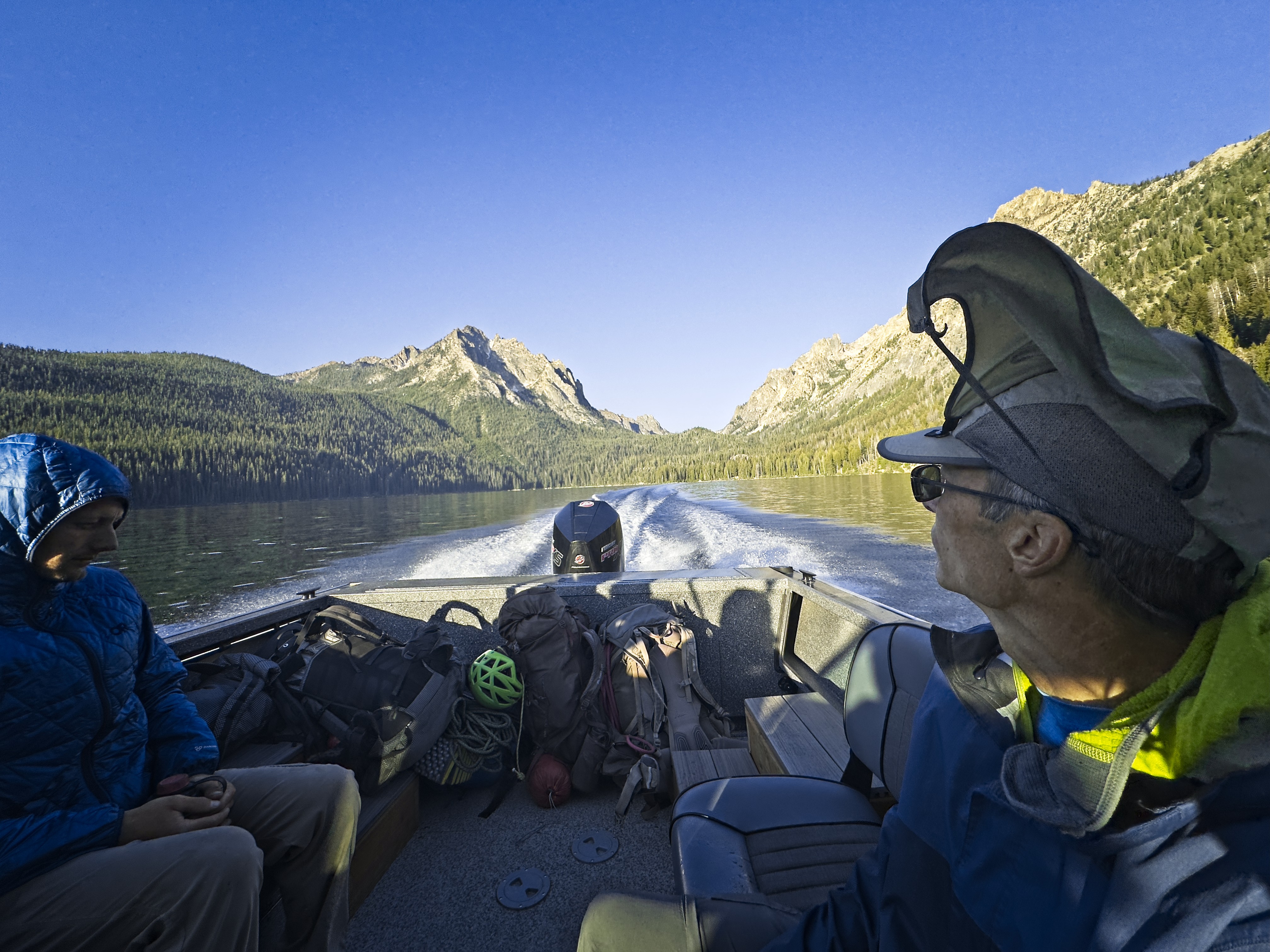
Early morning goodbye to the range from 6 or so climbers