Cirque of the Towers Climbing
Friends: SteveLocation: Cirque of the Towers, Wolf's Head, Pingora Peak
Elevation gain: 2000m = 2000m
Approach Day
After driving down from Boise and sleeping in Pinedale, we hiked up into the Cirque, meeting many parties. Great weather, and easier-than-expected hiking, at least to Big Sandy Lake.
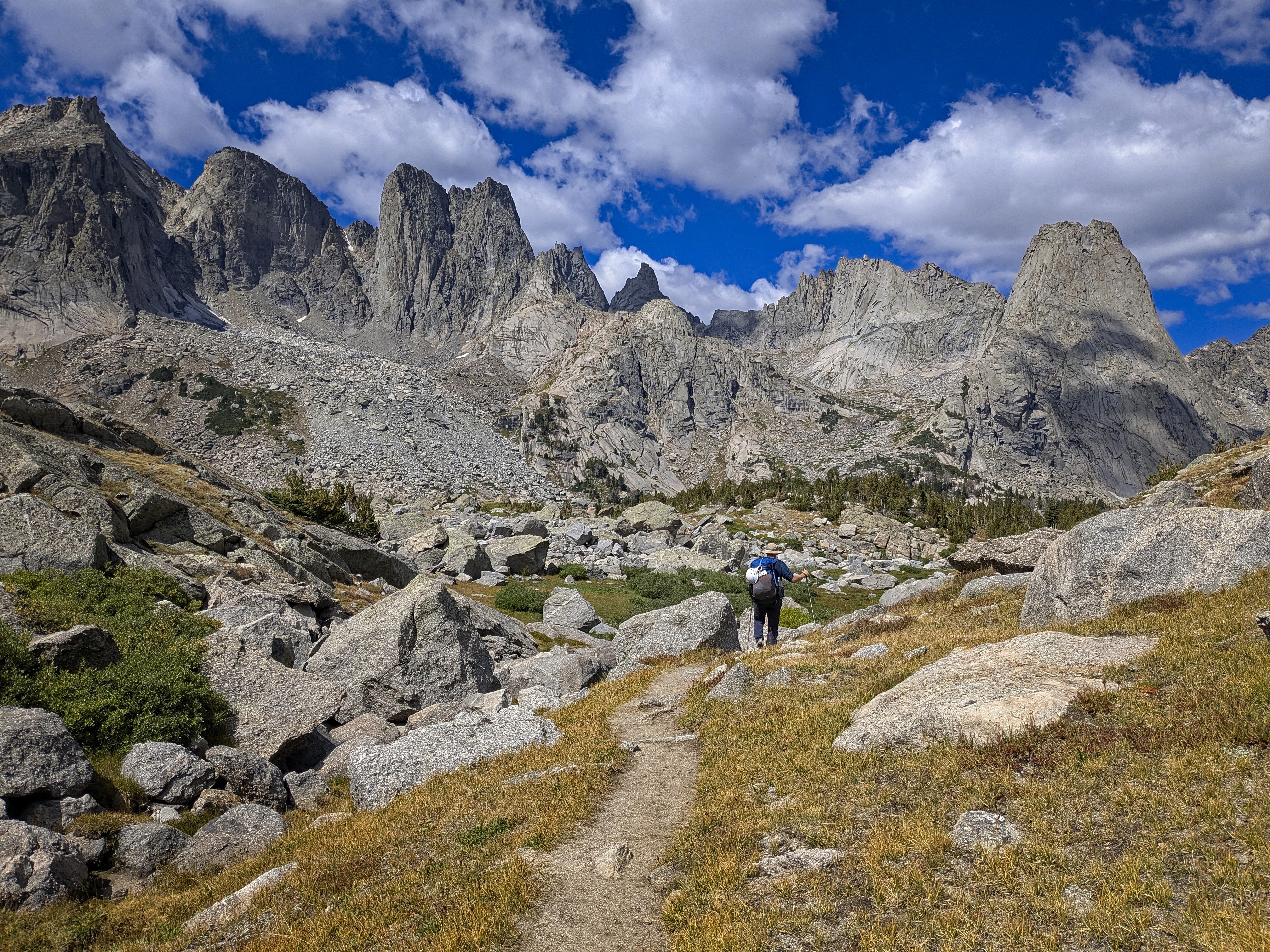
Michael hiking into the Cirque
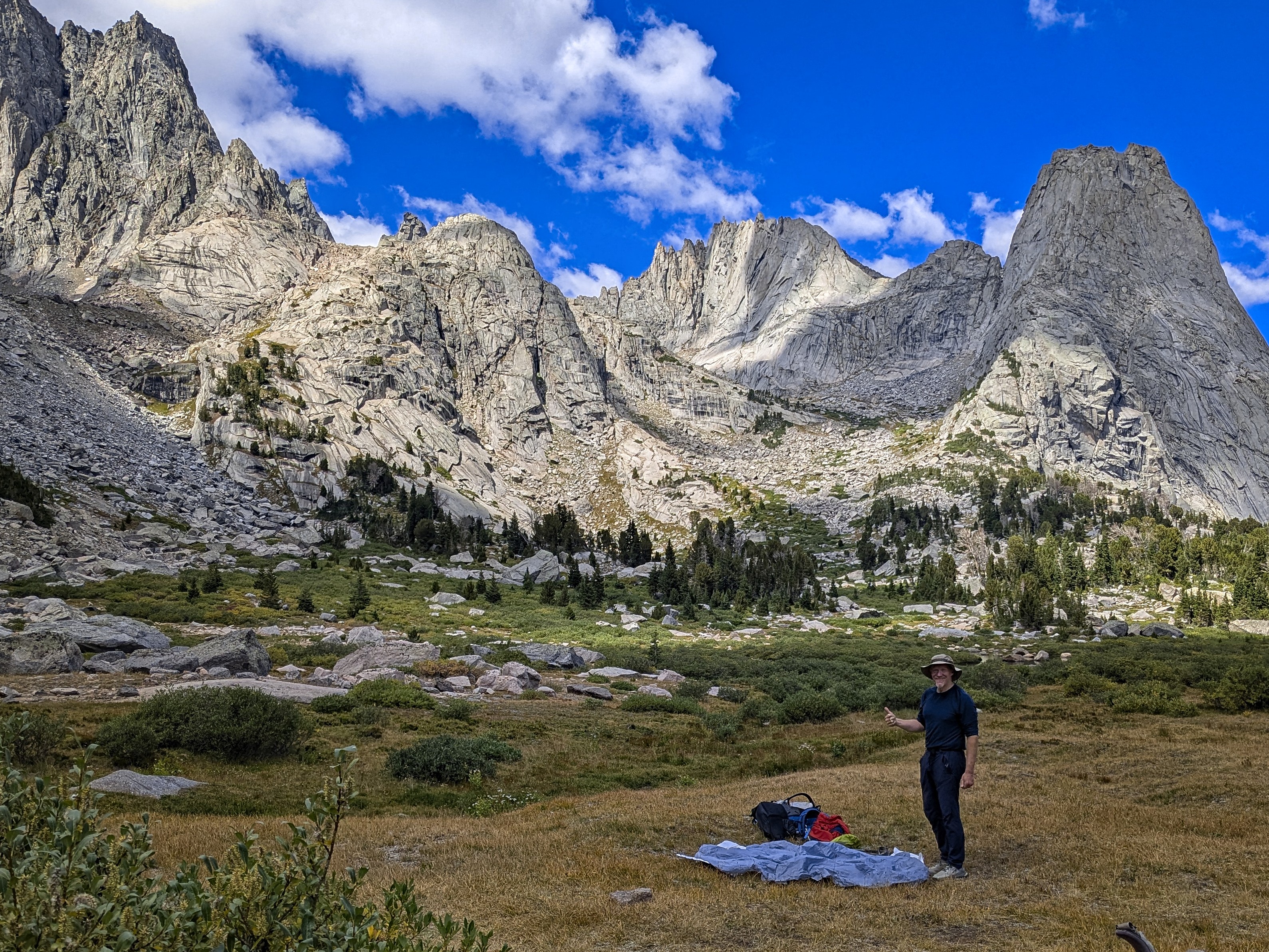
Happy to be here! Wolf's Head and Pingora, our objectives, are behind
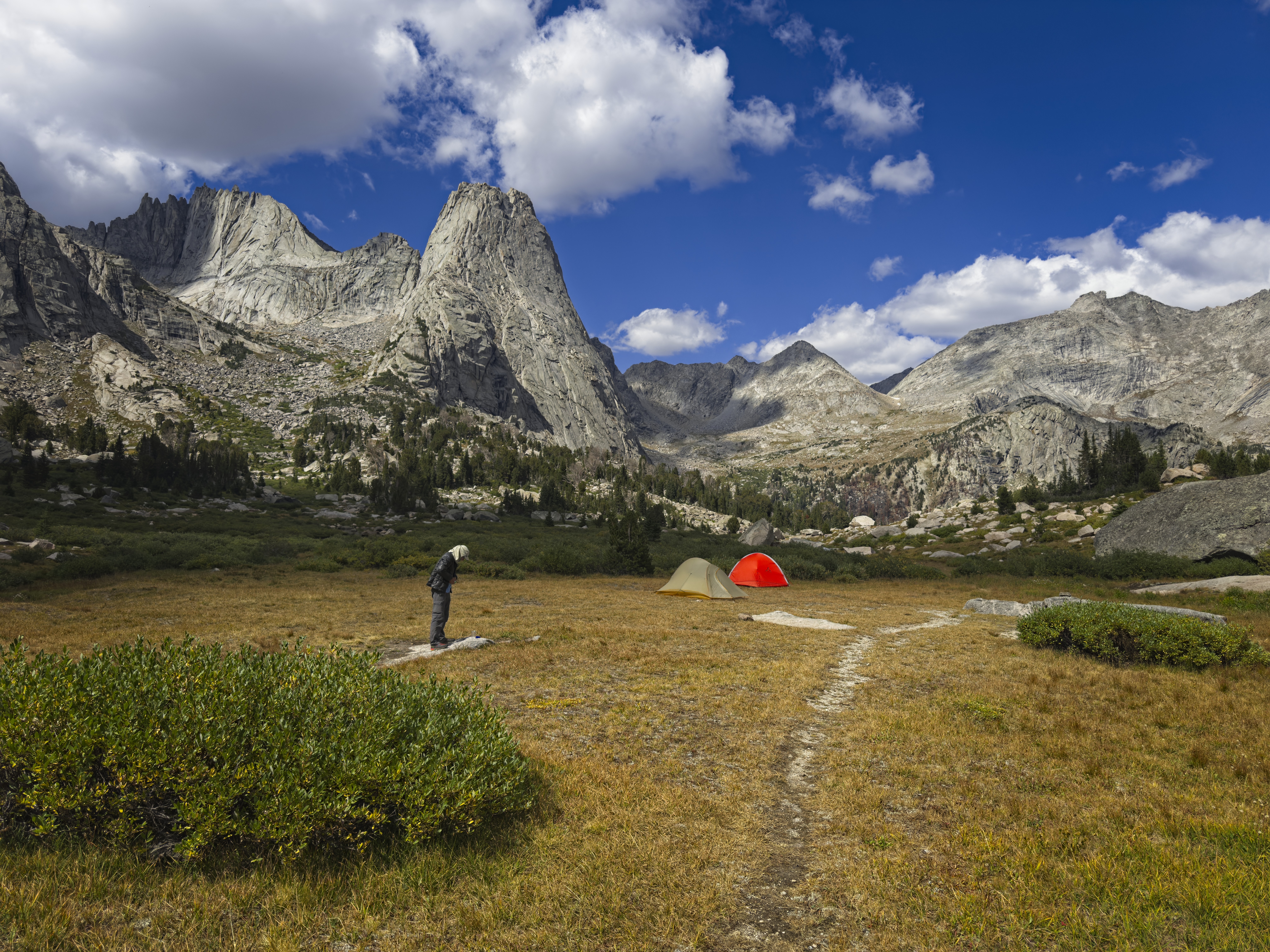
Steve setting up his tent
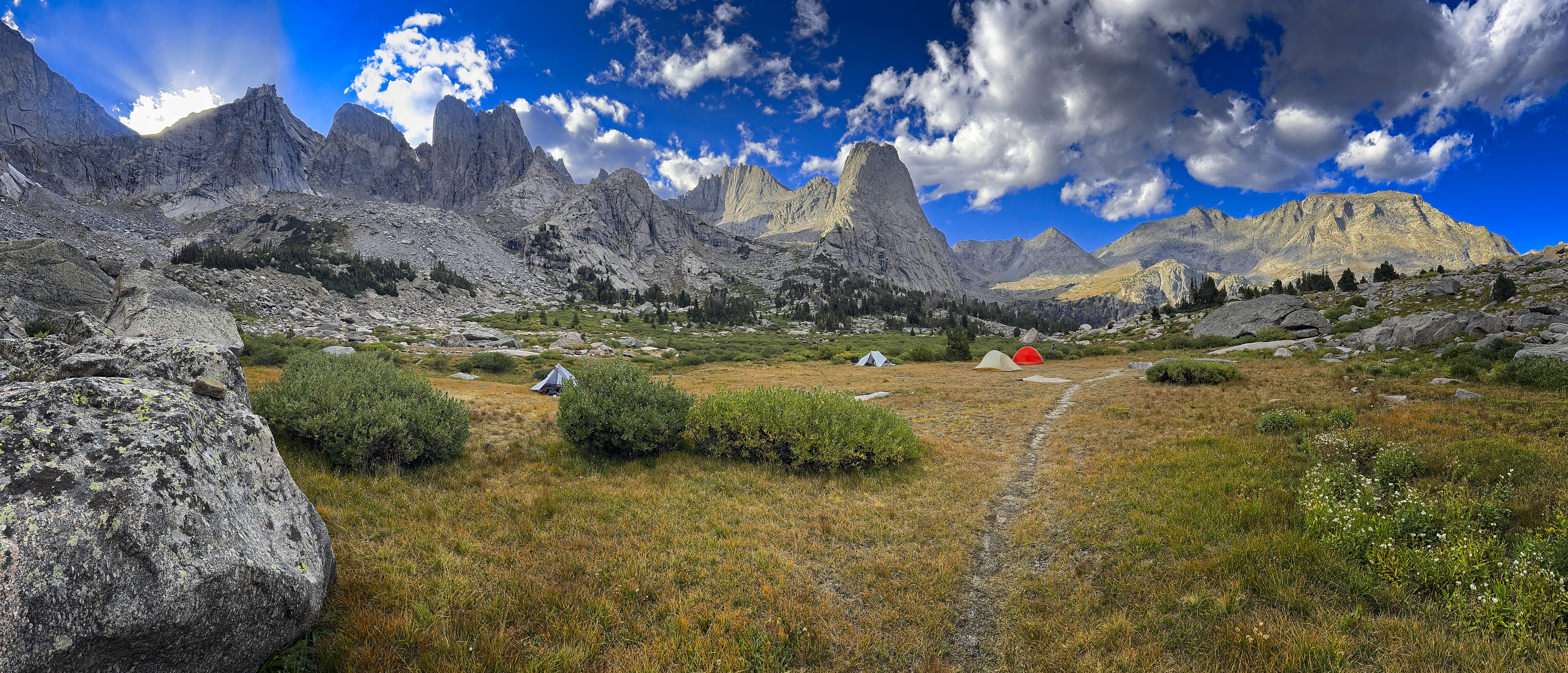
A pano-rama of the same area
We set up camp and prepared for the climb the next day.
Climb of Wolf's Head
We used the Mountain Project Wolf's Head East Ridge route description as a guide, which was really good. Specifically their advice about doing a long simul-climbing "pitch" from the start to a little ledge below the First Tower, then belaying four pitches to get through the towers, then again simul-climbing to the summit. This worked out really well.
But first we had to get up to the ridge crest. We hiked in the dawn up the trail to a point where boulders and scree reach a high point on the south face of the connecting ridge between Wolf's Head and Pingora. We left the trail to ascend this, noting the steepening gully/chimney above the fan of rock, and wondering if we should go up that a while, or step to the left and follow grassy ledges which made gentle ascending traverses of the south face. We chose the latter, however, pretty soon I hit my scrambling limit and stopped to get harness on. Steve gave me a belay and I went up, then back right then left again on a higher grassy ledge.
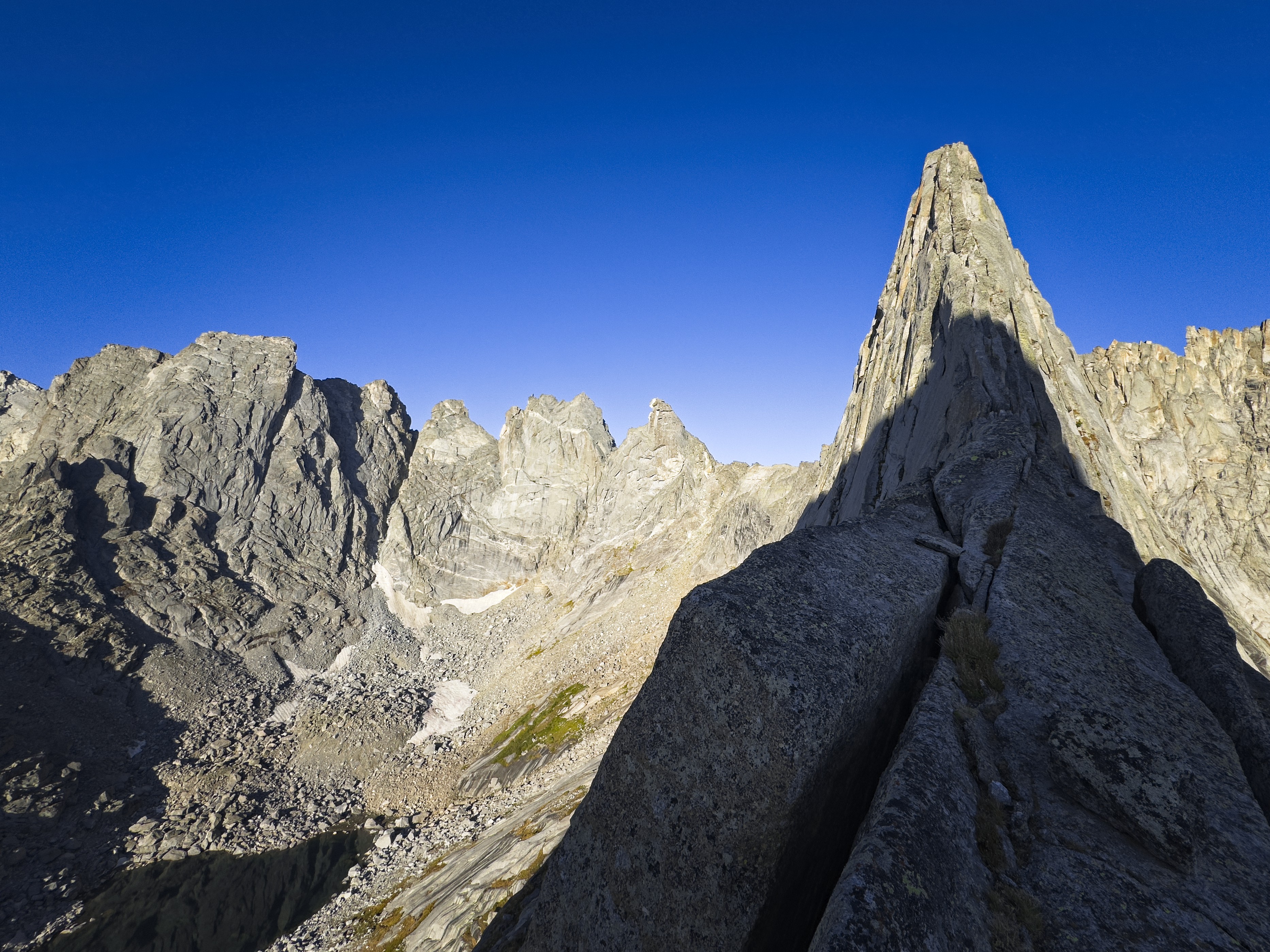
On the East Ridge of Wolf's Head, starting out early in the morning
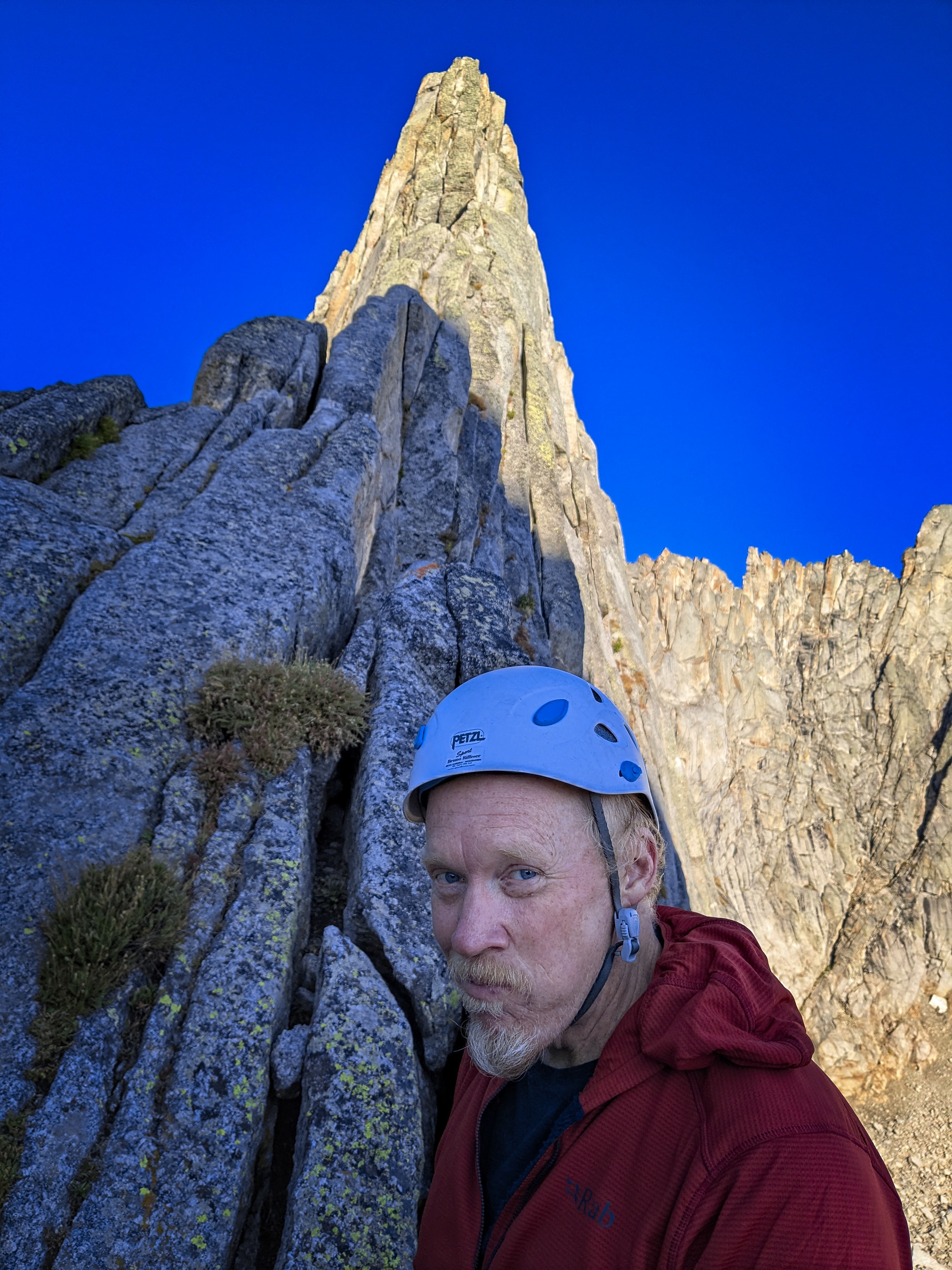
Michael, looking perhaps a bit dubious at the work ahead!
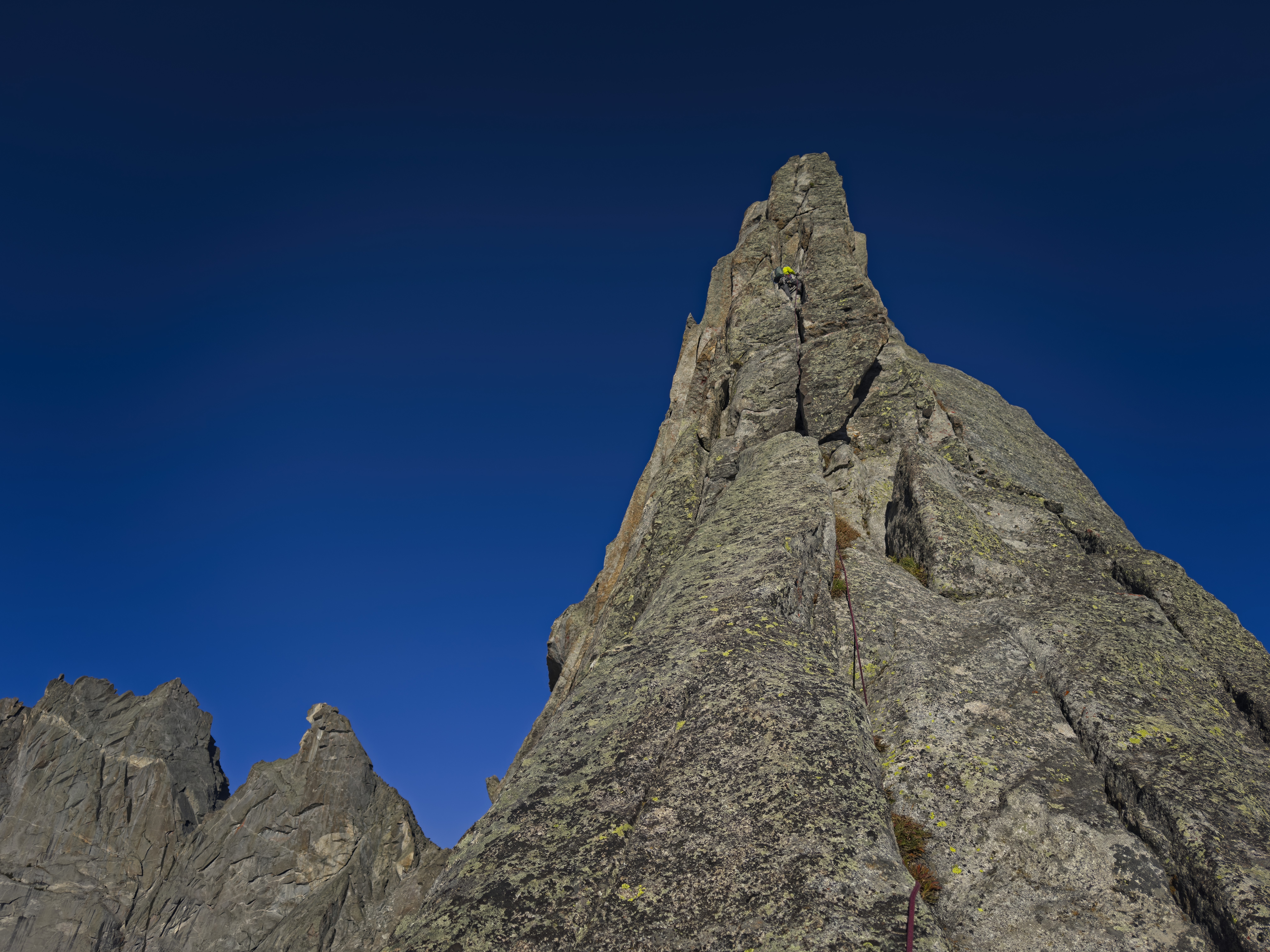
Steve on a long simul-climbing pitch to reach the first tower
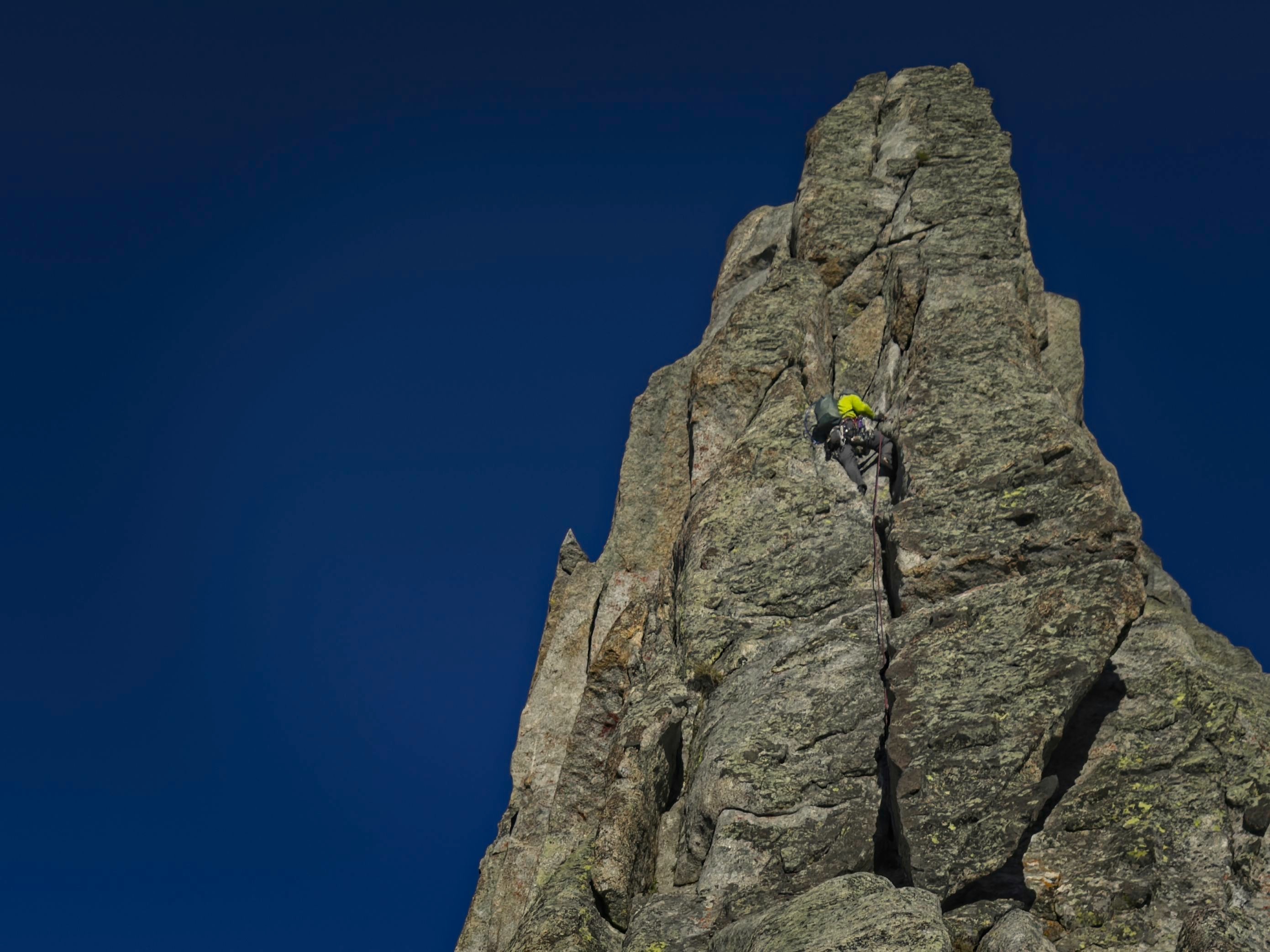
A closeup of the same...
I belayed at an apparant choice point: either continue reasonably up and left on the current grassy ledge, or make an exposed bouldering move up and right to reach a higher ledge. We were somehow convinced that by following the easiest line (up and left), we'd end up on a smooth and impassable slab. So every time I chose that direction I apologized loudly, but dang it, it just worked great!
Finally, I set off for a long pitch to the top, going once again, up and left on nice 3rd and occasionally 4th class ledges. Steve hollered up "you'll probably find yourself on a slab!", giving voice to our rather pessimisstic inner mood, however, after a few moves I found myself on the broad low-angle ledge about 50 meters below the crest. "Nice!" I said, rather surprised. I brought Steve up and we walked over to a notch a bit east of the low point on the ridge crest. There were a few moves of 5.0 in the chimney beneath the notch, then we were on top.
Moral of the story: take the easiest ledges, don't feel bad about going far to the west on them. We did go up and right once, pretty early in the precedings. We had many signs of passage (molded footsteps in grass/heather) on our ledges.
In the hours of pleasant climbing to follow, we saw several parties belaying within the grassy ledges, all on the much steeper ground further east, in and near the great gully/chimney atop the scree and boulder fan. My impression is that there must be real 5th class climbing in there.
Steve took off for the first pitch, enjoying an exciting long and narrow slab with huge drops on both sides. The terrain eased for a while, then steepened into cracks and corners, now in a bit of welcome sun. The route looked somehow improbable, but the rock was amazing. We had a pretty big rack, so he was able to protect well despite going for many pitches (I'd guess at least 5).
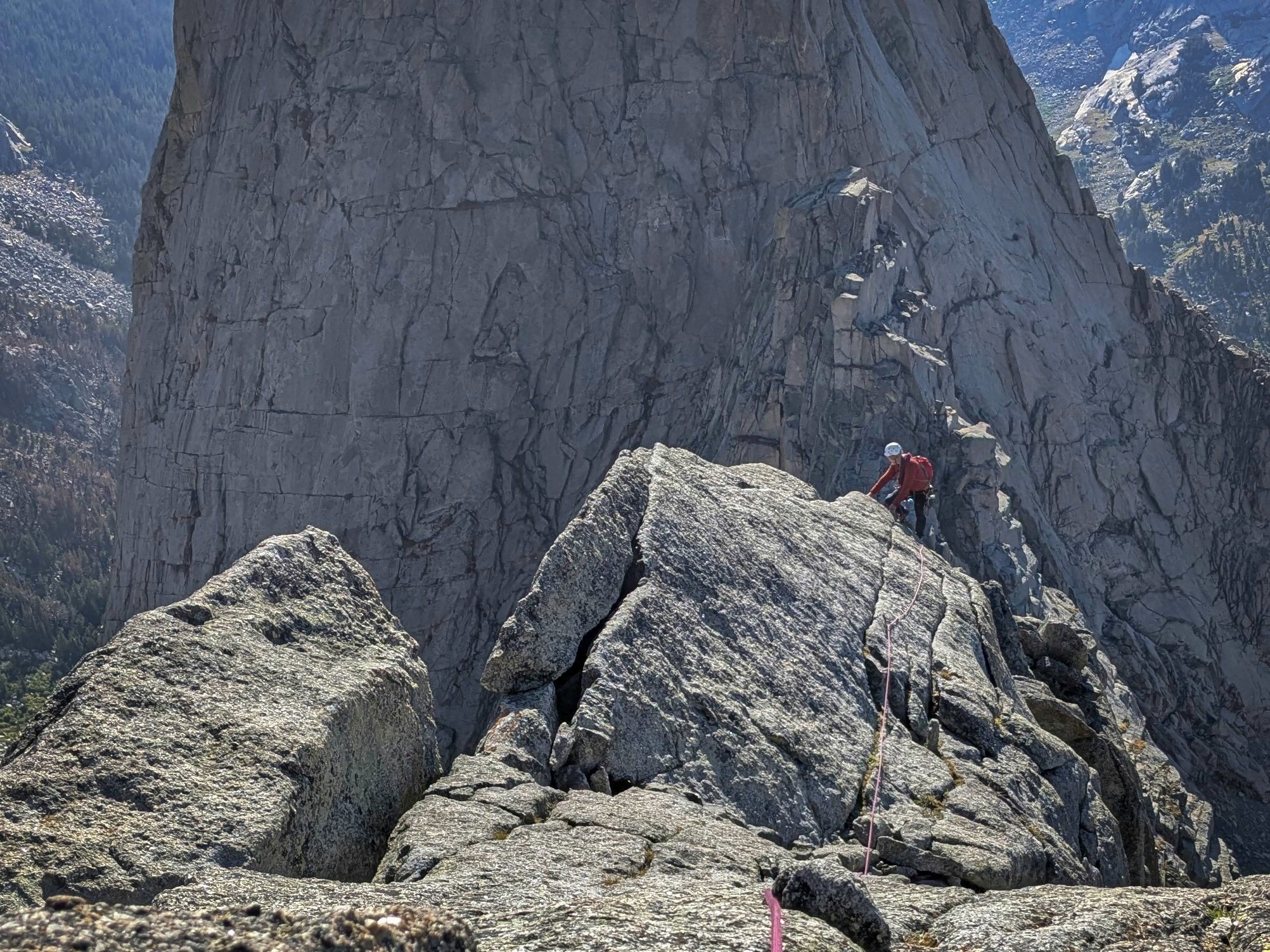
Michael following on the interesting slabby start
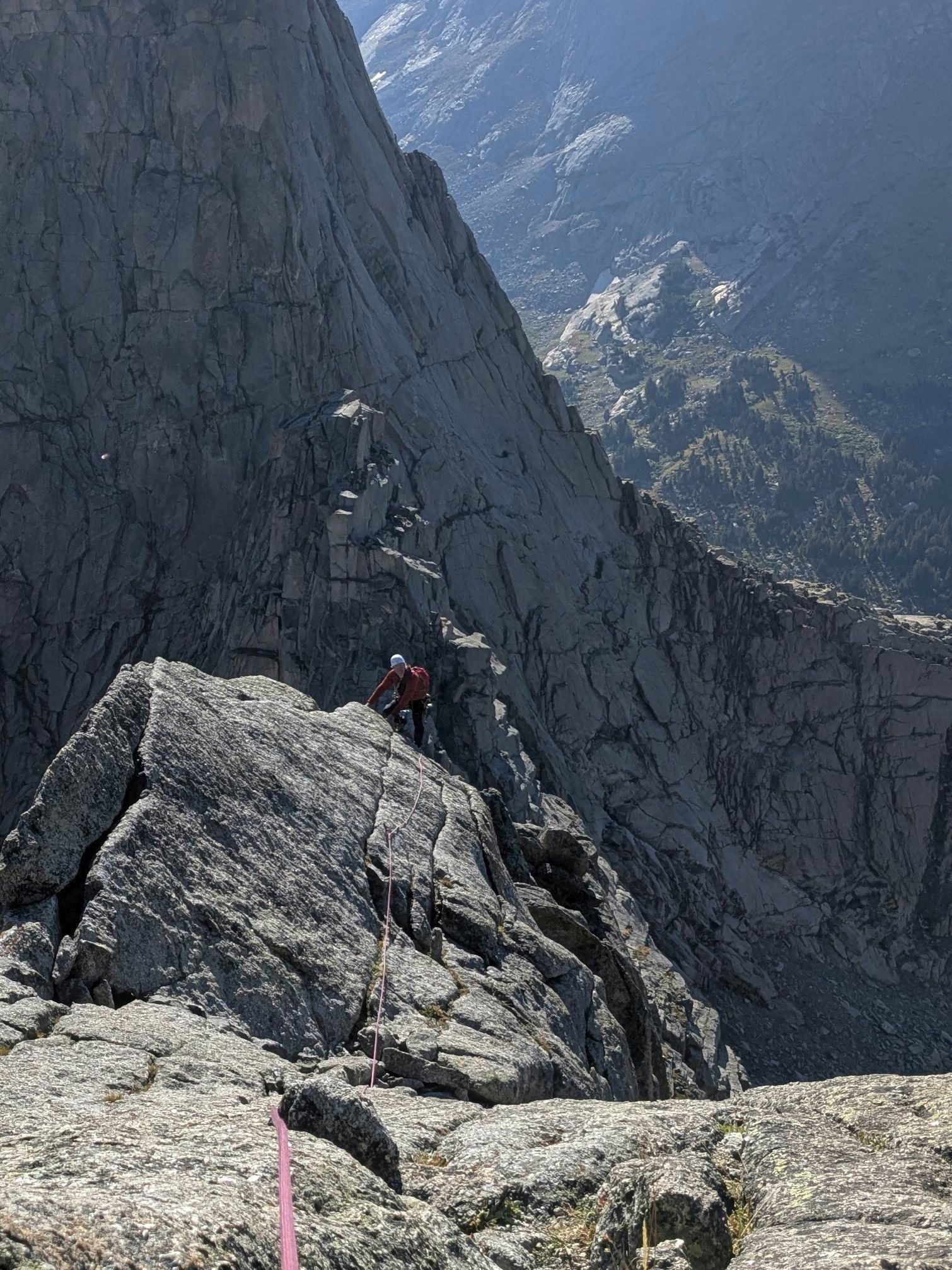
A similar scene...
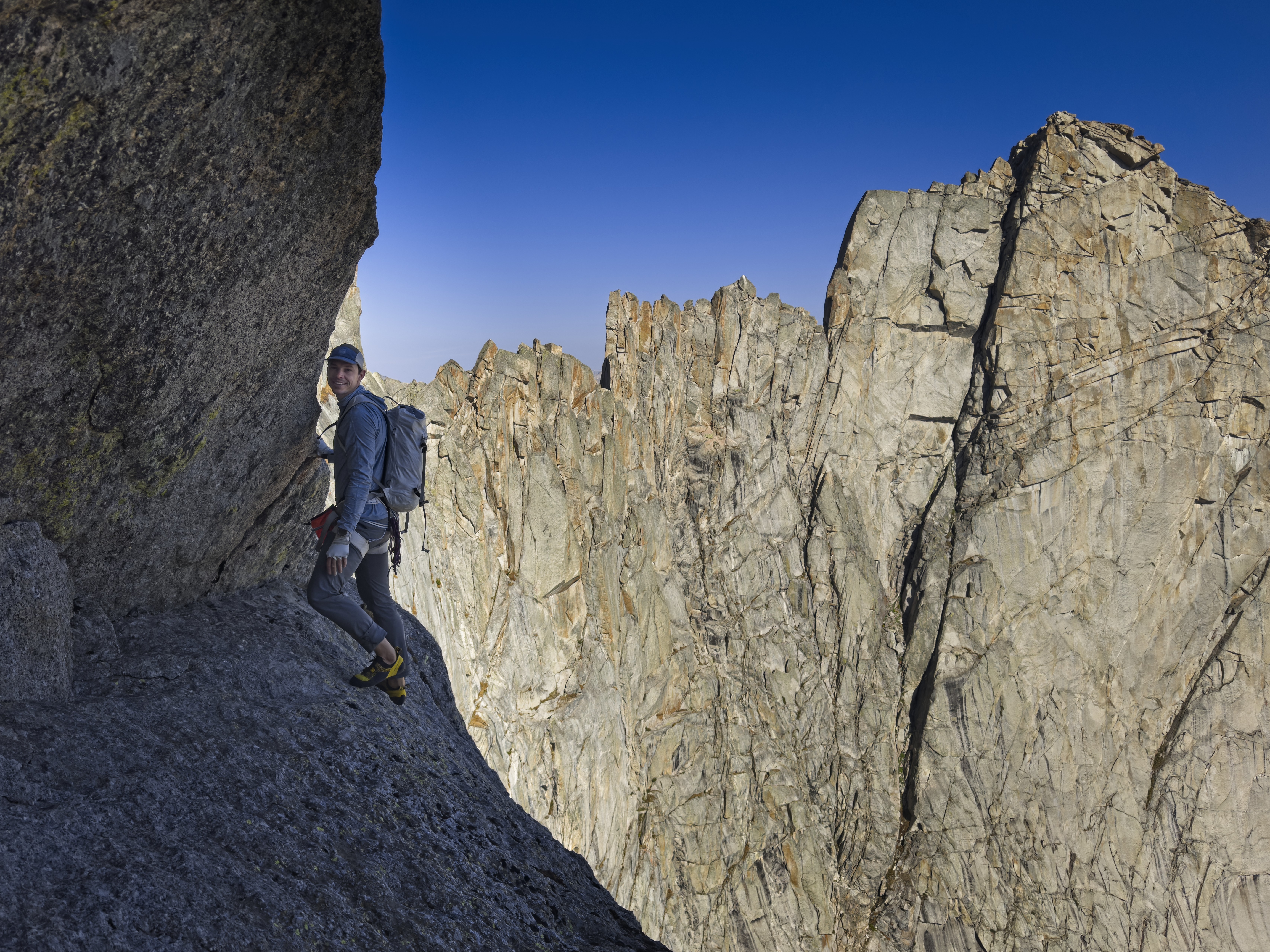
A soloist doing the Cirque Traverse
Steve built a gear belay somewhere near our target notch. He brought me over, then we were able to move that belay a few meters to the west to a better ledge with a fixed sling pinched between boulders. A soloist came through, and hollered down some advice about the chimney above. I should put my back on the east wall.
That was good advice! I scrambled up easy terrain to the chimney, hung my backpack between my legs, and got into it. After entering high, I stayed near the bottom of the chimney, then followed a rib of rock near the end on the north side of the ridge up to a ledge, where I built a gear belay. Steve would like this, haha!
Indeed, he came up, spared the worst of any thrutching and cursing by the grapevine of good advice. Steve sent me off on the "piton pitch," a slippery traverse marked by 3-4 pitons. I was traversing the north side under the Second Tower. Quite nice moves to another broad ledge.
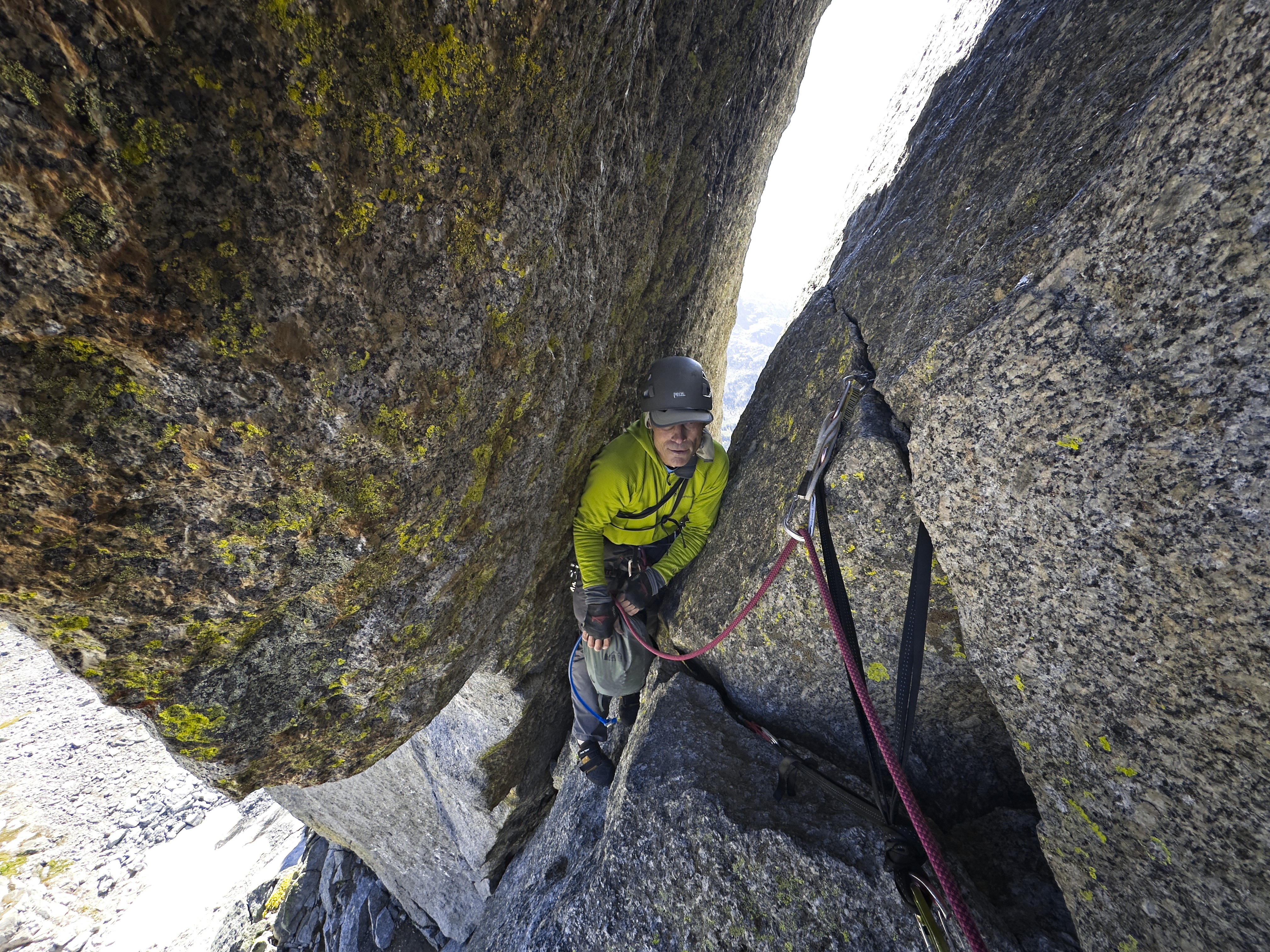
Steve coming through the slot chimney to round Tower One
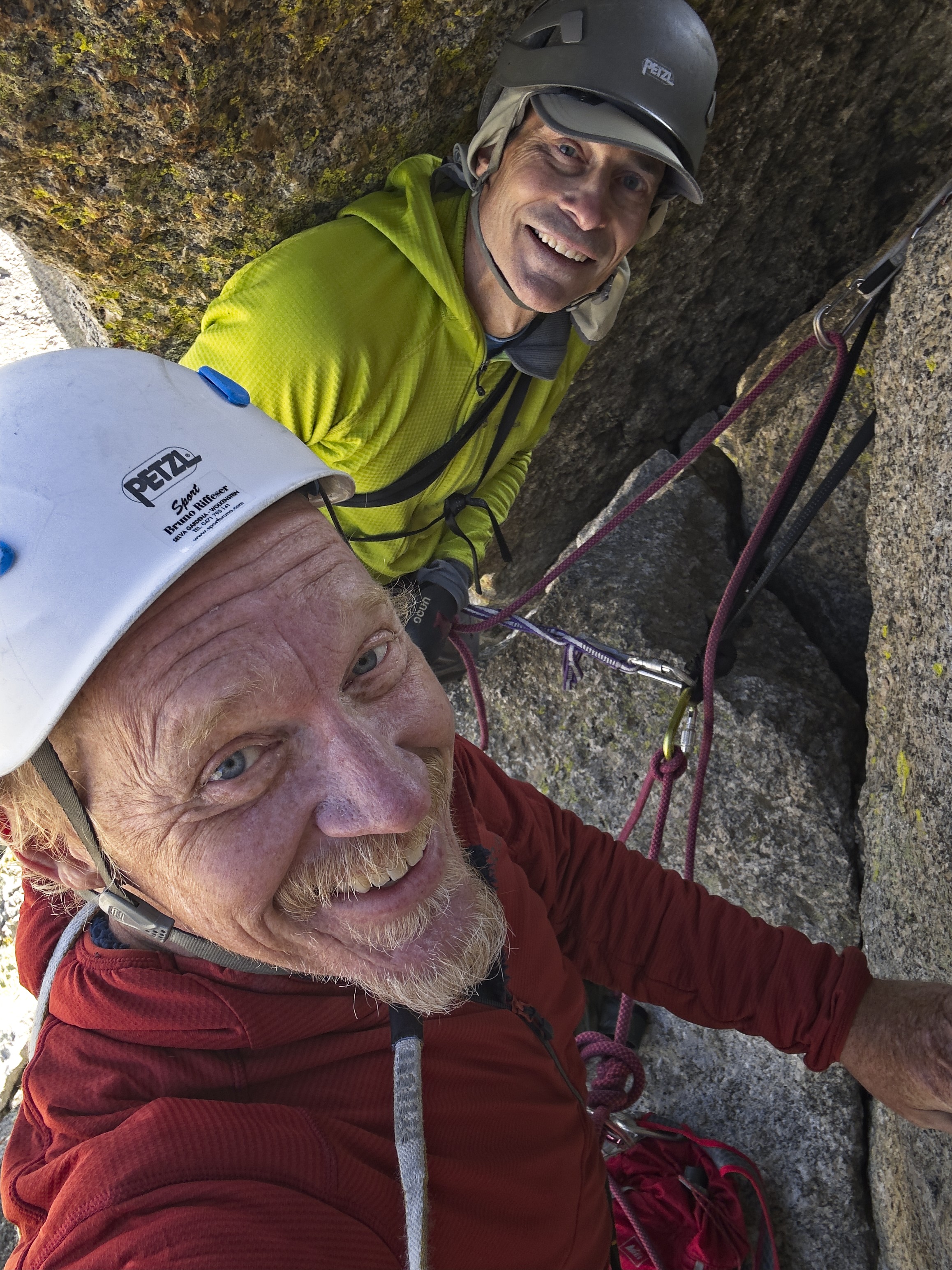
Steve and Michael at the belay after the slot chimney
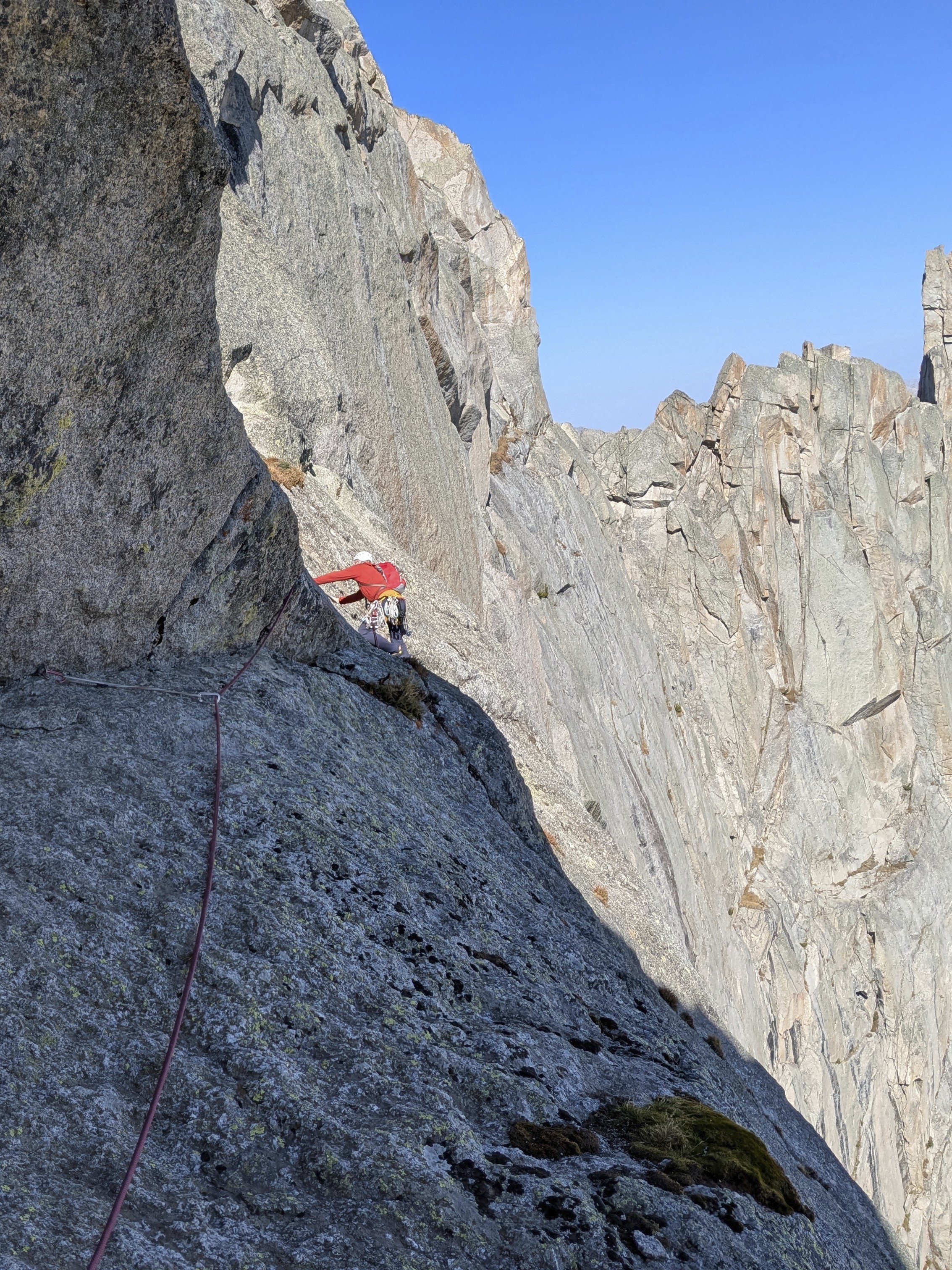
Michael heading out on the "Piton Traverse"
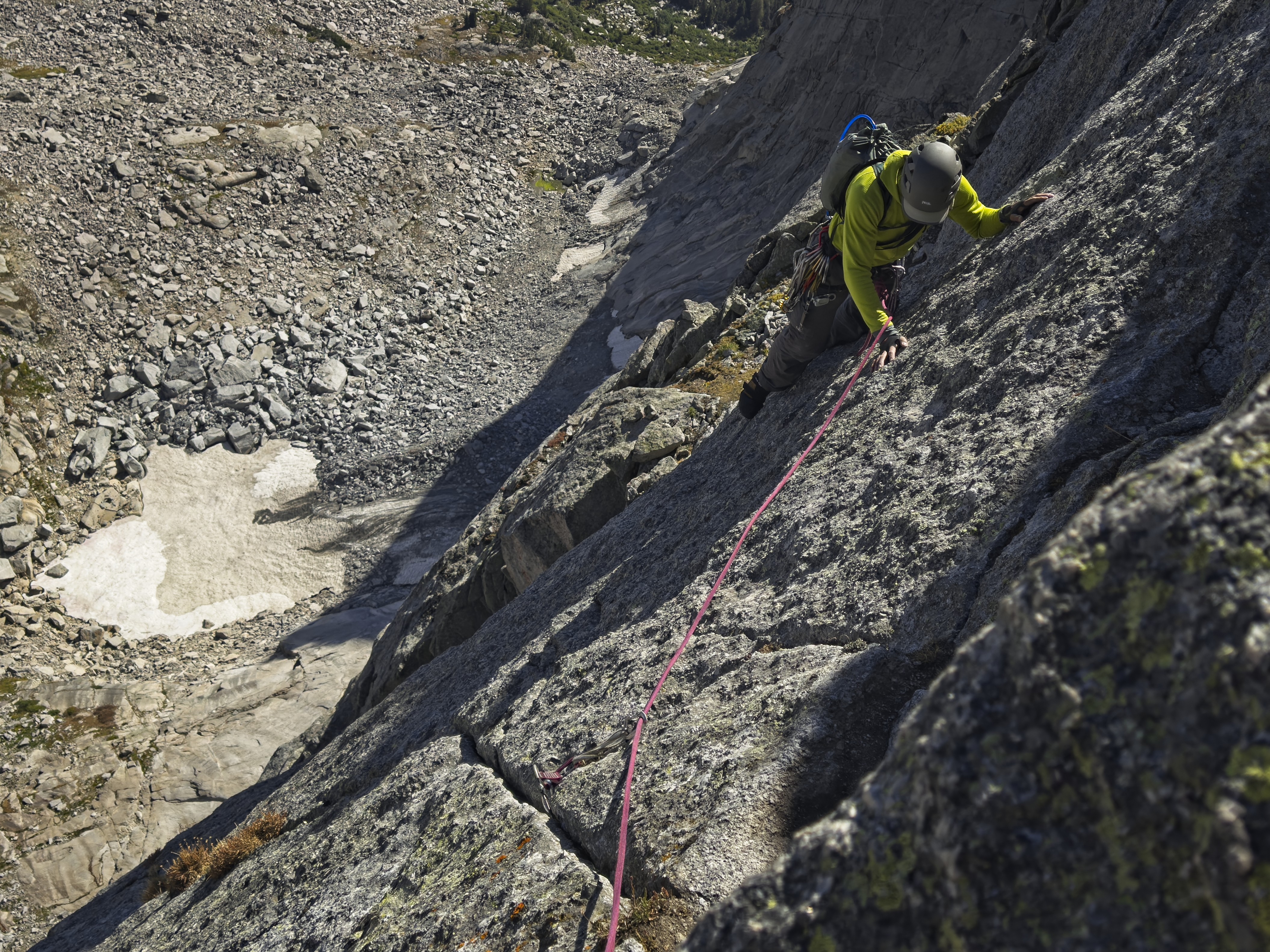
With Steve following that interesting pitch
The next pitch was such fun. Up a lieback crack 10 feet or so to a short finger crack right on the golden crest. Then right to a glorious hand traverse with lots of exposure. I had a great time slotting in cams and clipping the rope directly to them as I crabbed rightward. Eventually I rounded a notch out of sight, then walked a foot-ledge just below the crest on the south side (brave young people can balance on the ridge top or scootch forward au chavel). I brought Steve in from a cozy cavelet belay.
Now for the last technical pitch...Steve sent me out from the cozy cave on a hand traverse in a rather wide crack with a rounded edge. Yikes! Feet were scarce, too. Halfway across this intimidating traverse, I found a breakup which accepted an orange Metolius 4-cam. After another 4-5 meters, I reached a corner with some gear placements and a chance to get my feet up on a good ledge.
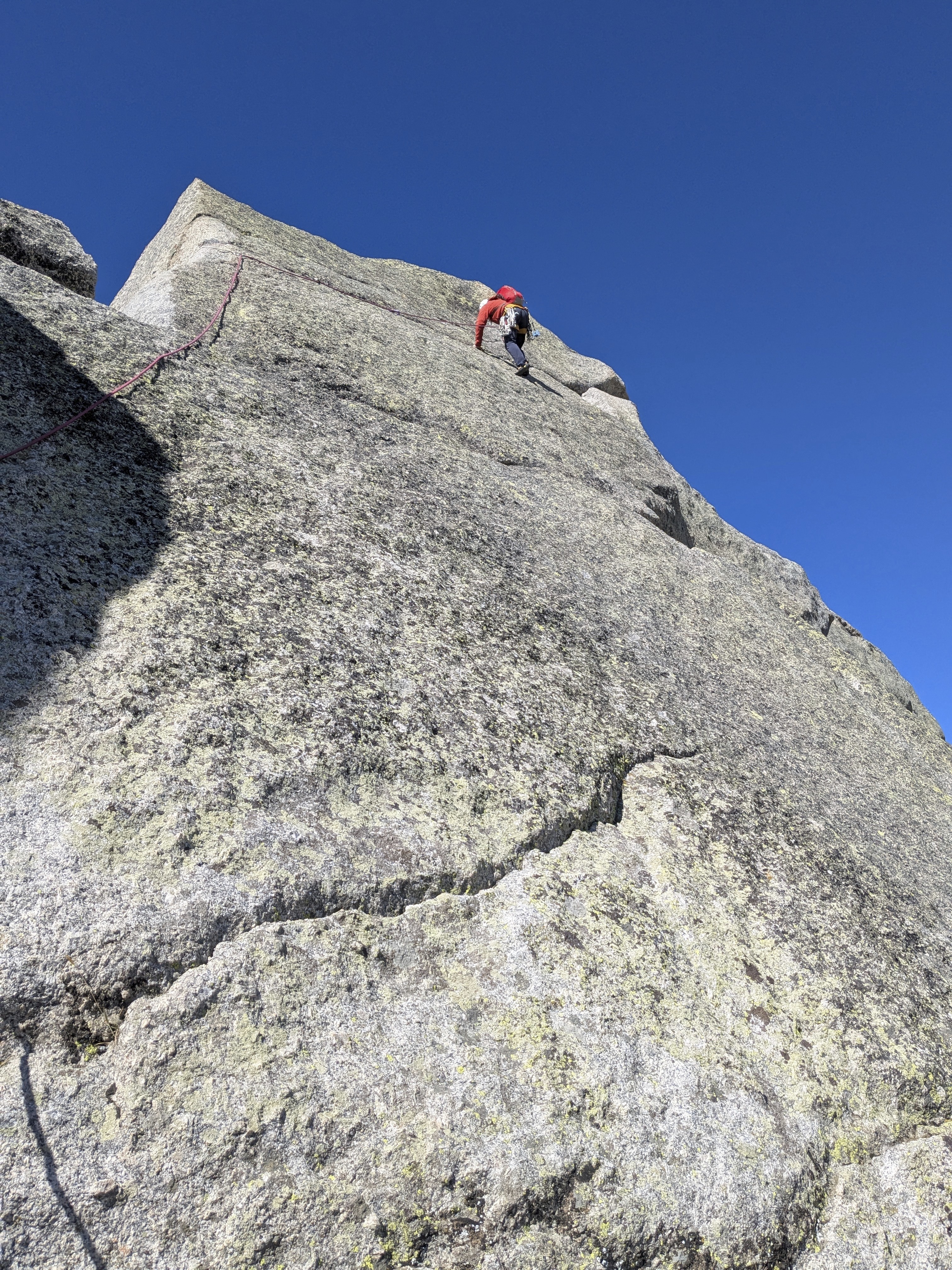
Michael on the fantastic north-side hand traverse
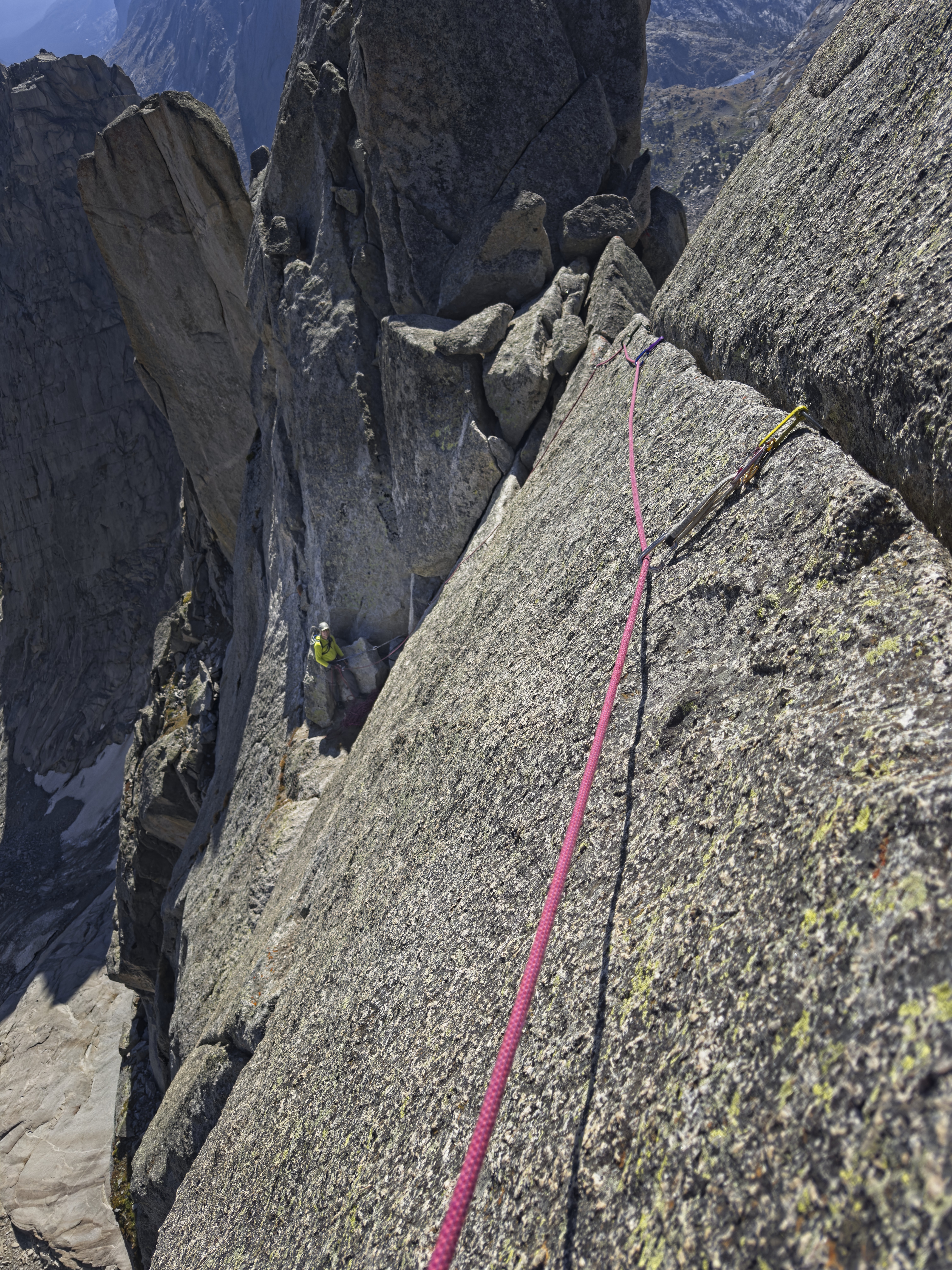
Looking back at Steve belaying that pitch
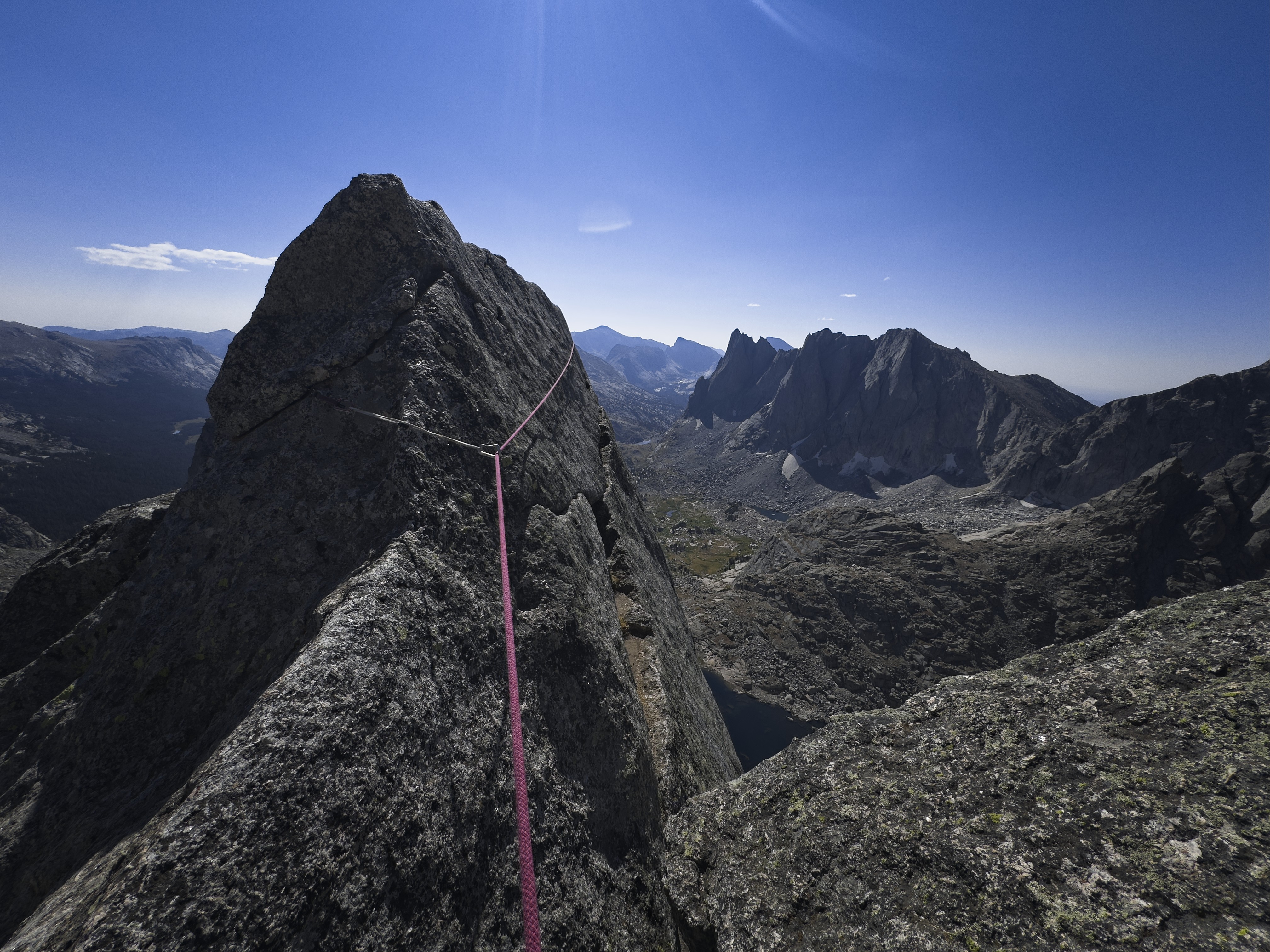
The end of the hand traverse pitch, looking back
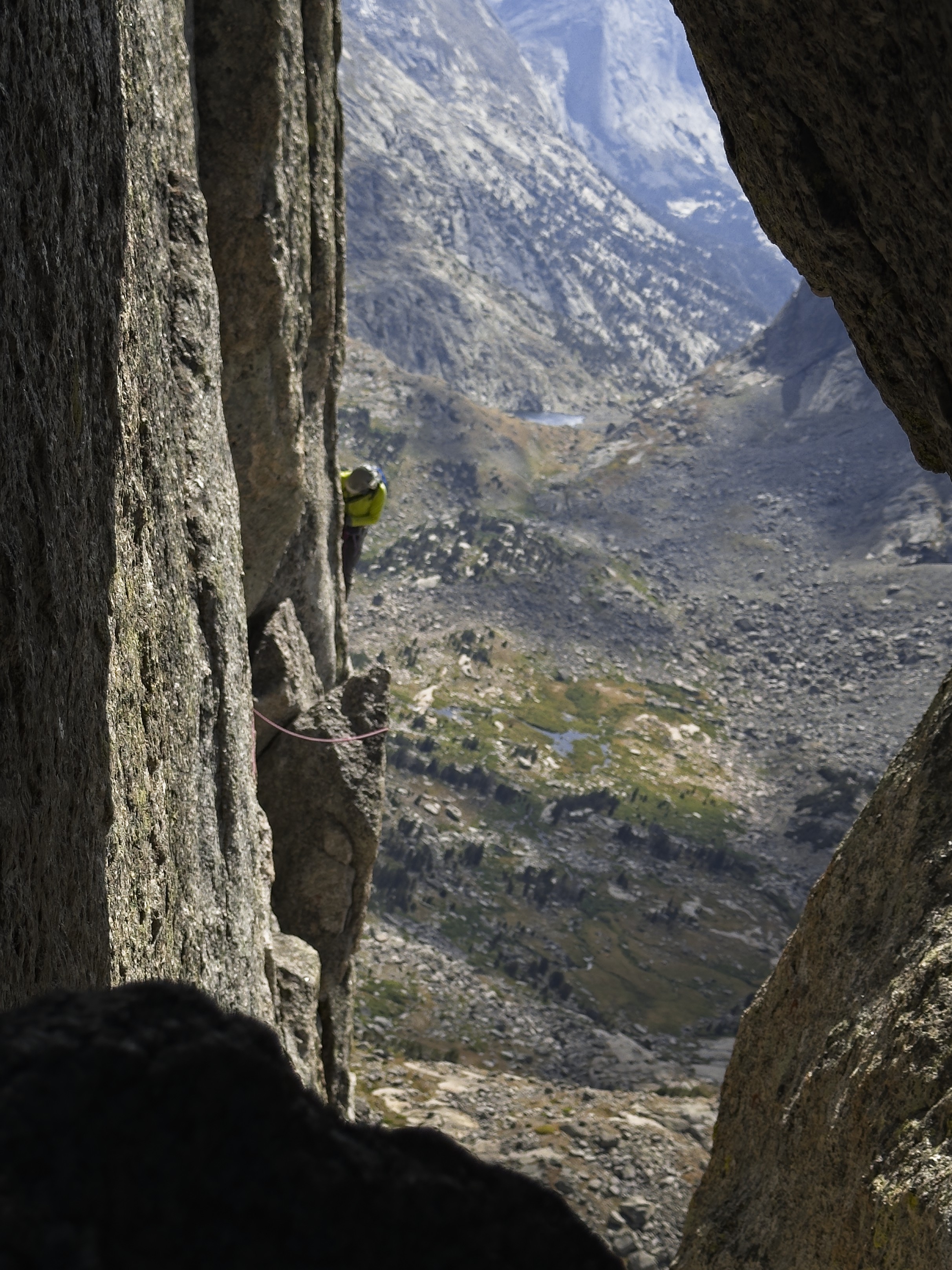
Steve coming around the corner on the south-side hand traverse and chimney
Now I needed to follow another hand traverse leading downward to the base of a chimney. This went easily enough, though the final moves felt slippery. The location felt odd and "out there." I felt better getting some gear in the chimney at a steep bulge, surmounted with some hand and foot jams. Whew! Above this, easy terrain led to the "Birth Canal," which I solved as a breech birth, my pack on a sling behind me. Soon Steve was with me and we marvelled over the interesting pitch.
He took off now, making for the summit. However, it turned out to be easier to belay me across after a 40 meter pitch marked first by relatively easy ledge walking, then a few steep moves up corners and cracks at the end. He took off again, and soon we were making the final moves to the summit separated by about 20 meters of rope. Nice! It was 12:40 pm.
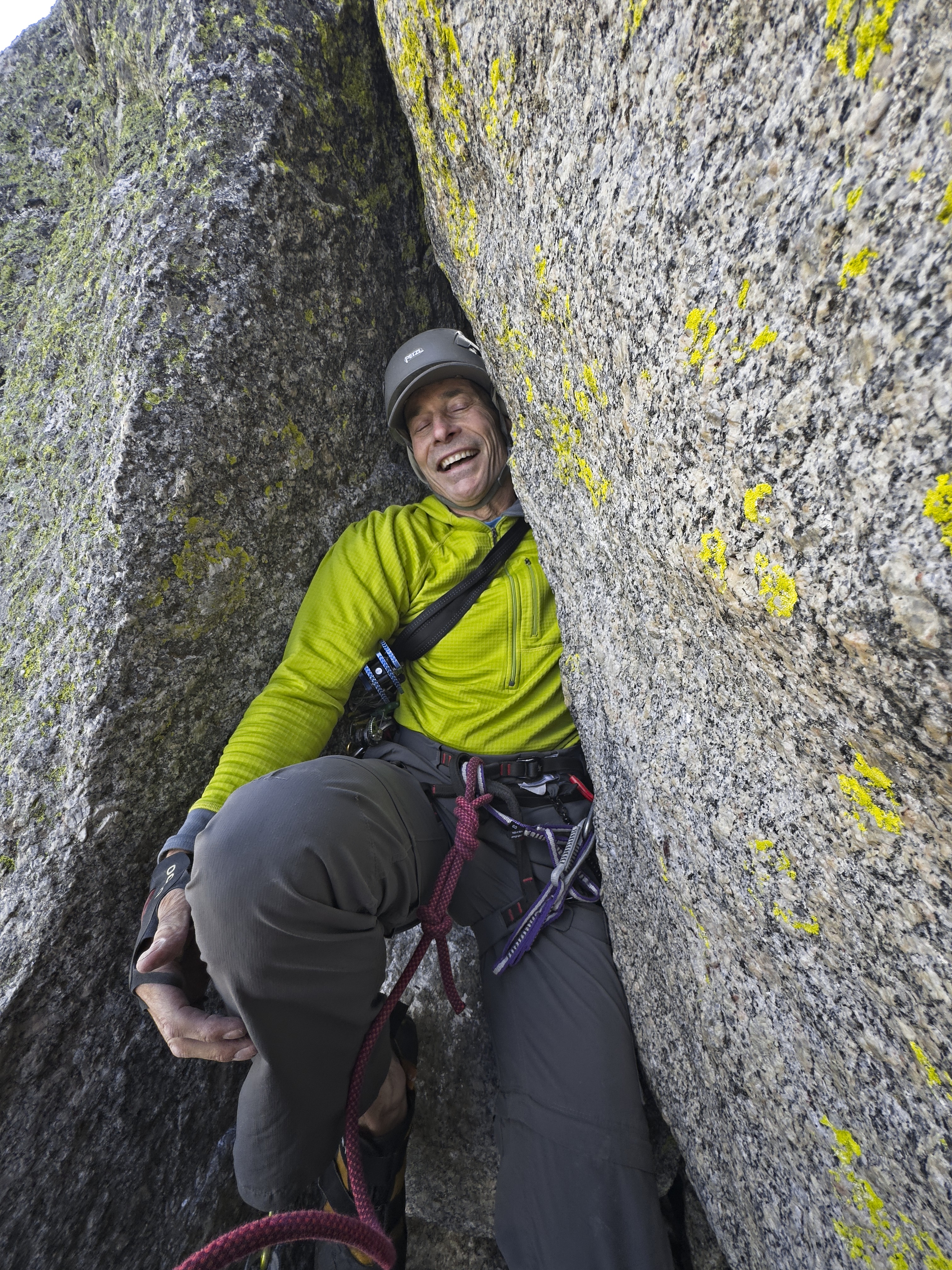
Steve in the birth canal, a breech-birth!
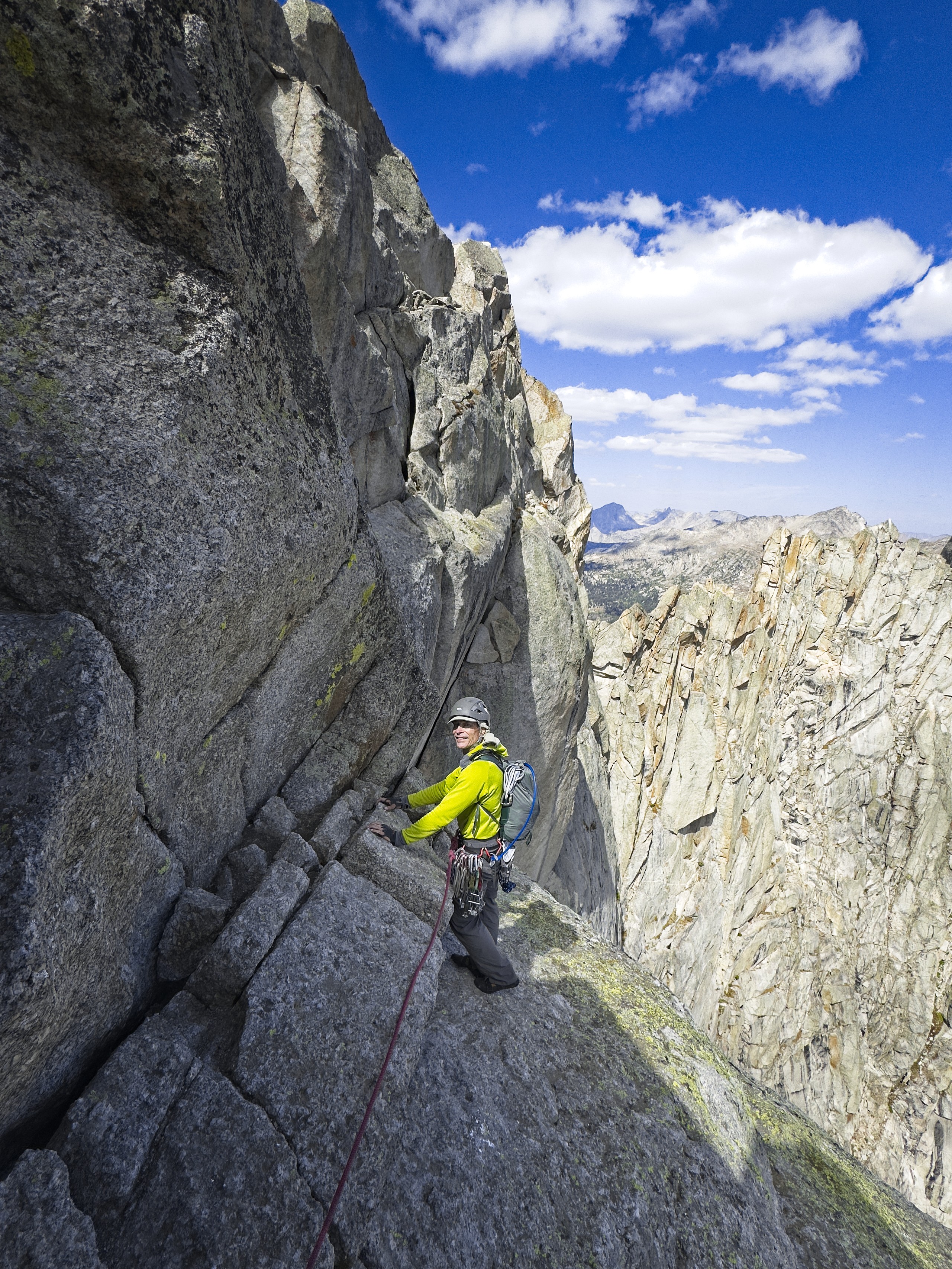
Steve heads out for the summit
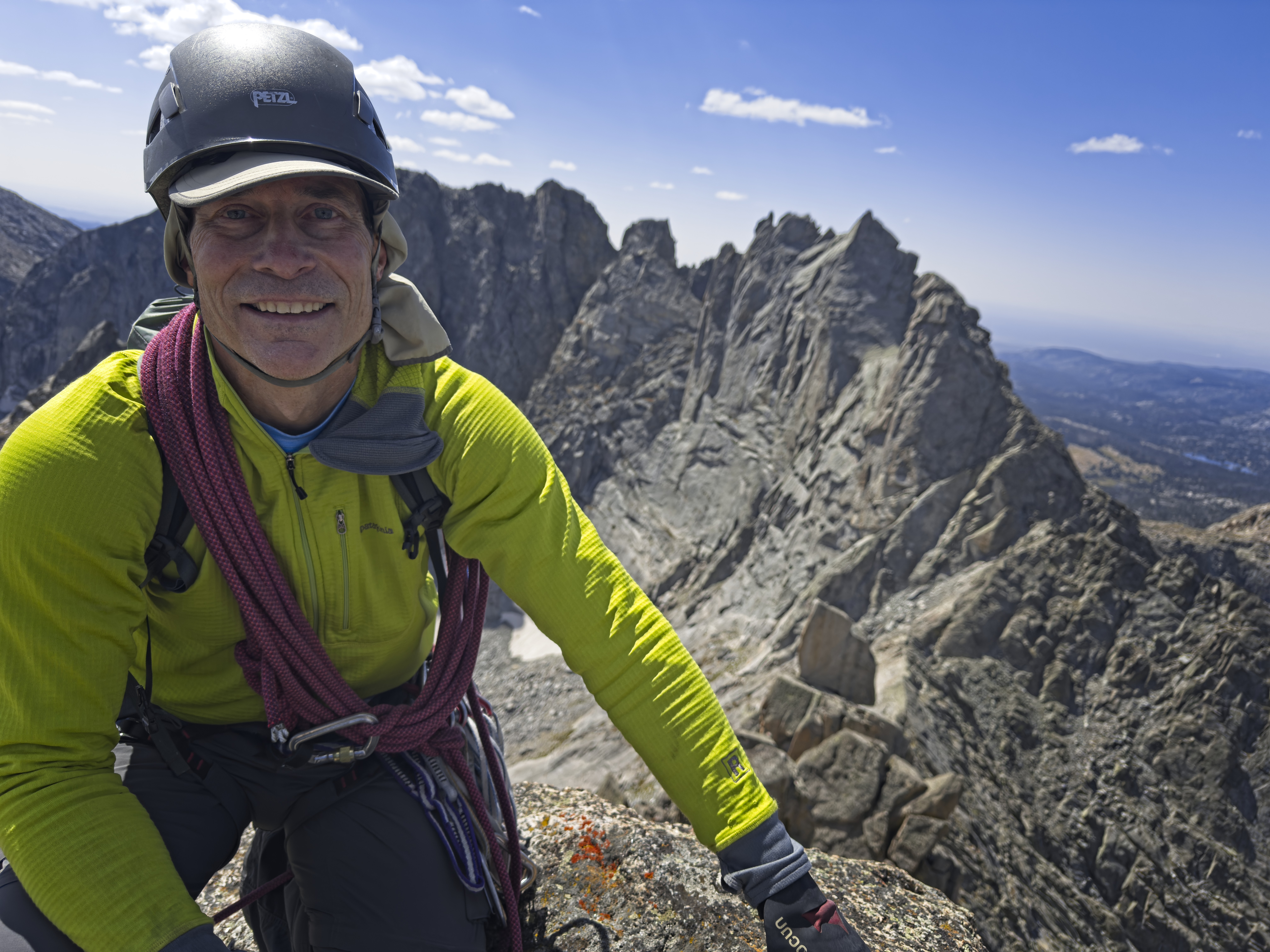
Steve on top
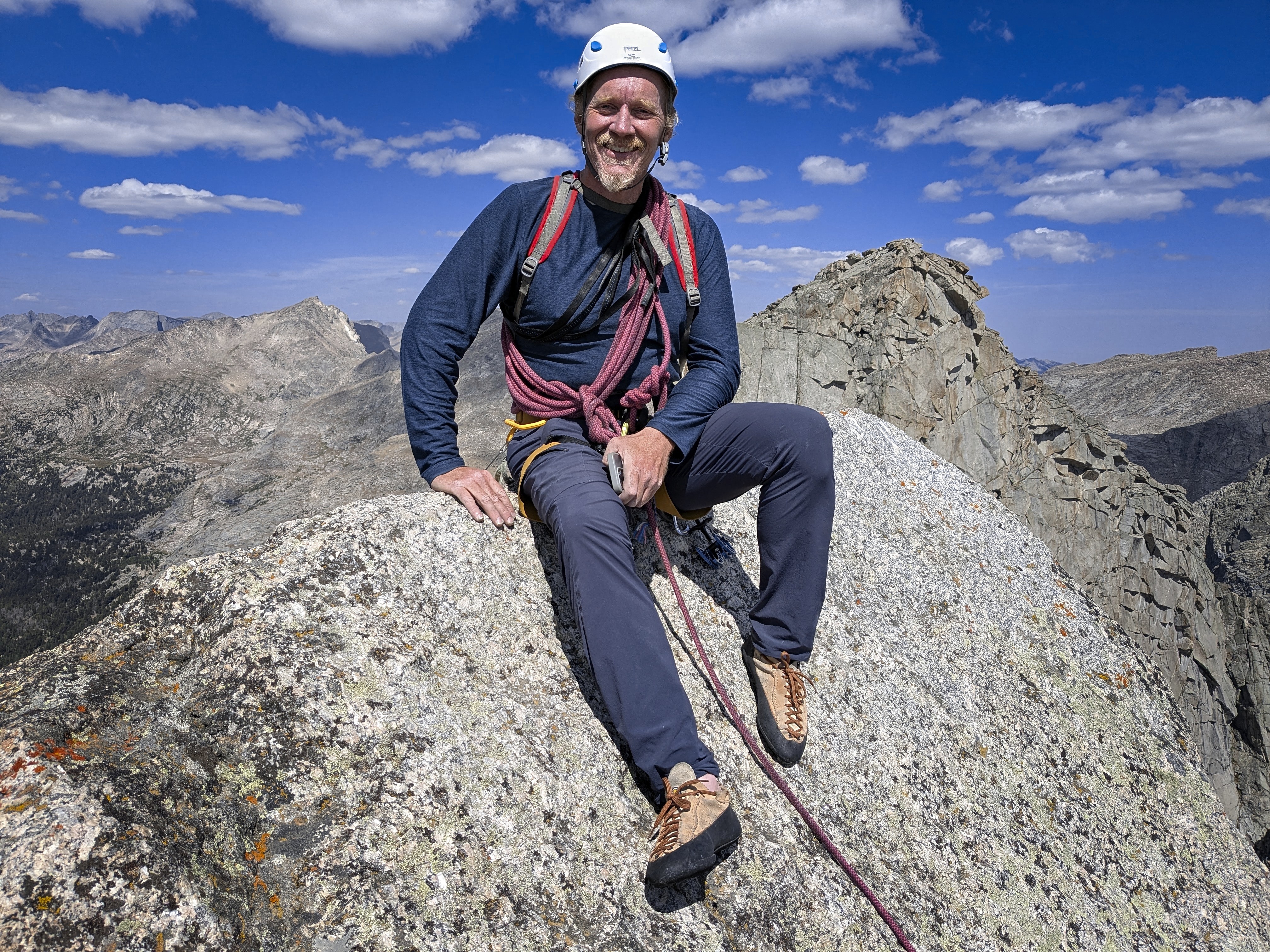
Michael on top
Despite the great views, we were eager to begin the rappels. Perhaps because of the eerie sight I'd seen 2 weeks before, after 10 pm by Shadow Lake, looking up at the mountain and seeing two desperate headlamp beams apparently searching for the rappel stations. I was smoking a cigar after our big day on Shark's Nose and Overhanging Tower. While I watched, they successfully descended 50 meters or more, but then the lower lamp began swinging from one side to the other, apparently looking for an anchor. Shortly after, the lights went out. Presumably, they would wait until dawn to continue their descent.
Steve set off on the first abseil, then the second. To find the third station, we coiled the rope and walked down a little trail. For the fourth rappel, there was a similar short scramble to find the anchor. On that rappel, we could see trails and ledges leading off east towards the notch between Wolf's Head and Overhanging Tower.
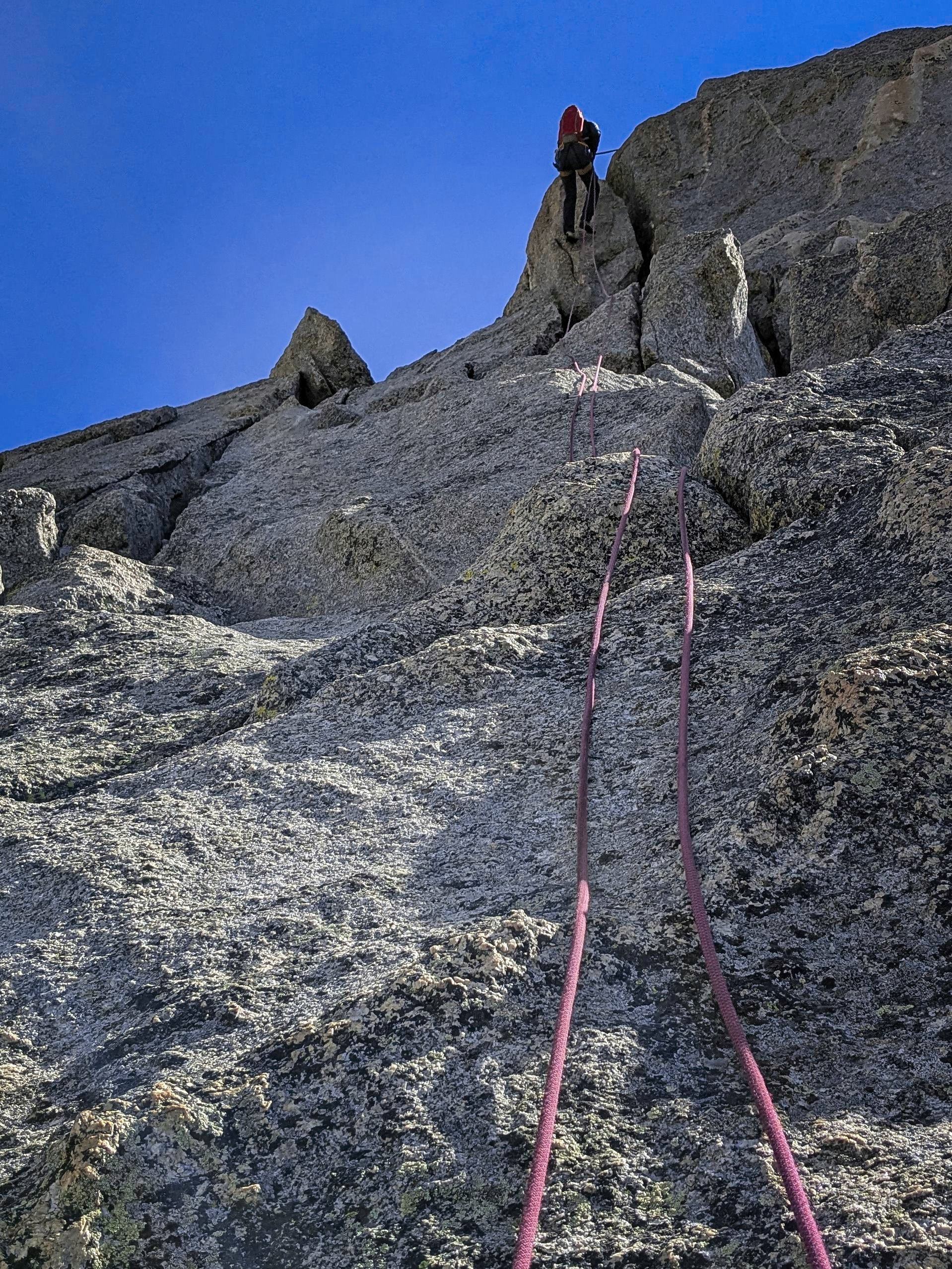
Michael rappelling
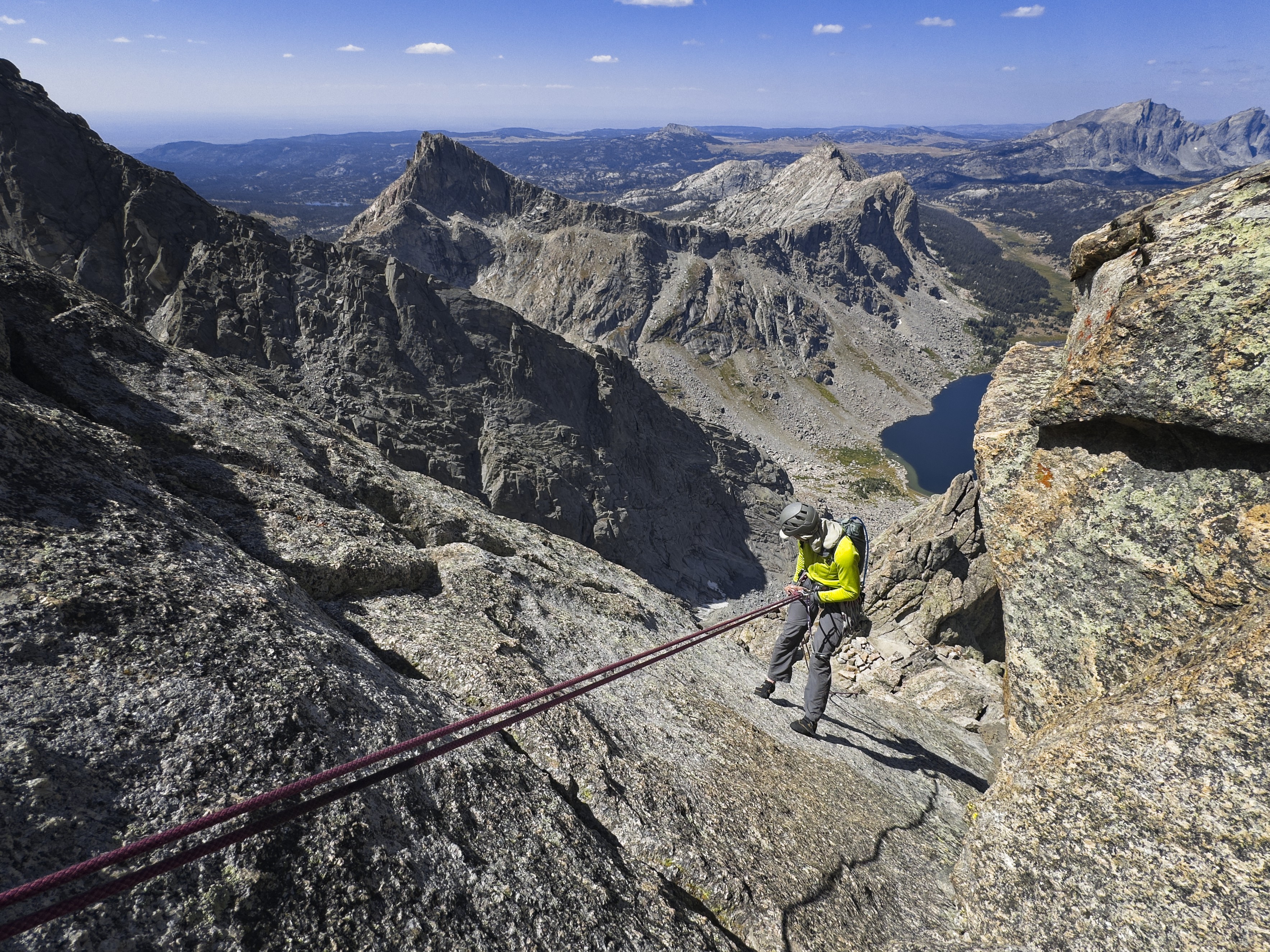
Steve rappelling...
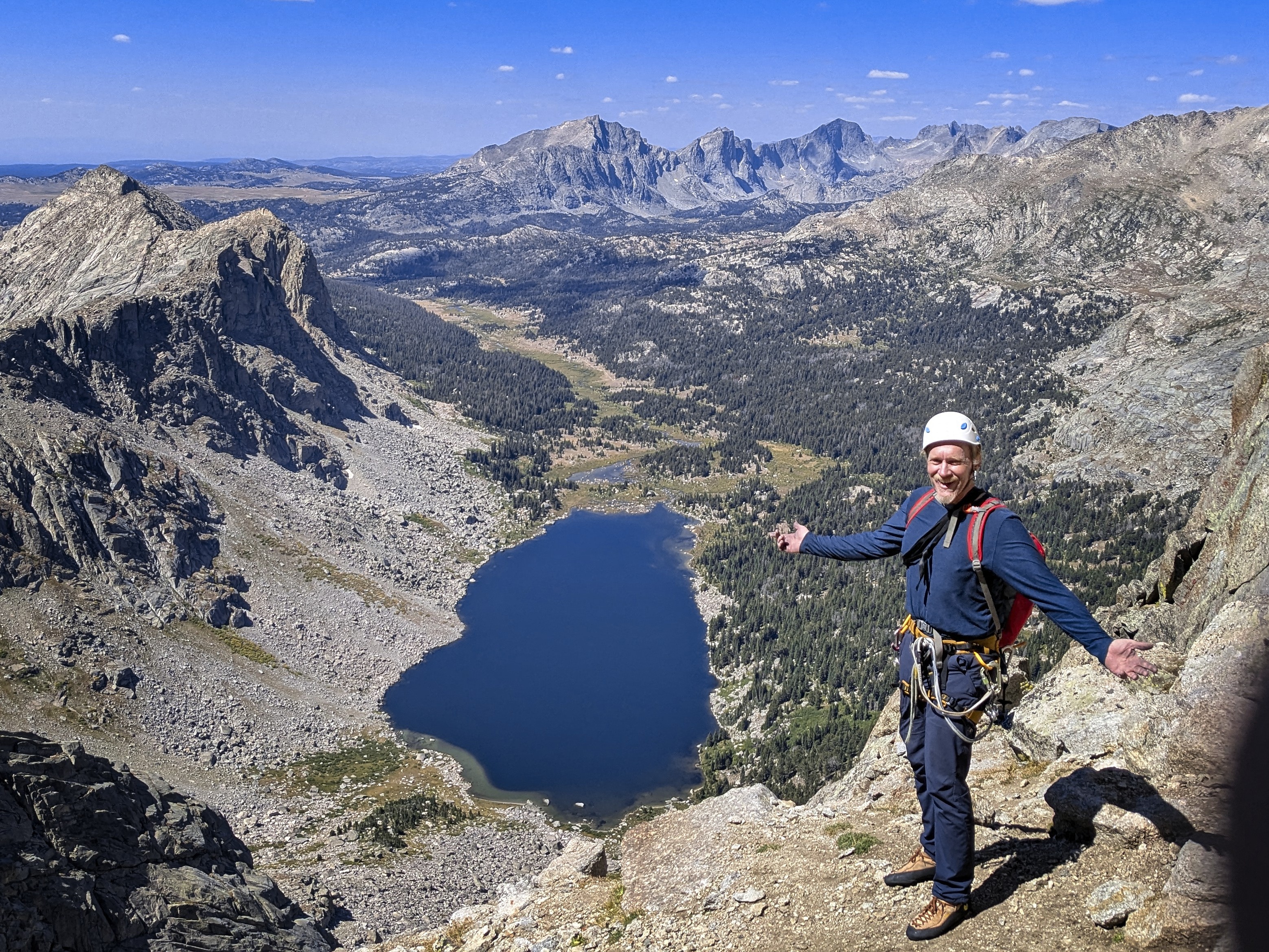
Michael with Shadow Lake behind
We walked those ledges for a few minutes, then reached the station for the fifth rappel, somewhat hidden around a corner. Straight down that, then we followed faint trails and natural lines off east again. Here, we ended up at a discontinuity after 10-15 minutes of scrambling. A cairn and a sling with a rappel ring indicated a short but steep rappel, then a continued scramble off east (or so I surmised).
We made the (overhanging) rappel, less than 20 meters. Then sure enough, cairns and faint trail led further east with a bit of up and down. Soon we were deposited in the gully and could follow a steep path up to the pass. Great! We knew there was another way on this last section that stayed a bit higher. Either way though, it seems that six rappels are standard.
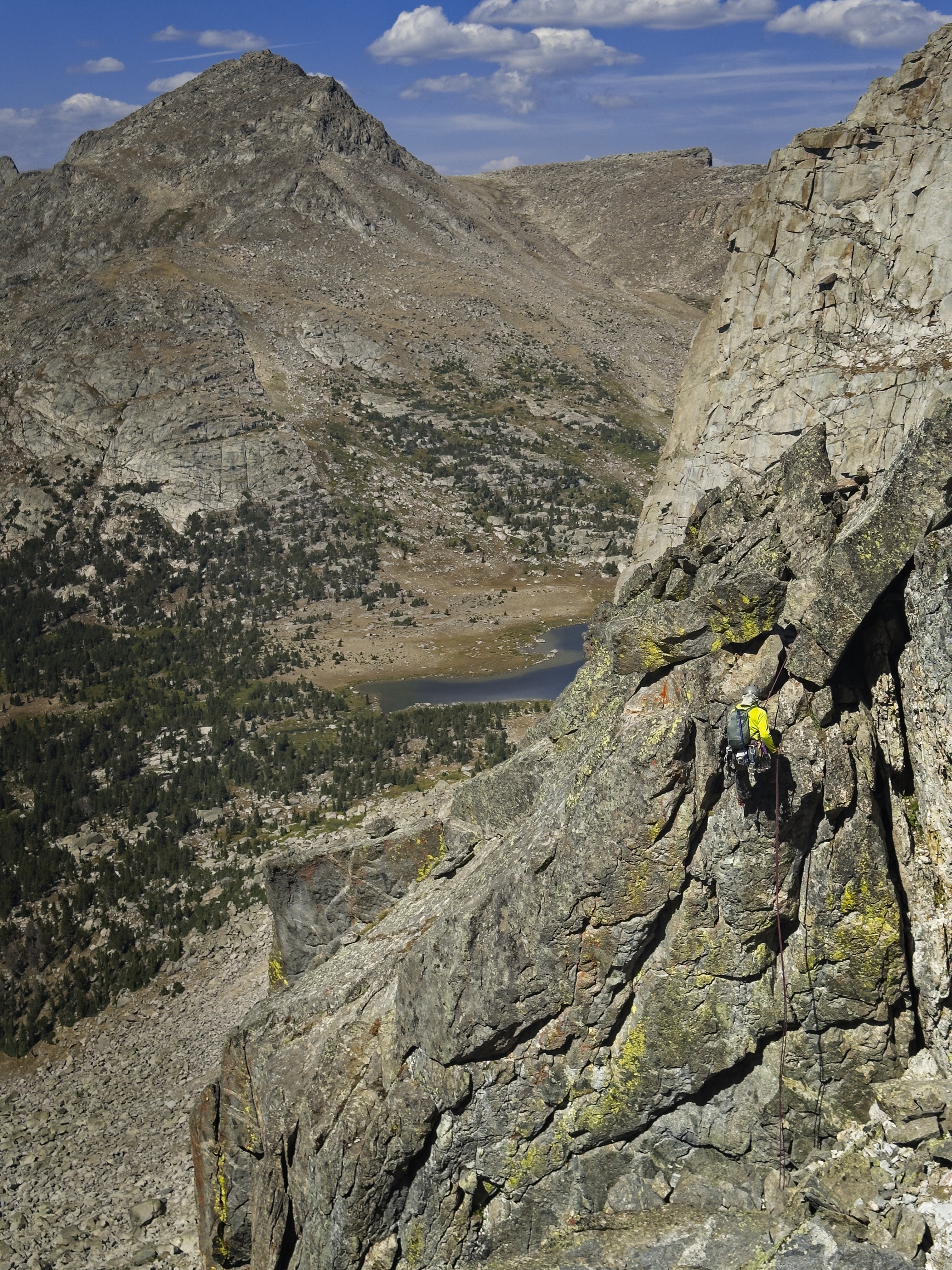
Steve on the last short but steep rappel before the notch between
Wolf's Head and Overhanging Tower
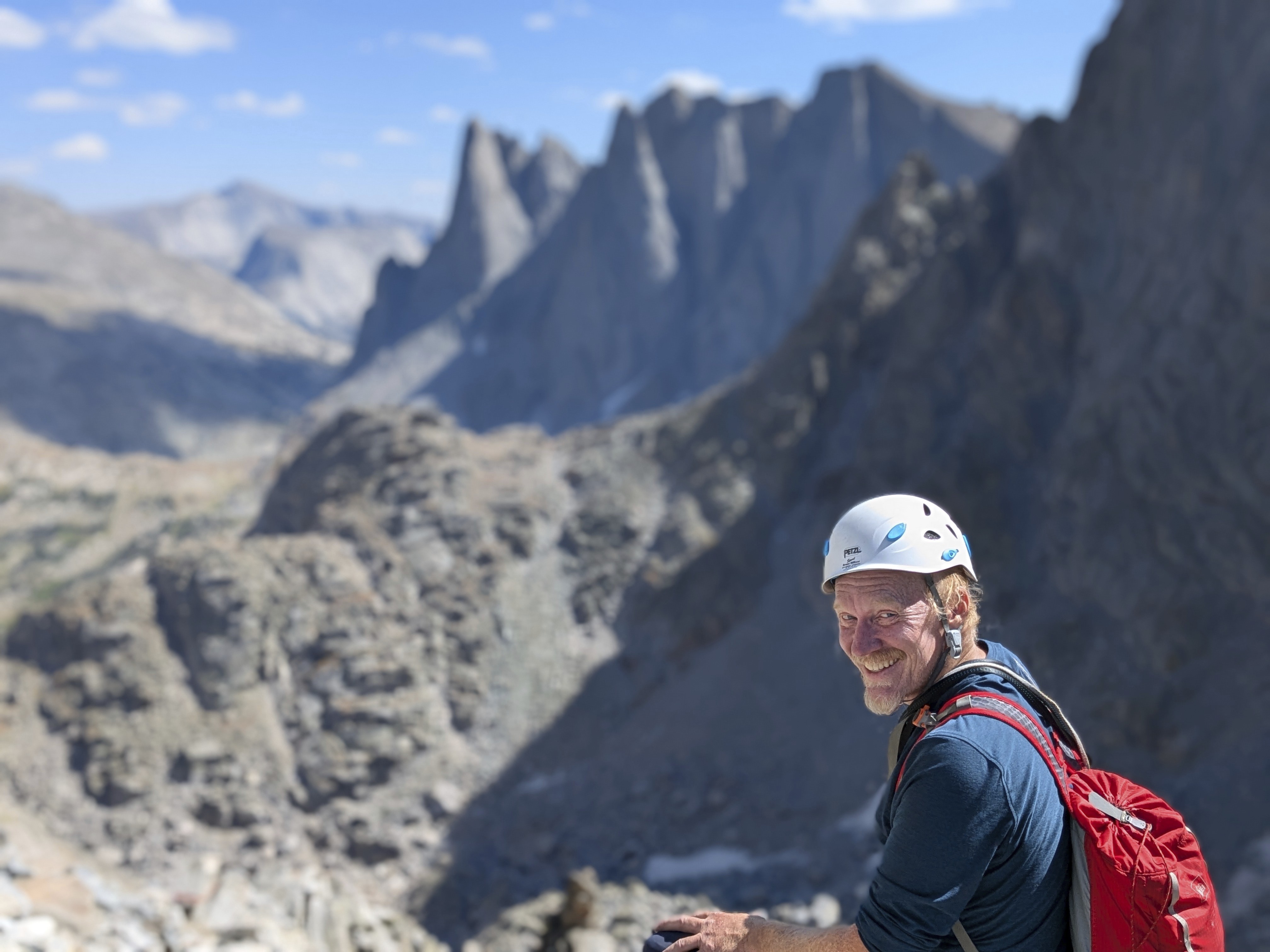
Michael resting at the notch
Descending towards Cirque Lake, we found a nice rappel opportunity that followed a hidden golden slab on skiers left of the gully. This was a great help. The descending that followed was only minimally tedious. Soon we were boulder hopping to grassy slopes above and along the lake. By my photos, I see we were on fairly harmless terrain above the lake at 3:20 PM.
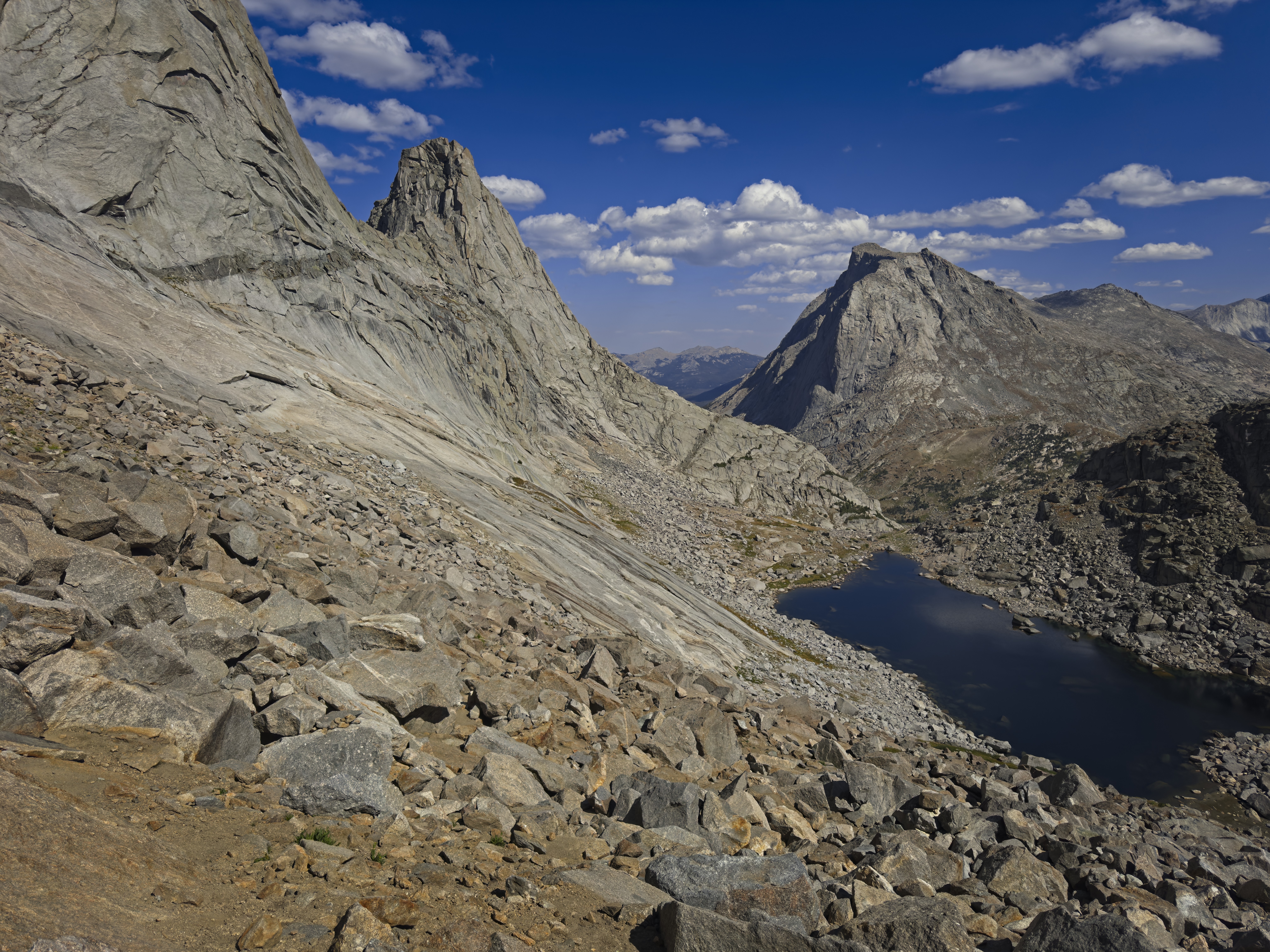
Making our way back to camp...
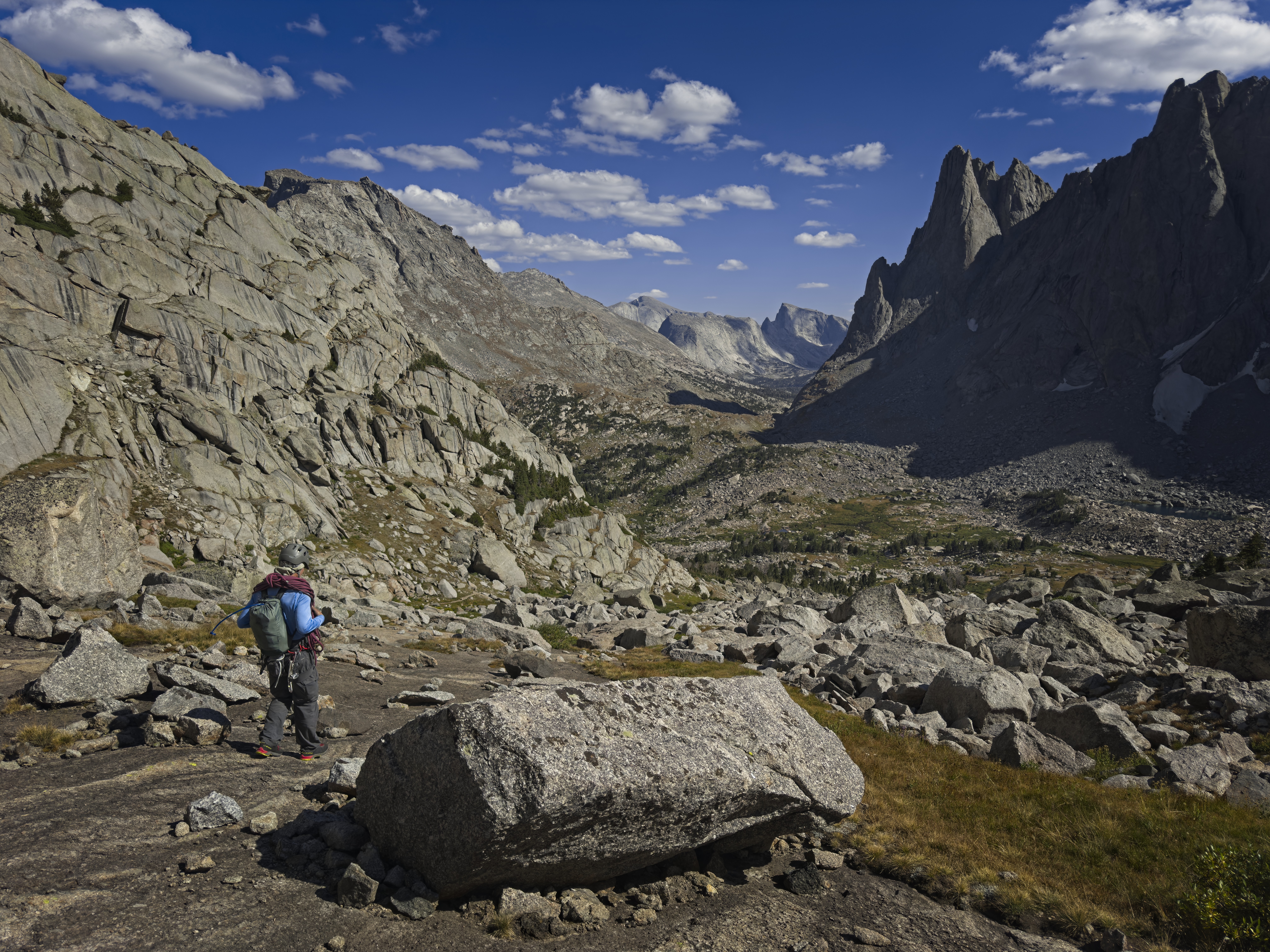
Steve continuing down...
We spent the evening resting, reading and exploring the basin a little bit.
Pingora Climb
I really have to thank Steve for assenting to the climb of Pingora. He was just worn out, and didn't get good sleep. If I was as tired as I think he was, I would have slept in, and planned to hike out a day early. But he called out that it was time to wake up and gear up, so I began the necessary actions. Change out of sleeping clothes, put water in the oatmeal, get the rack in the little daypack, stow harness, rock shoes and helmet, etc.
Soon we stood at the trail junction where the approach to the SW Buttress route (aka "K-Cracks") on Pingora starts. We couldn't imagine how a 3rd class trail could get us to the base of that route, however, it really does! We enjoyed scrambling from ledge to ledge, with the occasional switchback in a hidden forest-ledge. Finally, an exposed step-around to a slabby face lets you know you are pretty high up. After a few moves more, you are on a broad and low-angle ridgetop, and can mosey up to the start of the climbing.
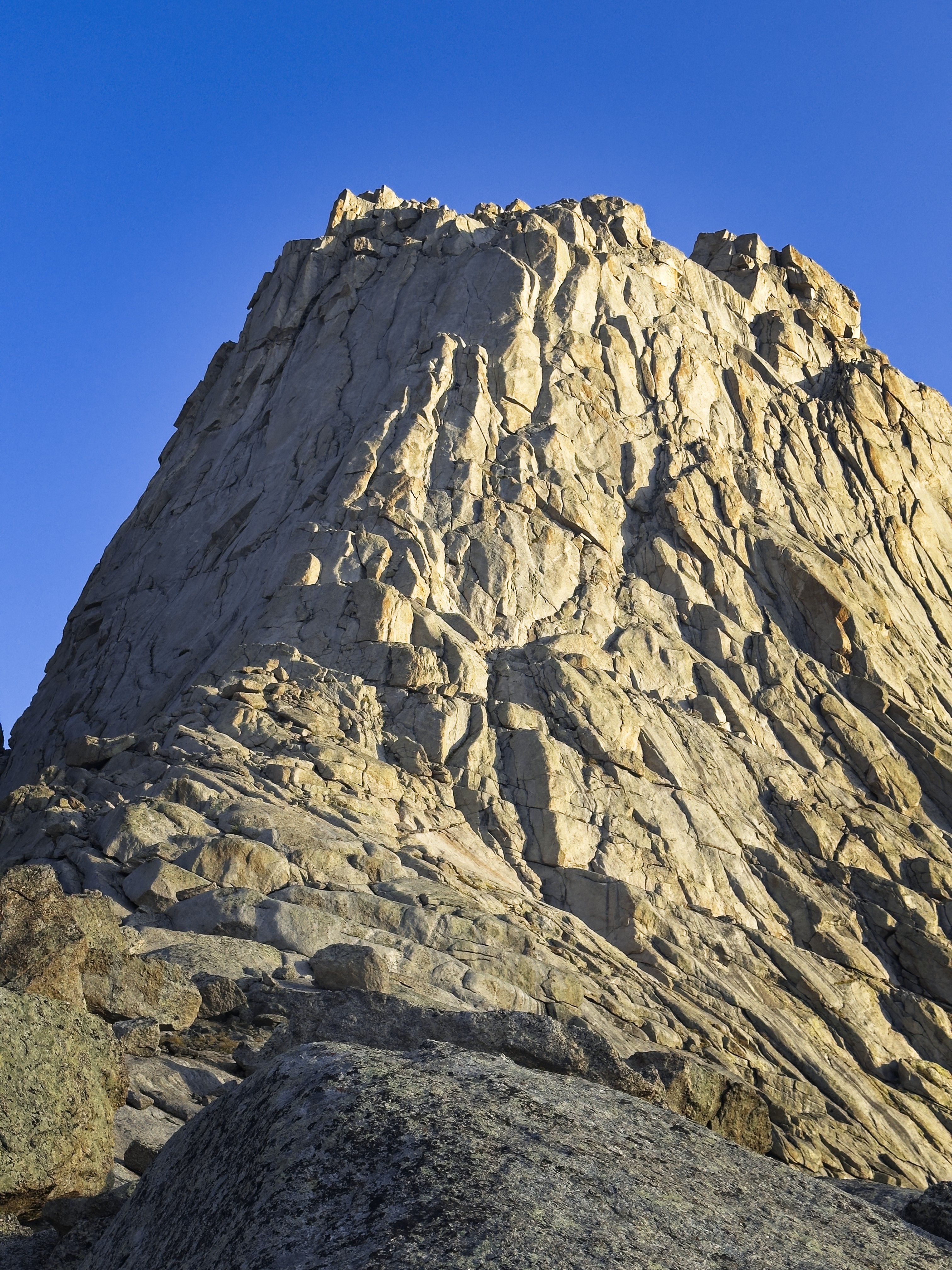
Our route on Pingora. Note the climber in the dihedral below the K-Cracks
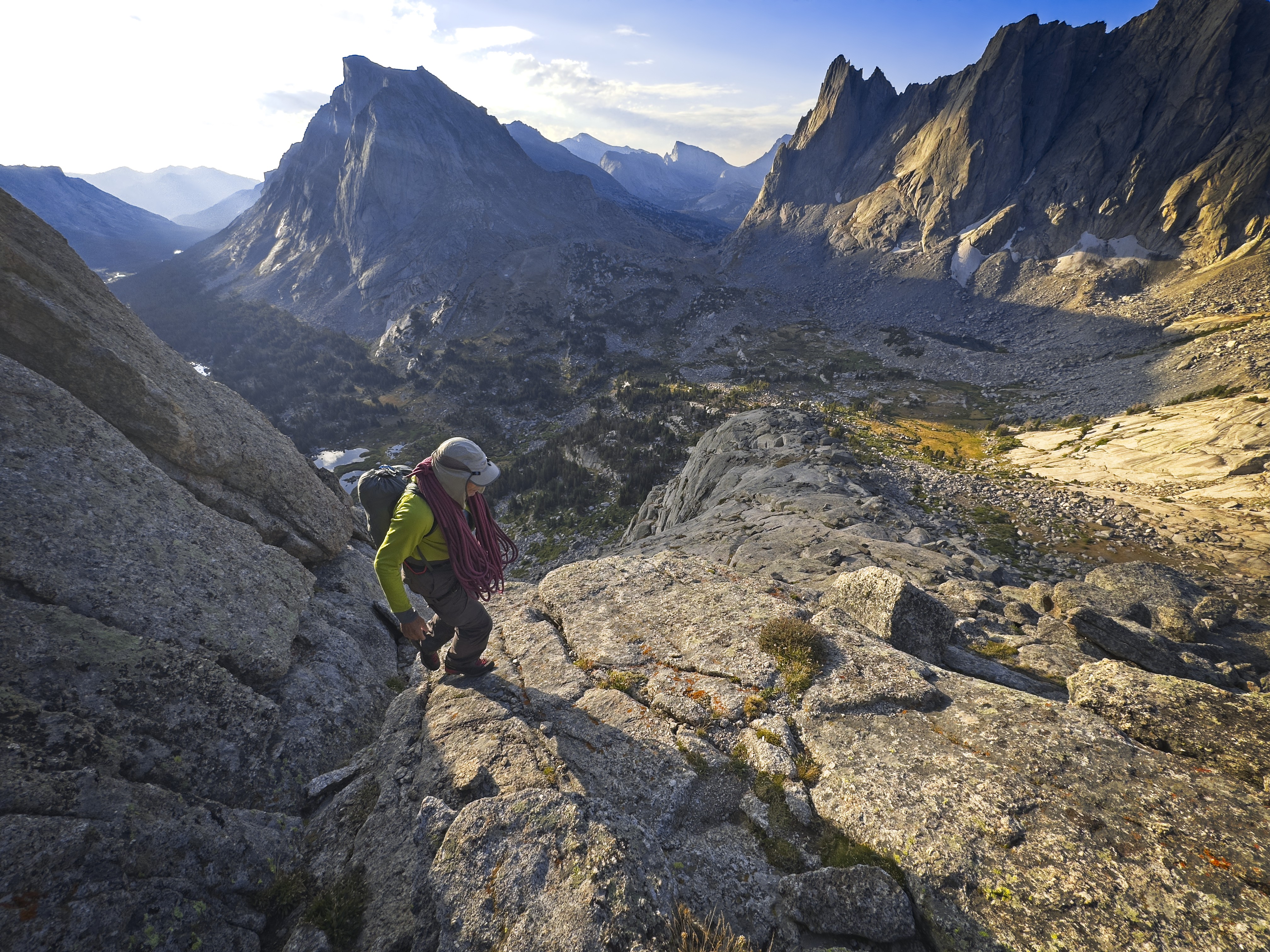
Steve approaches the first pitch on a beautiful morning
We went up to the first pitch, a rather disconnected 5.6 crack, above which we'd traverse to the right about 20 feet to stand at the base of a long dihedral. I found this first pitch harder than expected, and rather cold! But it was mercifully short. Now in the sun below the dihedral, we had to choose the right line. Hmm!
I chose the left side, for the nice hand-crack leading up. This was very fun. However, higher, it was clear that I was getting off the main line. I made an exposed bouldering mantel move to regain the main dihedral and continued for another 15 meters of great climbing. Here was a ledge on the left side that seemed appropriate for a belay. I brought Steve up and he sent me off again. The crux of the day followed: a steep finger-crack on the right side of the dihedral for a few moves to reach a ledge in the center.
Wow, very fun. This felt more like what I dimly remembered the Sierras to be. Stemming, hand and foot jams, edges, pockets, slabby foot moves below liebacks...just a continual stream of granitic conversation, a call and response that totally absorbed my attention. Too soon, the difficulties ended, and I followed slabby terrain to the crest of the buttress just below the upper headwall.
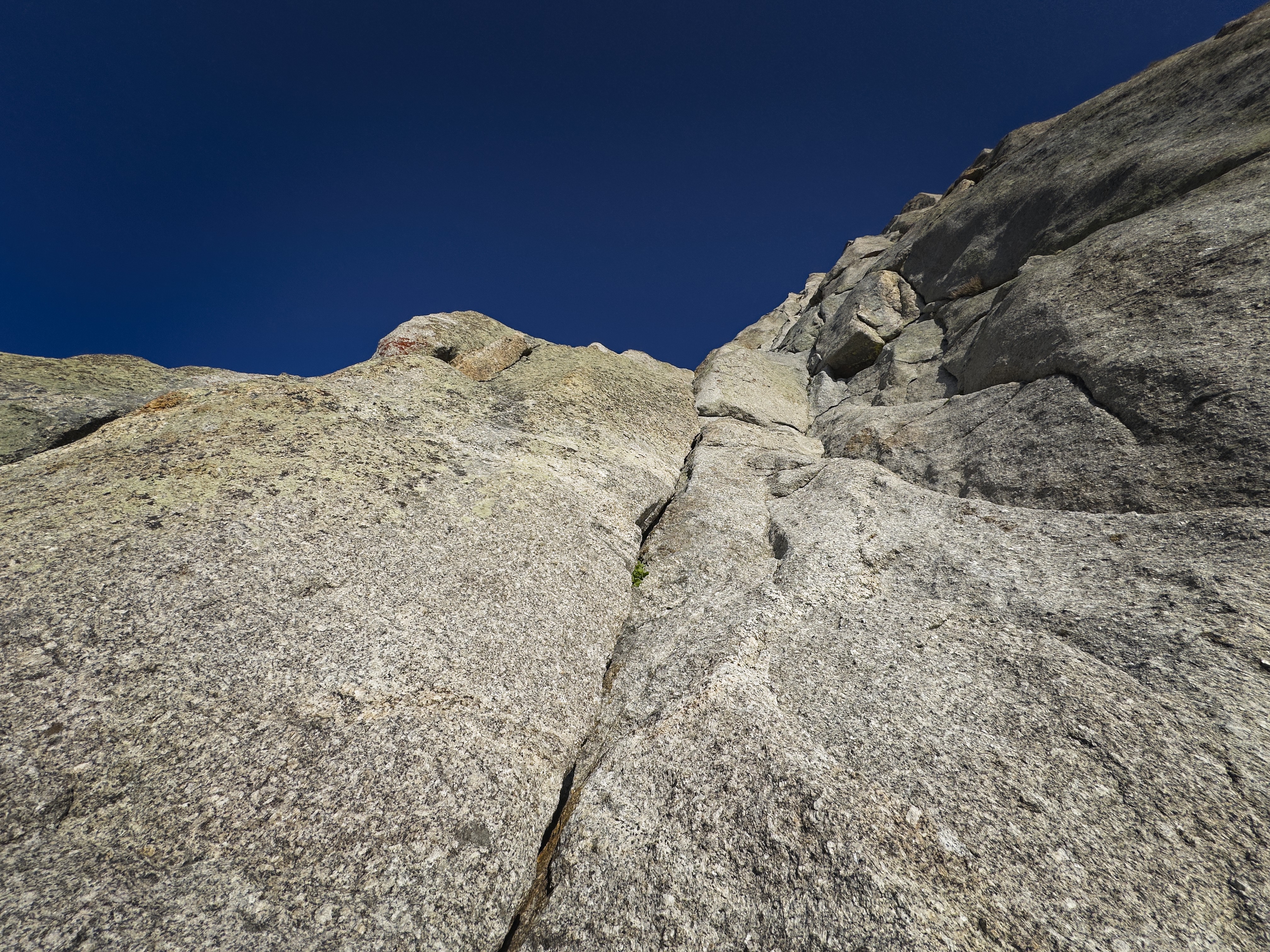
Looking up the dihedral, start of pitch 2 for us
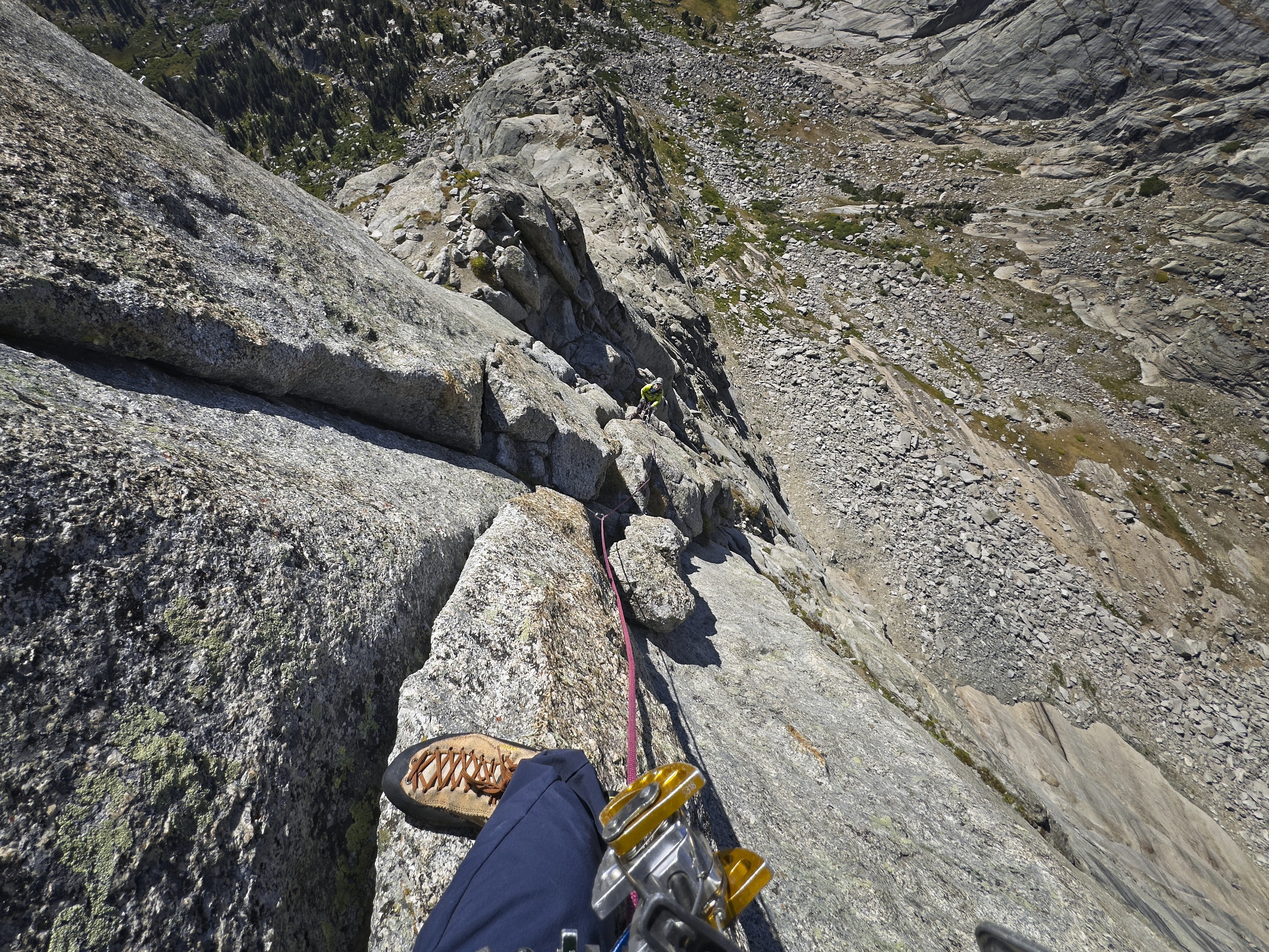
Looking down on the final pitch, we chose the variation left of the K-Cracks (5.6)
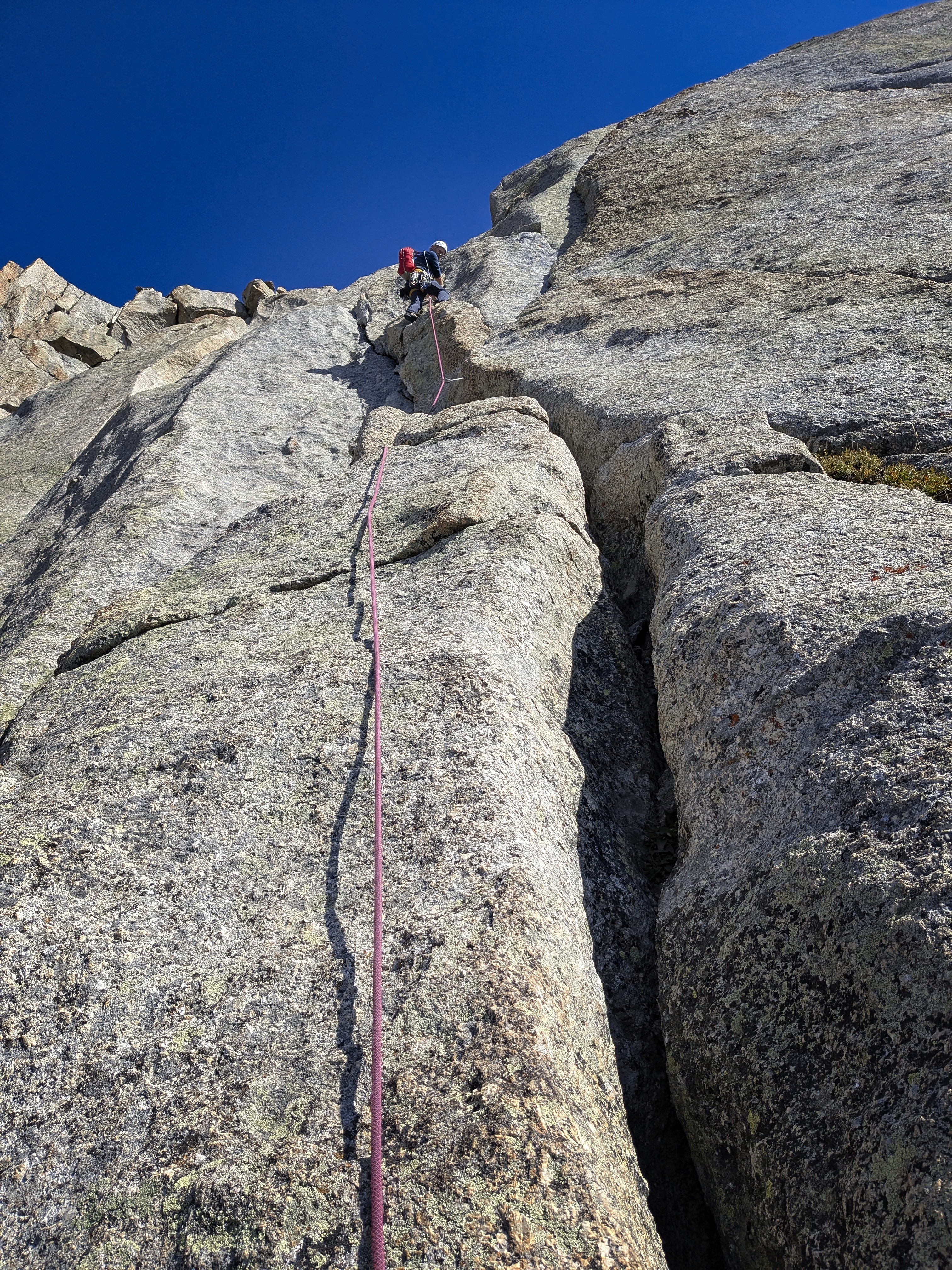
Looking up from the pitch 4 belay
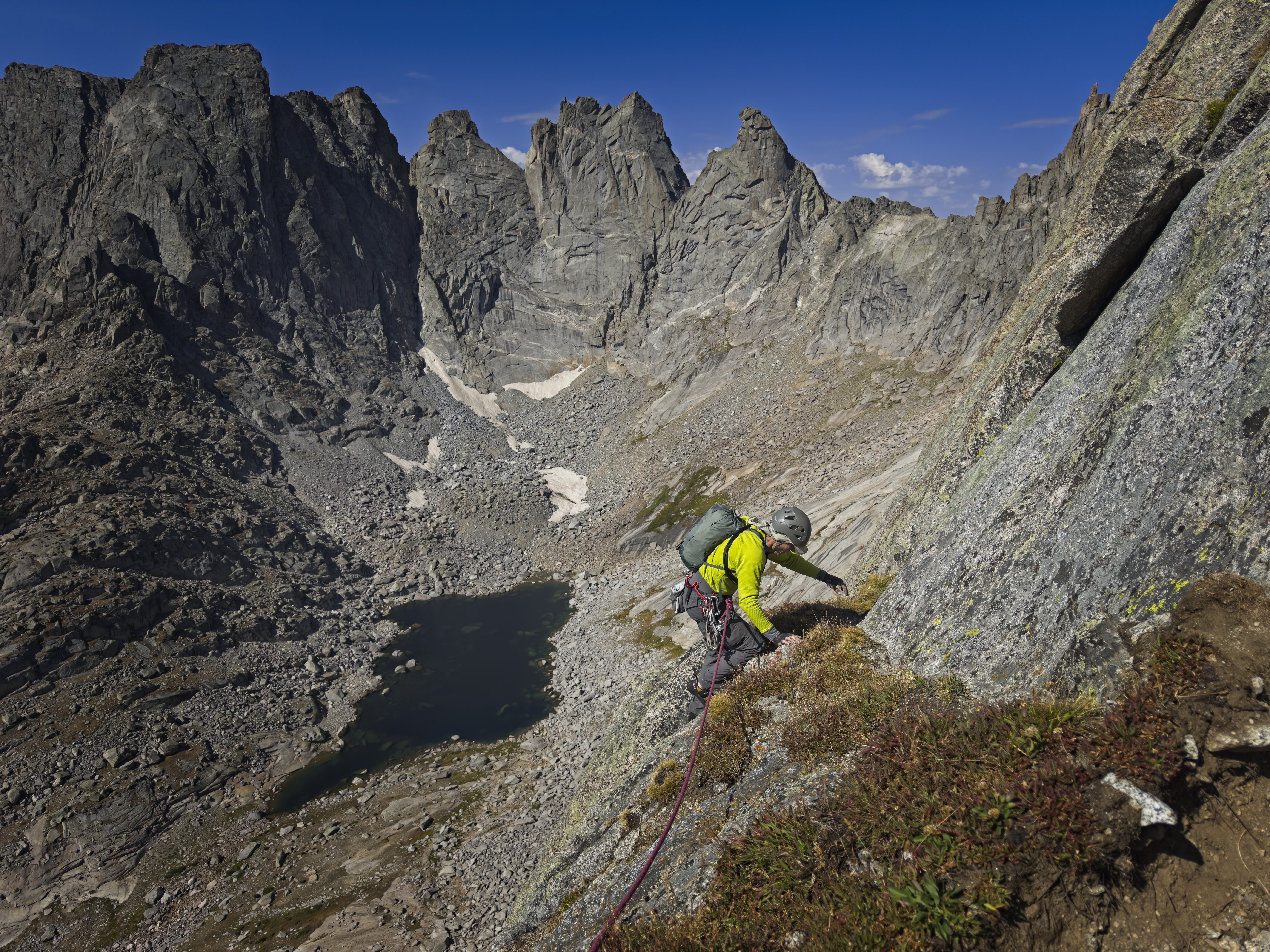
Steve finishes the technical climbing
We decided to climb the 5.6 variation left of the famous 5.8 "K-Crack." It begins above a bolted rappel anchor, so we moved the belay over there. This was another entertaining pitch up cracks and corners, probably about 40 meters long.
Steve arrived and we unroped for the scramble to the top. Here, we granted ourselves the time to enjoy the summit-life we'd missed the day before, taking various silly pictures, and gawking endlessly at the beautiful and austere sight of the East Ridge of Wolf's Head modelling an alluring sweep below us. There was a hedonic pleasure in contemplating that sweep and how we'd traversed it the day before, like ants spiralling a string of folded dimensions and somehow getting away with magic.
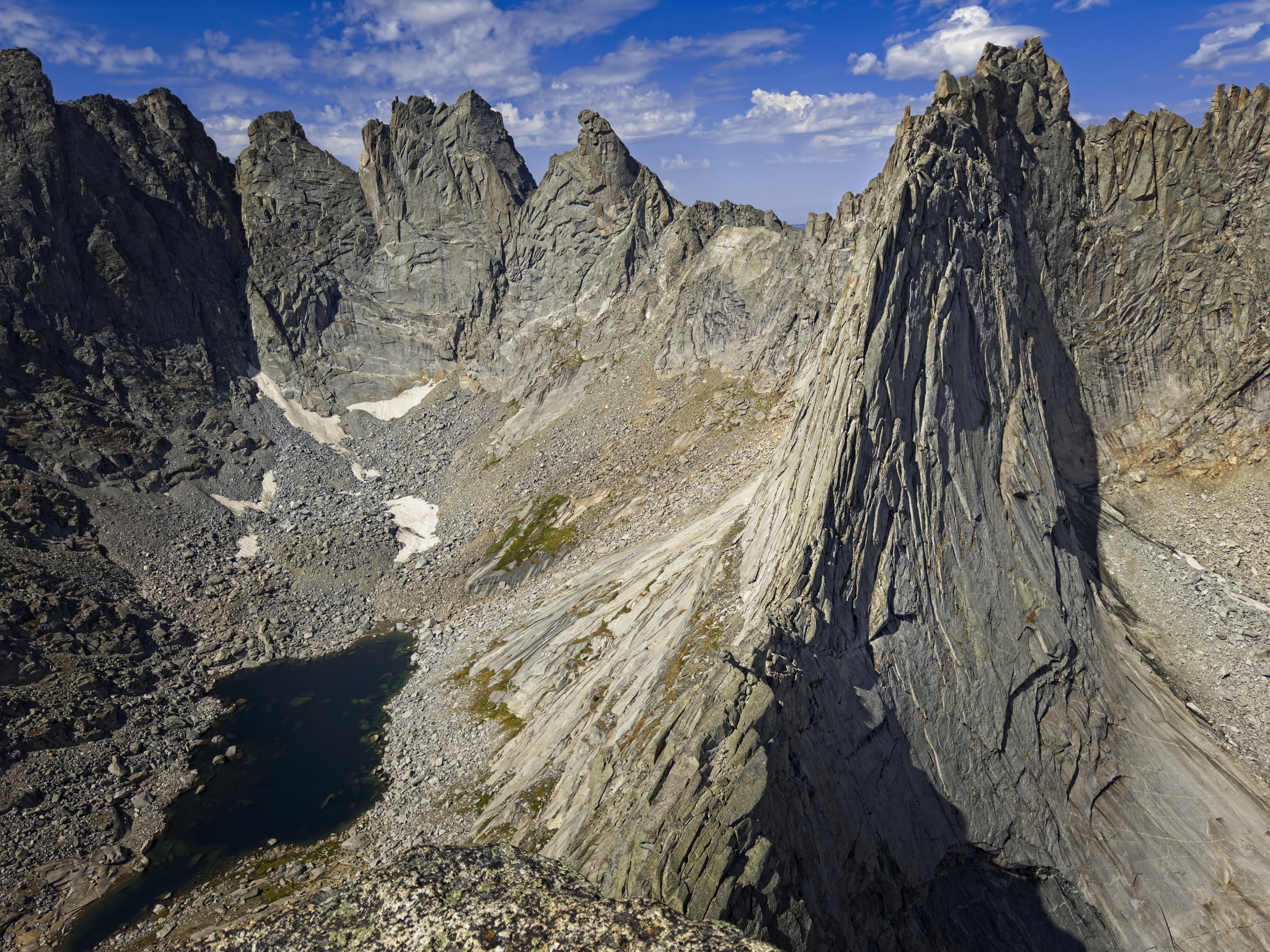
Looking down to the west, on the East Ridge of Wolf's Head
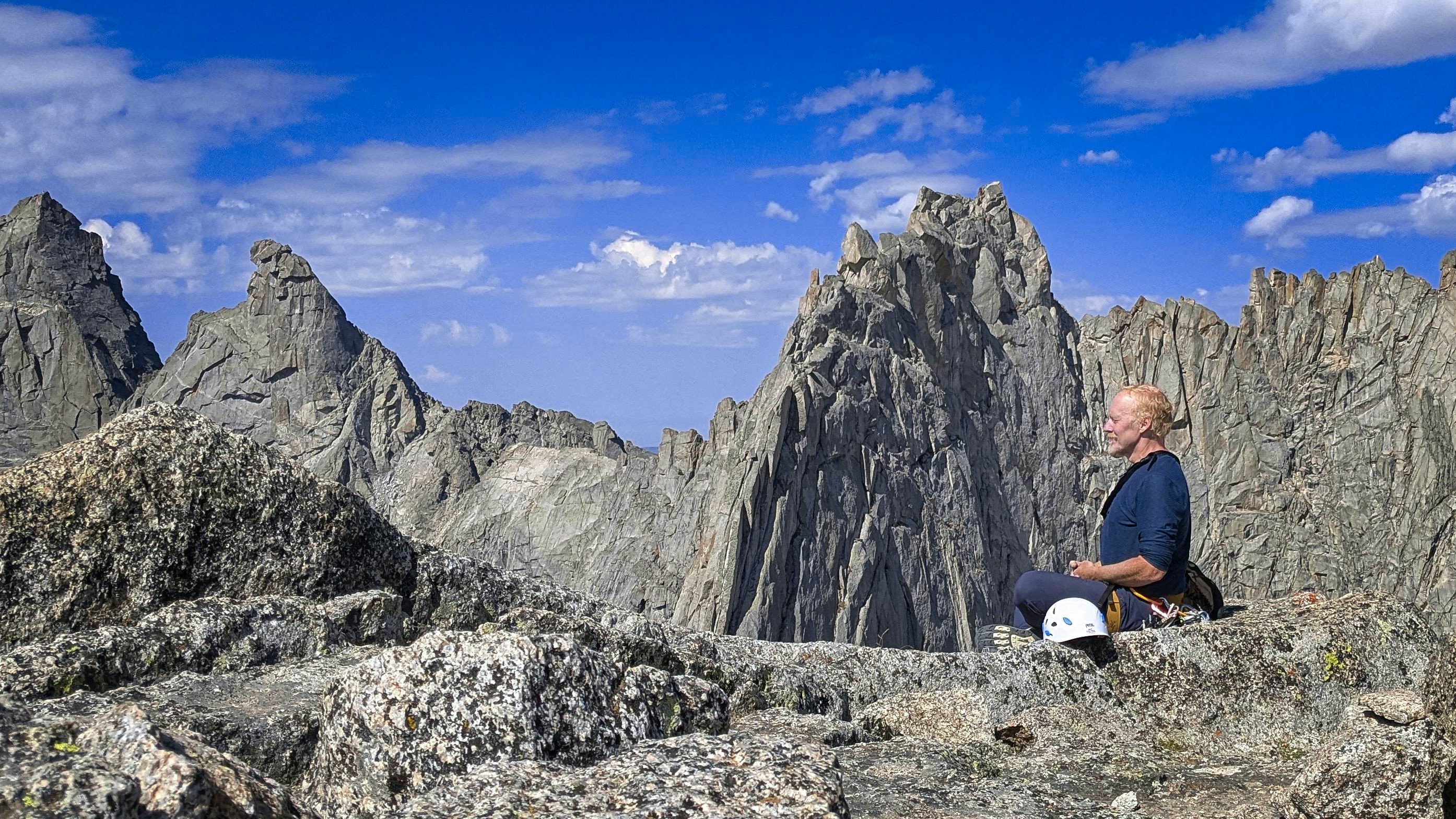
Michael in Zen mode...
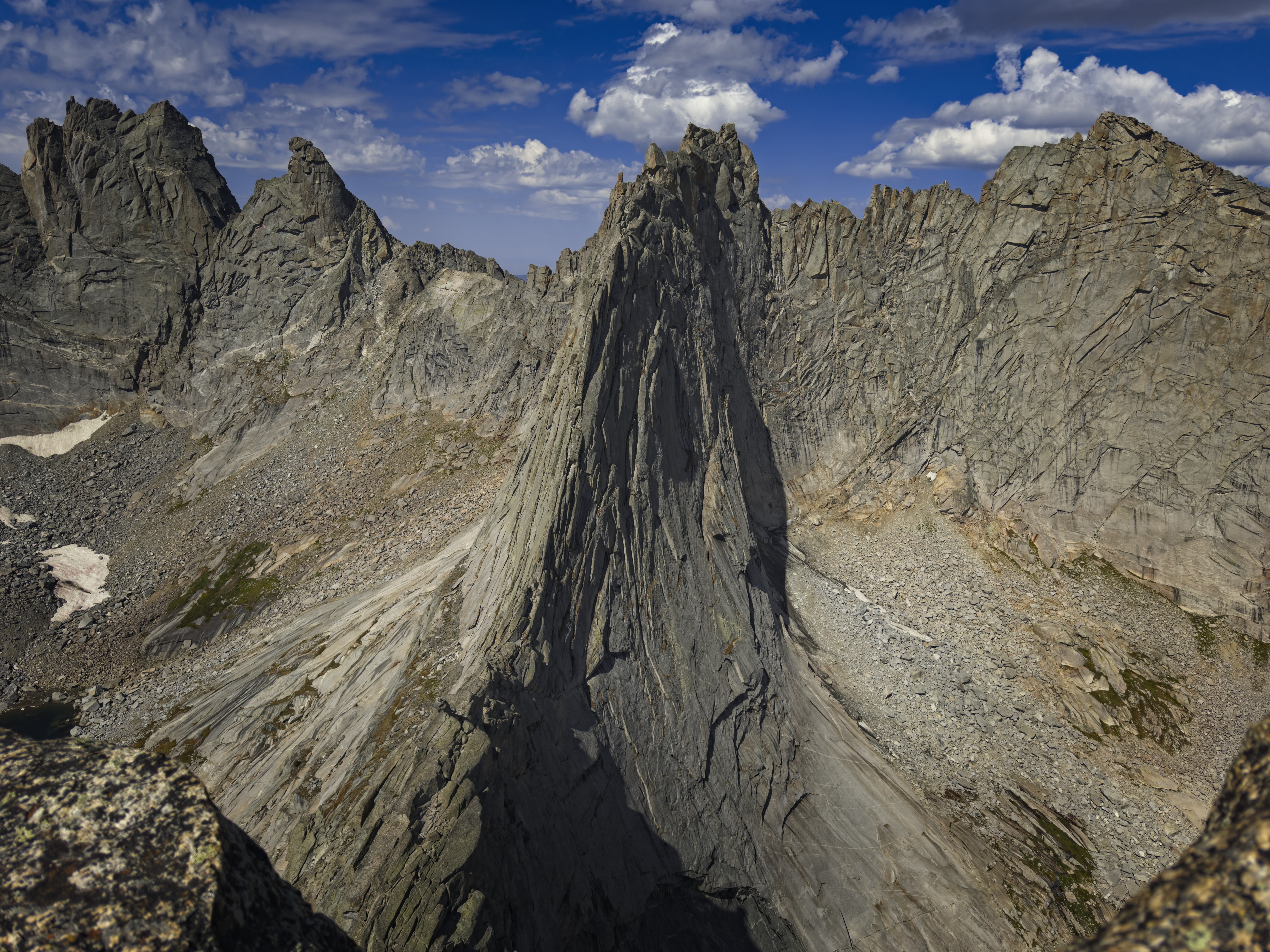
A similar shot...
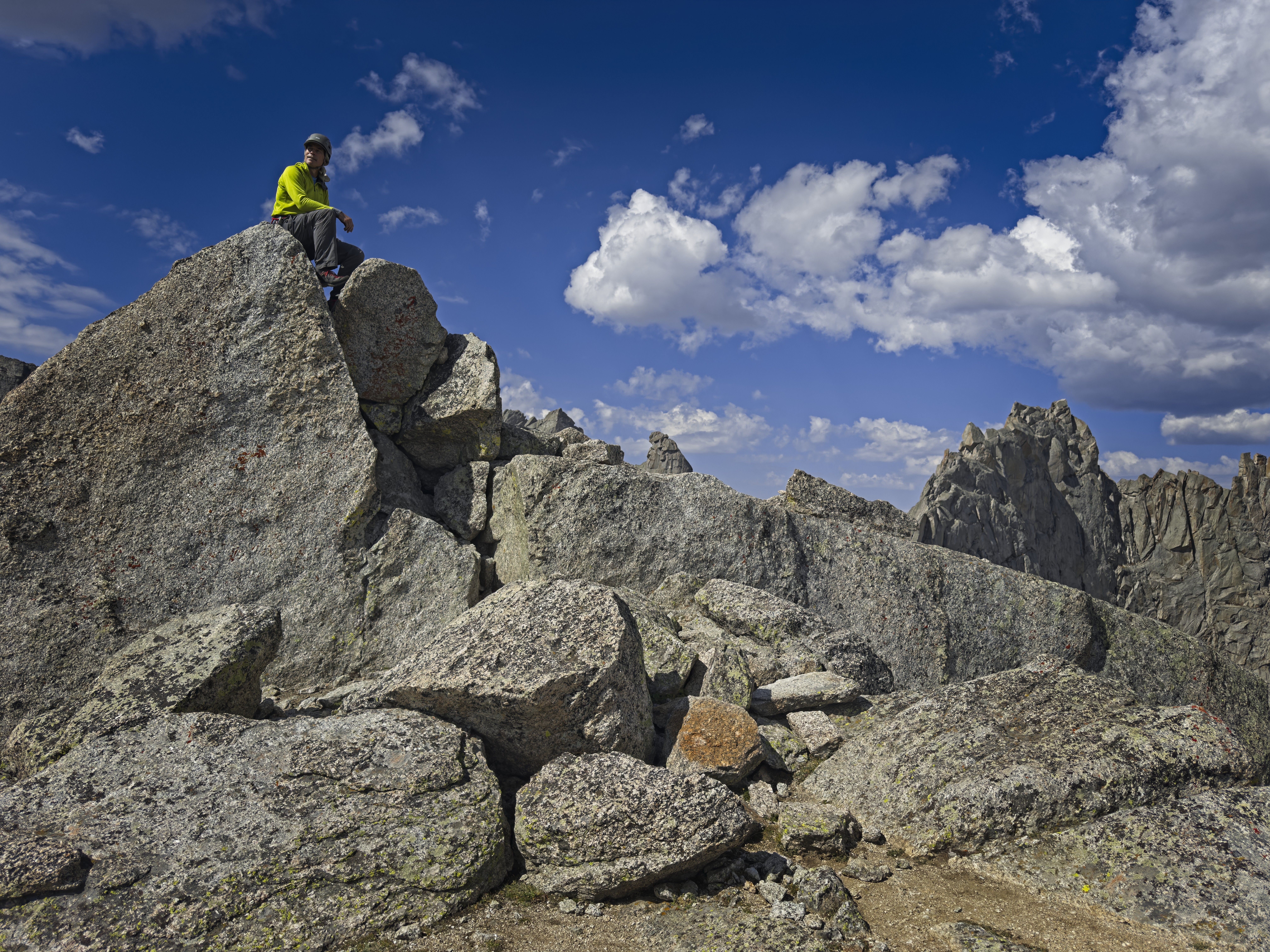
Steve on the summit of Pingora
Back near our rope, we joked with another party, then began the four abseils. All of this went great, though you should tie a knot in your rope-ends for the first and second ones, especially (we had a 60 meter rope). It began to sprinkle as we hiked down, though never turned into a downpour.
We had a nice restful afternoon, then hiked out the following morning. I had a great talk with a CDT hiker about living in a van and working, then heard some hilarious stories from a guy who works for American Alpine Institute in Bellingham, where my story began almost 30 years ago...
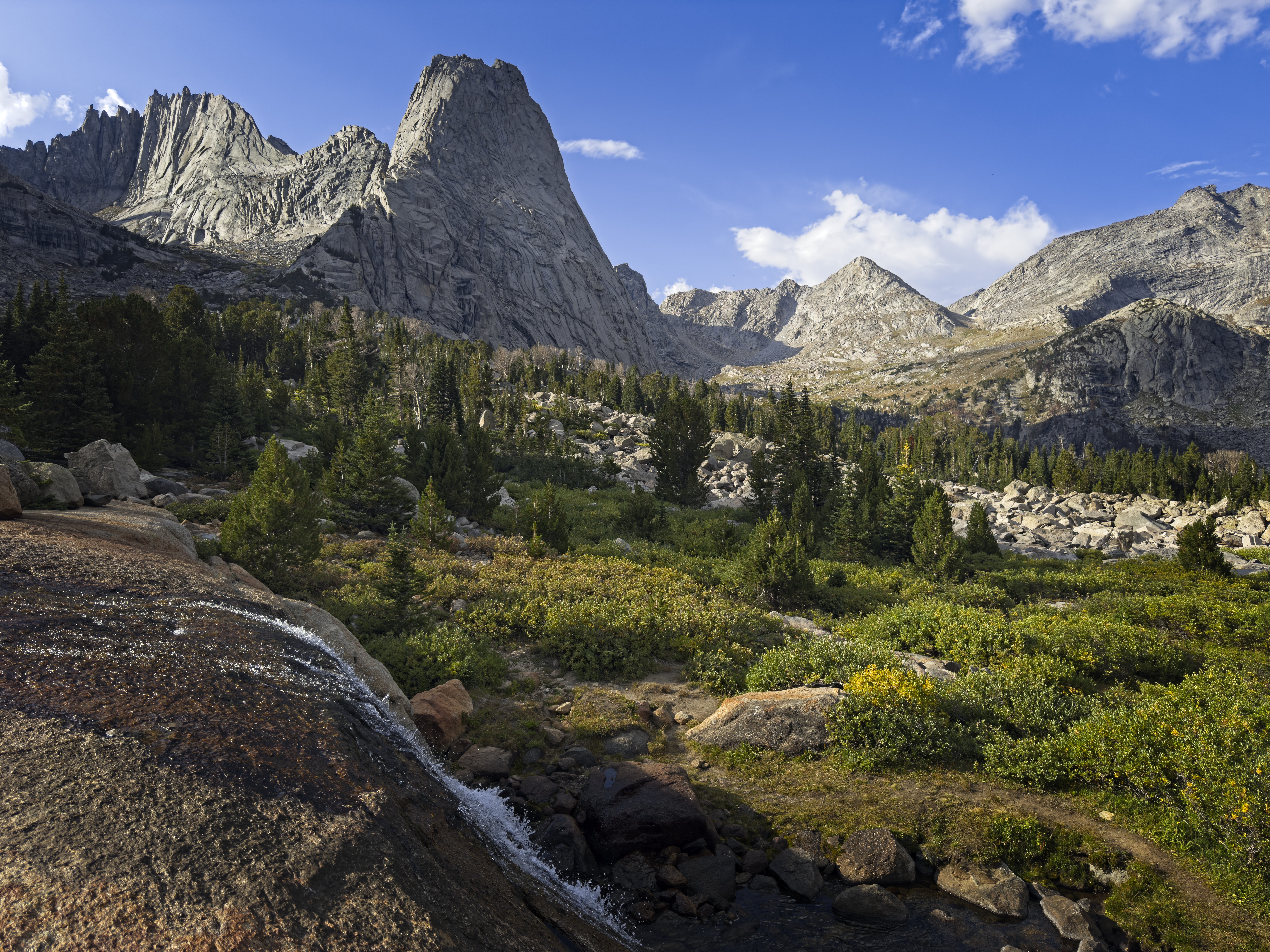
Saying goodbye to the Cirque from near our camp...
Big thanks to Steve and the Wind Rivers!